As the approval of the politicians by the periodic elections, the people towards the performance of the bureaucracyRegular survey about satisfaction/dissatisfaction is necessary. Once you pass public service, you should stop thinking that life is easy.
We use Google Cloud Translation Services. Google requires we provide the following disclaimer relating to use of this service:
This service may contain translations powered by Google. Google disclaims all warranties related to the translations, expressed or implied, including any warranties of accuracy, reliability, and any implied warranties of merchantability, fitness for a particular purpose, and noninfringement.
I still remember the sight of all the employees standing at the door of the Ministry of Education, Science and Technology at 7 o'clock that evening, illuminated by the flashlights of the cameras. There was one more responsibility in the series of new experiences after arriving as a public representative among the people. The work of MP and minister is very different.
Hardly any minister has received the training called 'Ministerial Orientation - Part 1'. So I have asked for an orientation, which should be given to every MP ie Minister-to-be. We have an idea of what to do, but the knowledge of how to do it must be learned from experience.
In this article, I am presenting the real picture of the government system. Transparency for good governance, transfer of experience for building political leadership and hope that a solution to our problems is possible is necessary. Through this article, I am also calling for the active participation of citizens and people's representatives in every stage of policy formulation and implementation, which is inevitable in democracy.
Reforms in the permanent government
After taking the oath of office of the minister, he had to enter the policy and program and budget work for the new financial year. Although the National Planning Commission had already distributed the ceiling of the budget, it had been submitted to the Prime Minister's Office, but we did not understand it.
The process would have been easier if the new minister had been given an orientation at the beginning about the schedule and process of making the budget. In this process, I learned an important lesson, it is necessary to make a plan keeping in mind who and when the employees who have to work in the budget are going on a foreign trip or work. I have approved some staff visit without looking at the staff visit schedule, this was a mistake. But I got to learn a lot by being involved in the budgeting process myself.
The most important job a minister has to do is to show the way how the bureaucracy should work and create a legal ground for it. "What to do" in the budget has been decided, now every ministry will have to make a program implementation manual for "how to do" the implementation as per the idea. We have also reconsidered the format of this manual, which forms the basis of budget implementation, and kept it predictable, transparent, technology-friendly and analytical indicators. Earlier this book was made only by Education Human Resources and Development Center, from this year every agency will be able to make it within June 25.
From the first day of implementation of this year's budget, preparations for next year's budget will be made. The next year's budget should be prepared in coordination with the stakeholders by understanding what has been done this year, what has not been done and why it has not been done. As soon as every minister changes, it is certain that the bureaucracy will not work by giving only superficial instructions and new work. It's not just about dreaming big, it's important to work according to a plan. Pre-planning study is also important. The
survey should be done by understanding how many people were surveyed, what was the method, in which geography, whether attention was paid to inclusiveness, economic diversity or not. Or, instead of 'we have discussed this with the teacher', we should ask whether the discussion was only with the teacher of the institutional school or of the community school as well. If we don't ask this question, we always make policy for only one group. It is important for every Nepali to understand that we have to work very carefully and meticulously. We have all memorized big words, but small things mean a lot in policy making and implementation. At the time of
, when the budget is spent and there is no effective implementation, it will come back to the staff. The reason for this is, on the one hand, political instability, which does not allow enough time to establish the priorities and working methods or culture of any ministry. On the other hand, there is a stalled moral development of employees. Before placing all the blame on the employees, it is important to understand that they are also the products of this society. With the exception of
, the complaints of the private sector about the manpower in Nepal, the situation is the same with the government employees. Our educational system is not producing skilled manpower. On the other hand, there is no incentive system for employees who do good work. Even for promotion, one had to be senior or pass the test. Since doing good performance does not play any role in moral development, employees are giving more priority to preparation for promotion examination than office work. And the employee who does more and better work, more work will be added to him. This is the first experience of working so closely with
bureaucracy. If we analyze the character of bureaucracy all over the world, we find one commonality - procrastination. It seemed that after we came, the work would be uneventful. All can easily be changed once the minister is ready. But it will take time to reach the target due to some legal constraints and some lack of staff. Sometimes a branch with a staff of three has ten people to do the work, sometimes there is only a branch where there should be a division. Sometimes there is a problem in resource mobilization and sometimes there is a lack of functionality.
There will be difficulties in reaching the goals set by oneself due to various reasons. But we don't need to despair. We are conducting short courses of one to three months duration in collaboration with Purvanchal University to increase efficiency. We will now be able to provide the necessary capacity building for our employees in this very important task of developing human resource capacity. Apart from decisive administrative roles, we are also arranging for interns in technical and other work to increase agility.
Minister should be able to say 'no'. If you can't say no to unnecessary meetings or requests, 'yours', the executive role is likely to be fruitless. When they say no, the employees also say no in different ways. Instead of increasing the use of technology and increasing transparency, it was found that they were trying to avoid it as 'children's mercury'. As in the political party, in the game of the 'gut' in the bureaucracy, the nominated experts who were selflessly supporting the ministry were not even given financial facilities and were written in the news as 'outsiders'.
Even when an employee from within the government system was brought in as an expert, he was taken back saying 'you have a long career brother'. Will try to make it alone. The way to resist the political leadership of the bureaucracy is to 'seek to melt'. There is a custom of seeking the minister's 'instruction' but changing the decision as 'adjusting the language' or changing it according to one's own preferences. Information about loopholes in the law and limits of political leadership is used by the bureaucracy to their advantage and security. There is also a tendency to not like 'suggestions' and avoid the urge to be accountable by saying 'how many days will it last?' Honorifics used in the ministry also have a ranking order - Jee, Jew, Sir, Saab, Mr.
Be it the nature of the bureaucracy or being women of the younger generation, initially it took time to establish the foundation of trust and confidence in the ministry. When trust is two-way, work can hardly be done. This nature of bureaucracy is also a response to the erosion of honesty and integrity of political leadership in the past. I take these incidents as a product of their established perception of the post of 'minister', which seems to be changing. Regular surveys on the satisfaction/dissatisfaction of the people with the performance of the bureaucracy are also necessary as approved by periodic elections of politicians. Rewards or punishments are inevitable based on the results of such surveys. There should be an end to the thinking that life is easy once you pass public service.
I have improved some functionality. I have stopped piling up too many tasks at once. Considering the experience and ability of the employees, I have started to offer step-by-step work. My team thought that 'you don't understand a bit, need a simple analysis'. Mainly, I have explained to them the reason and basis of what we have to do. Rather than 'political pressure came' during budgeting, I reminded them about my role by saying 'You are a Nepali first and then an employee'. I work with the sense of responsibility of being a Nepali before being a minister/MP. The most important role in the country's development is the permanent government, i.e. the bureaucracy. What kind of setting is the
?
In 100 days, every decision or new concept I make will have at least twenty people behind it and at least a thousand people involved in its implementation. So here we need a hero and not a hero. The support I need from MPs, well-wishers and citizens is in policy making. MPs should focus on policy making. The legislature should clarify the scope and procedure of delegated legislation in the bill to hold the executive accountable. If the Parliament makes a good substantive law, it is easy for the executive to make procedures.
A lot of the minister's time is spent on submitting bills in the House, amending existing laws, creating guidelines, procedures, and standards. These are important tasks as the procedure to be formed at the final stage of drafting the law will give the bureaucracy a framework to work and create a structure for coordination among stakeholders. The main function of the executive is to implement the legislative intent. In the coming days, I will analyze whether the guidelines, procedures, rules, standards made by the executive are in accordance with the law made by the legislature, and whether they have reached the people.
Being elected through proportional representation, I have no obligation to please my constituents. The country as a whole is my constituency and I am clear that I am a minister of the nation and not a party minister. But nothing is possible with just one person. The revolution in the society is not brought by the leader, but by the society itself. A leader is only a guide but the responsibility and power of the citizen is the greatest.
People's representatives should also think of solutions along with speaking the voice of the people. Citizens should also hold the leadership accountable in the process. Where the process is not clear, a predictable process should be demanded and the practice of mere gratuity will cease. It is acceptable only by ensuring broad public participation in both the process of making and implementing laws. It makes it easy to update or amend laws that are not in sync with people's expectations.
100 days work is focused on the implementation of existing laws. Focused on the establishment of the method. So far we have not been able to put education as a priority of politics. We have not taken the responsibility of reforming the country's education sector. But, now I am clear - the solution to our problems is possible. Transformation of Nepal's education sector is possible. The quality of school education can be improved. It is possible to complete the
four-year course in four years. It is possible to become a person who conquers the world by studying in a public school. It is possible to make students the best people in the world by guiding them from an early age. To meet the shortage of technical manpower, the necessary manpower can be produced in Nepal by increasing the quality of training. Technology invented in Nepal can be used to lead the world. Today may not be tomorrow, it will take time but it will happen. We will leave it to you.
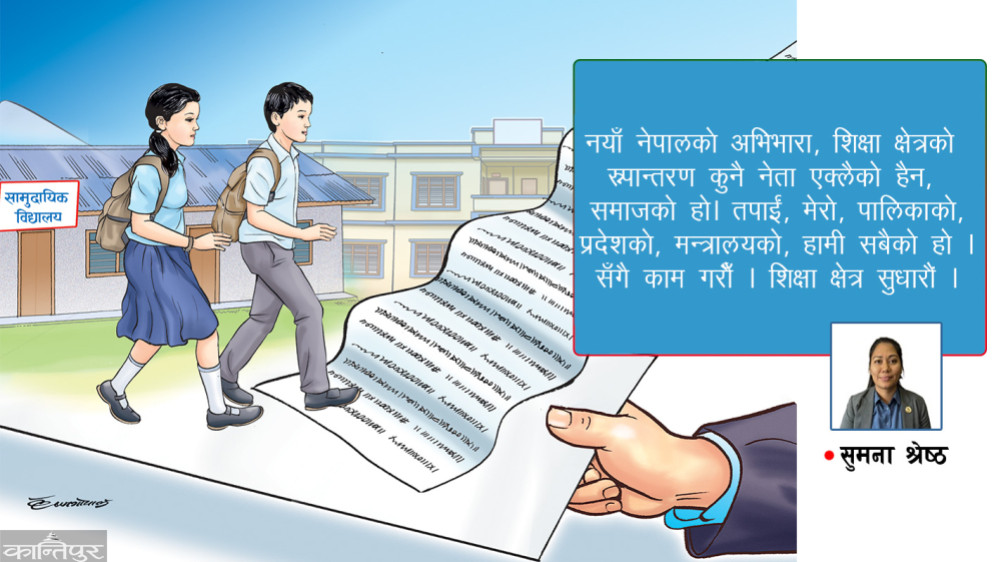
New Nepal's responsibility, the transformation of the education sector is not of any leader alone, but of the society. You belong to me, to the municipality, to the province, to the ministry, to all of us. Let's work together. Let's improve the education sector.