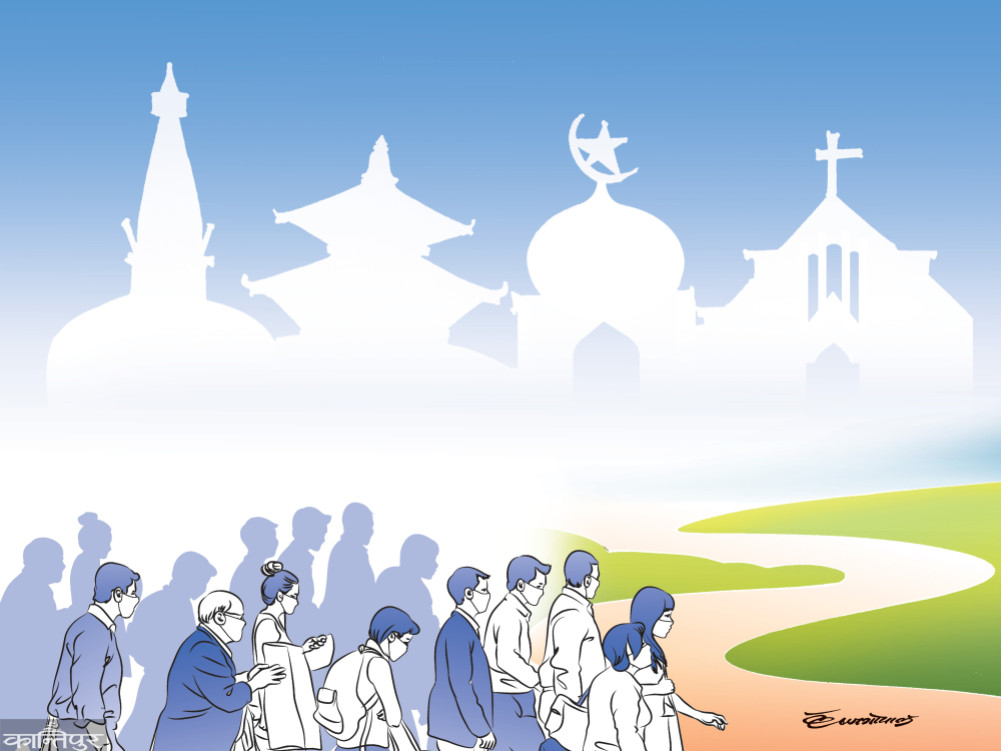
No one can deny that the character of Nepali society has always been secular in nature. Various here for centuriesPeople of religion and caste have lived together and there is no history of any religious extremism being tolerated.
We use Google Cloud Translation Services. Google requires we provide the following disclaimer relating to use of this service:
This service may contain translations powered by Google. Google disclaims all warranties related to the translations, expressed or implied, including any warranties of accuracy, reliability, and any implied warranties of merchantability, fitness for a particular purpose, and noninfringement.
A few weeks ago, there was a scuffle in the United States Parliament between the ruling Democrats and the opposition Republicans. Republican MP Brian Mast, who won from the state of Florida, accused the US government of spending 500,000 US dollars for non-religious people in Nepal.
In response, the Minister of State for Foreign Affairs of the Biden administration, Richard Rahul Burma, replied that there is no policy of the US government to promote people who follow or do not follow any religion and no money has been given to Nepal for that purpose. He said that US policy is to respect religious freedom. As the elections are approaching in the US, this conflict between Democrats and Republican lawmakers is intensifying.
Mast's expression in support of former American President Donald Trump caused some waves in Nepal. The news was published with the headline that America distributed money to spread religious disbelief or atheism in Nepal. There was a debate on social media from both positive and negative angles. Meanwhile, on March 13, the American Embassy in Nepal issued a clarification that the American government supports the right of every citizen to practice or not practice the religion of their choice. According to the embassy, for more than 25 years since the US International Religious Freedom Act was passed, the US government has stood by the right of people everywhere to believe or not to believe according to their own principles. This US State Department global grant was designed to promote and protect the religious freedom of all individuals. This includes members of marginalized religious or faith communities in countries where they are facing persecution.
2023 On the night of December 24, I received a message from a foreign friend on my messenger - 'Mohana, you don't believe in Christmas. Still, I wish you and your family a very Merry Christmas and a Happy New Year.''I wrote back, 'Thank you. Best wishes to you and your family. Who told you I don't celebrate Christmas? I support secular ideology and festivals of all religions are an auspicious occasion for me.'
Last month, during the festival of Tihar, I posted a picture of us lighting a lamp in the kousi of our house with a message of good wishes on social media, which was liked by many. At night, I received a message from a Facebook friend on Messenger. He talked negatively and preached according to his own thinking. I said, 'How can it be good for me to keep my house dark and live in seclusion when all my villagers are celebrating with glittering lights?' Then I did not think it proper to engage in arguments with him. There was a wide gap between my understanding and his.
In our environment, religion is a sensitive topic that is closely related to people's sense of community. Secularism was a complex issue in the political transition from 2063 to 2072 and the constitution writing process. Finally, all the major political forces of the state agreed to continue the principle of secularism embraced in the interim constitution of 2063 as the collective concept of the state of Nepal. According to the famous sociologist Jean Babero, there are three main bases of secularism - the separation between religious institutions and state institutions, the guarantee of complete freedom of religion and conscience, and the state of non-discrimination against anyone based on religious or non-religious views.
This is the basis of the principle of secular state embraced by the Constitution of Nepal 2072. Article 4 of Part 1 of the Constitution explains secularism and says that 'secularism' should mean 'religious and cultural freedom' including the protection of religious culture that has existed since time immemorial. Explaining the fundamental rights of citizens in Part 3 Article 18 of the Constitution, no one shall be discriminated against on the basis of religion, but the state is not prohibited from enacting separate laws for the protection of socially or culturally backward groups. Our constitution, which is considered progressive compared to the constitutions of various countries, is a proof of the self-respect and developed consciousness of Nepali citizens. However, there are groups who do not like secularism and that is their constitutional right.
Let's take a look at how many religions there are in the world. According to the Pew Research Center on Religion and Public Life, which conducts research on religion and society, there are currently more than 4,000 religions in the world. Among them, Christianity, Islam, Hinduism, Buddhism, Sikhism, Taoism, Judaism are considered to be major religions based on followers. Some of these religions, such as Christianity, Islam, Hinduism and Buddhism, are not limited to their place of origin but have spread to other parts of the world. 85% of the world's population identify themselves with some religion, while 15% deny any religious affiliation. This is the data till 2021.
Religion is concerned with beliefs that guide the moral and social behavior of its followers. At its core is a strong belief in the power to control human destiny. In addition, each religion has a specific prayer system, purity, purity, beliefs, religious symbols, language, dress, food, festivals, and culture. The funny thing is that even though religions differ from each other culturally, all religions have the same basic purpose. To promote love, sympathy, kindness, compassion, justice and truth among human beings. To maintain moral conduct, collectivity and order in the society and to make every person responsible for his behavior. Even those who do not belong to any religion or have religious apathy cannot deviate from human feelings like humanity, love, sympathy, kindness, love, compassion, justice and truth.
Even though secularism has been formally written in the constitution, no one can deny that the character of Nepali society has always been secular in nature. People of different religions and castes have lived here for centuries and have been able to practice their religion and culture without any hindrance. Nepal's religious tolerance can be an example for many countries. There is no history of religious extremism being tolerated here. In villages here, it is common to see Muslims collecting donations for Durga Puja, celebrated by Hindus, and Hindus organizing iftari (breaking of the fast) during Muslim Ramadan.
Hindus, Muslims, Sikhs, Christians all participate in Dussehra events. On Eid, Kirati, Buddhist, Hindu, Bahai, Bon all say Eid Mubarak. No one, Hindu-Muslim, hesitates to wish Christians a Merry Christmas on Christmas. Due to this peculiarity of Nepali society, the anti-secularism idea has not been able to get popular support of Nepali people. However, in recent years, there have been incidents of increasing religious polarization in the society and attempts to incite violence in some districts of the Terai by creating religious tension. But it seems that such planned events were brought under control in time by the wisdom of the administration and enlightened citizens. In fact a festival of any religion should be an occasion of celebration and joy for all. Festivals are an opportunity to boost business, promote cultural exchange and strengthen social harmony. It should not be used as a means to increase unnecessary hype, social tension and mistrust.
columnist to summarize the opinion he got in the interview with the common people, Dasain, Tihar, Eid, Ramadan, Christmas, Baisakhi, Buddhapurnima, Chhath, Mahpuja, Lhosar and other festivals are cultural heritage of human civilization. Kaaba, Kashi, Pashupati, Golden Temple, Vatican, Lumbini are world heritage sites. Rama, Krishna, Mohammed, Jesus, Moses, Buddha, Nanak, Confucius are not the members of any community but they are the personalities who have contributed the greatest to the spiritual development and welfare of the entire human society. The biography of Maryada Purushottam Rama, the compassion of Jesus, the wisdom of Buddha, the dispassion of Mahavira, the abstract speech of Saint Kabir, the holy speech of Guru Nanak and the spiritual message of Prophet Muhammad have led millions of people to the right path.
Can his welfare message be limited to any one community? If not, will we live in the circle of narrowness or will we join the horsollas of our friends, neighboring countrymen with the spirit of pantheism? This may be a matter of personal choice. We are witnessing a time in history where magnificent Hindu temples are being built in Muslim Arab countries. Quaid-e-Azam University in Islamabad, Pakistan organizes Holi program for its students. There is a growing awareness that the future of the human race is not in cultural isolation (cultural isolation) but in cultural assimilation (cultural assimilation).
This writer spent his childhood and youth in Nepalgunj, where social relations between all religions and castes are strong and harmonious. Hindus participated as much as Muslims in the tradition of tazia during the Muslim festival of Muharram. Hindu Dussehra fairs and Tihar bazaars were equally attended by Muslims. When he was working in the National Human Rights Commission, a delegation from the international organization Humanist International came to visit Nepal.
The delegation met with political parties, civil society and organizations to understand the situation of religious freedom and non-religious groups in Nepal. In which the columnist mentioned that the Constitution of Nepal is very progressive in terms of human rights, but there have been challenges in implementation and some incidents have come to light where the rights of minority groups are being violated. Humanists International places humanity above religion and works for individuals and groups of all religions.
Almost 5 years later, in the wake of Brian Mast's speech in the US Parliament regarding Nepal, some online magazines and social media users also covered the writer's discussion with Humanist International. The columnist is clear in his opinion - the constitution of Nepal has given equal right to every citizen to follow any religion or not to follow any religion according to his wish and the law will not discriminate between citizens on the basis of religion. This is the true meaning of secularism.