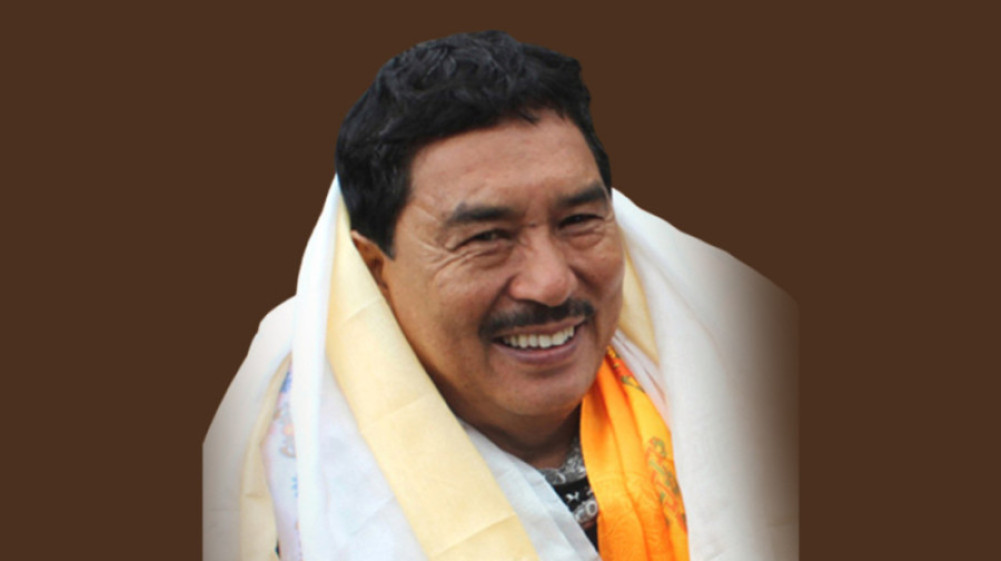
Contrary to the jurisprudential belief that the law is equal for all, the treatment of Gurung has given rise to questions on the court itself.
We use Google Cloud Translation Services. Google requires we provide the following disclaimer relating to use of this service:
This service may contain translations powered by Google. Google disclaims all warranties related to the translations, expressed or implied, including any warranties of accuracy, reliability, and any implied warranties of merchantability, fitness for a particular purpose, and noninfringement.
The Supreme Court has made a contradictory order to lift the suspension of Congress MP Tek Bahadur Gurung, who has been sentenced for corruption by a special court. According to the law, an order has been issued to release the suspension of Gurung, who has been convicted by the court of being suspended from the position of profit as soon as the corruption case is filed.
Even in the judicial circle, after such an order came in conflict with the precedent of the Supreme Court. There is also a concern that the public's faith in the entire court will not be shaken when an order is issued in this manner without a logical legal basis, precedent and theoretical recognition.
Former Minister of State for Labor and Employment Gurung was elected as a member of the House of Representatives from Manang last year while the case related to corruption was pending in the special court. Due to the same issue, the Federal Parliament Secretariat issued a notice that he was automatically suspended on December 12, 2079. Two months later, a special court convicted Gurung. His position has not been revoked due to an appeal to the Supreme Court. While the appeal was pending, Gurung went to the Supreme Court demanding lifting of the suspension, in which the bench of Justices Manoj Sharma and Vinod Sharma issued an order that surprised the judicial circles. Whereas, in Section 33 of the Prevention of Corruption Act, 2059, there is a provision that if a corruption case is filed, the national servant (a person holding a public office) will be automatically suspended until the case is resolved. It is a close example that the Supreme Court has rejected the petition filed by the owner of Pappu Construction, Harinarayan Rauniyar, to release him after the suspension of the post of MP due to the corruption case.
The Social Welfare Council chaired by the then Minister of Women, Children and Social Welfare, Badri Prasad Neupane, leased the land of Bhrikutimandap to Gurung on August 20, 2069. At that time, 60 acres of land was given for 10 years at a monthly rent of Rs 5 lakh 55 thousand without competition. While Gurung took the plantation by paying a rent of 9,250 rupees, he leased some land to Ichchumati vegetable market for 78,571 rupees. In this case, the abuse of authority investigation commission and the special court concluded that irregularities were committed through collusion. The Authority initiated a case against them on 21st January 2075. On February 26, 2079, the Special Committee had given a verdict that Gurung would be fined Rs. The special court has convicted the then Social Welfare Minister Neupane as well as the officials of the council.
The manner in which the hearing of the writ for lifting the suspension proceeded hastily is also questionable. Once, the case of Pesi climbing was not heard and was postponed for months, and on Gurung's petition in the Supreme Court, Pesi was raised 5 times within a month. The order was issued by the bench of Sharmadway on Friday. Contrary to the jurisprudential belief that the law is equal for all, the treatment of Gurung has given rise to questions on the court itself. It also raises doubts about other judgments or orders from the court, which is a matter of concern. Courts earn people's trust by administering justice without question. With strong public faith, the image of the court will also become proud. In the case of those who have political access, the court should be aware that the public's trust will be lost if separate orders and judgments are made ignoring the laws and precedents.