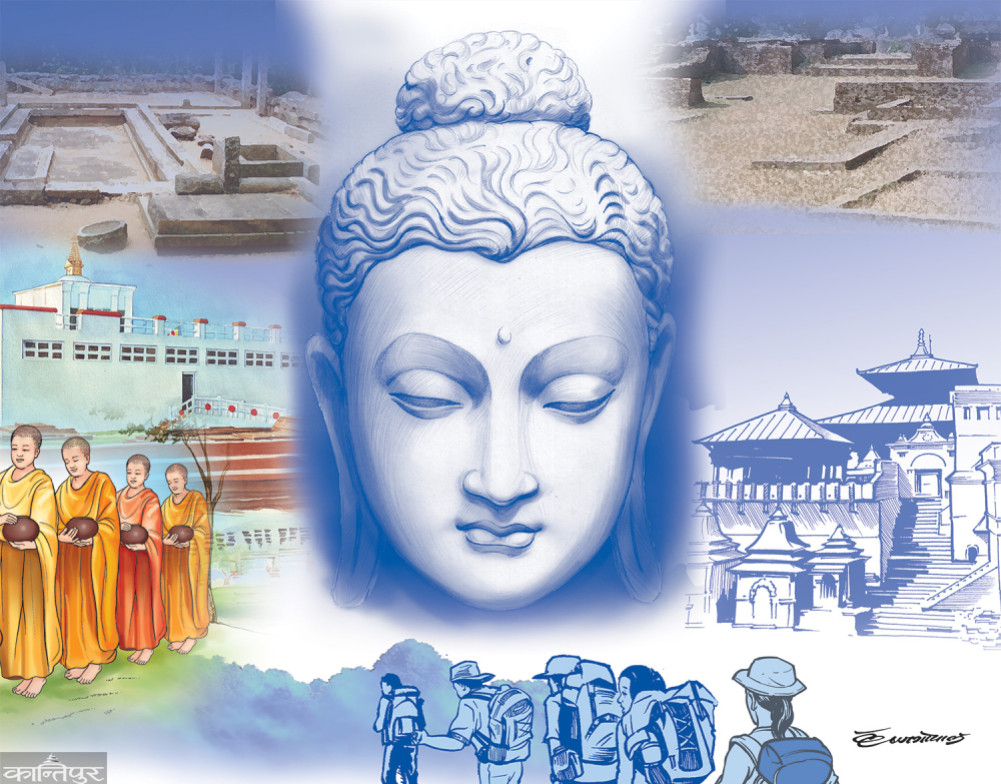
Nepal needs to bring more clarity and innovation in tourism diplomacy as it is an area that can be developed without irritating its neighbors who are competing for rapid economic development.
We use Google Cloud Translation Services. Google requires we provide the following disclaimer relating to use of this service:
This service may contain translations powered by Google. Google disclaims all warranties related to the translations, expressed or implied, including any warranties of accuracy, reliability, and any implied warranties of merchantability, fitness for a particular purpose, and noninfringement.
In the first week of February, as a member of the delegation of the International Relations and Tourism Committee under the House of Representatives, I participated in observation visits to various places in India and high-level meetings. Just a week before our visit, Nepal was visited by Foreign Minister S. Jaishankar from India and Deputy Minister of Foreign Affairs of the Chinese Communist Party from China.
Nepal's unique nature of geopolitical location must be due to our neighborhood relationship, when we talk to India, China and when we talk to China, India comes to be interdependently connected. You don't have to be a student of international relations to realize that the diplomatic messages expressed against the background of the security interests of both countries and the perennial concern that Nepal is used against each other are underpinning the political differences that appear in diplomatic affairs in Nepal.
While listening to the meetings during the visit to India and the message of the Chinese leader in Kathmandu, I felt that since both India and China are neighbors competing as world powers, it is natural that we have expectations based on different interests. However, there are areas where we can benefit from both countries beyond geopolitics. India and China have given high importance to Nepali tourism sector. Their views may differ but how we use their affection is important. Keeping in mind the fact that India and China are the first and second countries in tourism contribution, if it is to be carried out systematically, the area where Nepal can gain comparative advantage is tourism. That is, the diplomacy that we can do with India and China outside of geo-political confrontation can be tourism diplomacy.
While welcoming our delegation to the Parliamentary Committee, Uttar Pradesh Chief Minister Yogi Adityanath said that India can become the biggest source of tourists in Nepal. India can become the biggest source of tourism in Nepal, Nepal has many holy places where Indians want to visit. Nepal can become a big center of eco-tourism. Yogi's statement represents the mainstream of Indian tourism about Nepal. Our tourism with India is basically cultural, religious and spiritual, India seems ready to help promote it further.
A week ago, the Chinese leader also expressed a similar opinion in Kathmandu. Sun Hayan, Deputy Minister of the Foreign Affairs Department of the Communist Party of China, said in an interaction with the Nepalese leader in Kathmandu, "Many tourists come to Nepal, but there is no development in the east, we cannot rely on one infrastructure and destination. New infrastructure and destinations should be created.'Hayan's clear message was - develop new infrastructure and destinations, more Chinese tourists will be attracted by themselves.
The challenge of Nepal practically adopting and using the two different types of tourism strategies given importance by the two countries is now before us. Indian interest seems to be towards easy access of Indians to our religious places of importance and integration of Nepalese religious tourism with Indian religious pilgrimage sites. India's intention to connect our religious places, including Pashupatinath, which are held in high esteem by Indians, with the places of Indian religious tourism and also to promote religious diplomacy has been heard in all dialogues.
China may have progressed a bit in terms of infrastructure, most of the Chinese tourists, leaders or other business people who talk to them complain about the lack of our road and transport infrastructure. One of the five important components of China's infrastructure project, the Belt and Road Initiative (BRI), is the expansion of people-to-people relations at the civilian level. That's why when emphasizing on tourism promotion and road infrastructure, they also give the message that we will help in its development from the Chinese.
In the history of Indian 'public diplomacy', recognition of cultural promotion has always been central. The fact that India wants to place itself at the center of Hindu Sanatan and Eastern civilization as a whole is not hidden, but there is no doubt about including Nepal in religious tourism. Due to the similarity of the Puranic texts, it is deeply established in the Indian public mind that Rishis, Maharishis attained eternal knowledge through meditation, chanting and austerities in our Himalayan region. Even though India is a country with a huge population, it seems that religion and culture are used as the main link to connect the country.
Indian Council for Cultural Relations (ICCR) and Indian Council for World Affairs (ICWA), two important institutions in India that are more than half a century old, are culturally considered important institutions for promoting 'public diplomacy'. ICCR works with the Indian Ministry of External Affairs on external cultural diplomacy while ICWA works to expand India's relations with other countries through studies, research, debates and publications/broadcasts.
is active as a tank. In the year 2017/18, out of the total expenditure of about 1.9 billion US dollars by the Indian Ministry of External Affairs, about 3 million US dollars was spent on 'public diplomacy'. Probably, most of the semi-political and institutional visits to India from Nepal fall under this category.
The most convenient aspect of our tourism promotion with India is the social norms based on similar language, culture, costumes and mythological and Vedic knowledge. The ease of exchange due to open borders is not only related to socio-economic but also cultural proximity. In Nepal and India, cultural similarity is strengthened due to similar attitudes towards Hindus and Buddhists. Studies have shown that the main tendency of most of the Indian tourists who come to Nepal is religious. Especially, Indian tourists come to Nepal with the aim of observing and visiting religious places such as Pashupatinath, Swargadwari, Pathibhara, Kalinchok, Mankamana, Bindhyavasini, Janakpur, Lumbini, the worshipers of the world's Hindus.
Lumbini, Nepal's birthplace of Buddha, and India's Bodh Gaya and Sarnath, India's place of enlightenment, have been proposed many times to unite as tourist destinations. The sign between Ayodhya in India and Janakpur in Nepal became more exposed during the latter's dedication to the Rama statue.
During the opening of the Ram Mandir, Diwali in Nepal shows the mythological similarity between the two countries, the recognized consensus of the people and the multifaceted nature of the relationship. We have many issues with India at the political level. But the exchange at the civilian level in international relations is also known as 'track-two diplomacy', which plays an important role in developing mutual understanding between the two countries while erasing the bitterness. And, citizen-level ties help bridge differences in political leadership in the two countries. In this sense too, our tourism diplomacy with India is desirable.
China is the number one tourist exporting country in the world. Various studies have shown that China has also made tourism exports a means of expanding its 'soft power'. The researcher concludes that China has adopted the belief that "all citizens abroad are ambassadors of the country". In 2015, China's National Tourism Administration officially introduced the term "tourism diplomacy" (China.com.cn, 2015).
An important fact for us - China is a country with a majority of Buddhists. As Nepal is the birthplace of Shakyamuni Gautam Buddha, it is possible to attract a large number of Chinese tourists religiously. It coincides with Lhosar and Chinese New Year of the Nepalese Tamang and Sherpa communities. The cultural relationship is extended by the life of the northern and Himalayan areas of Nepal, which are connected to Tibet and Bhot region. Although the Chinese have been visiting Nepal since long ago, China officially included Nepal in the list of tourist destinations only in 2002. The number of Chinese tourists visiting Nepal every year has been increasing significantly since the Chinese government placed it on the destination list. In 2019, most tourists came to Nepal in history. Importantly, even during the off-season, Chinese citizens come to Nepal in large groups and are among the top spending tourists in the world.
China's Ji Huang and other researchers have mentioned in a research paper titled 'In Pursuit of Happiness: Impact of the Happiness Level of a Destination Country on Chinese Tourists' published in 2021 that Chinese tourism chooses countries with high happiness indicators. . Despite announcing the Tourism Year and Tourism Decade, it seems that Nepal has not done anything for this in practice. However, after March 15, 2023, the Chinese government has also listed Nepal in the list of tourist destinations that its citizens can visit freely.
In terms of infrastructural development, the pace at which China is progressing has already started coming to Nepal. It is too late to develop a diplomatic skill that can take help from there to develop a diplomacy that attracts them in terms of infrastructure and not just limiting the word 'connectivity' used by China to tourism diplomacy at the civilian level.
Generally, the realist conception of international relations focuses on economic and military power in the relationship between two countries. But in such a relationship, without keeping the power at the center, the social/cultural dimension can also be made decisive. Tourism diplomacy is a part of that. A sovereign country, whether geographically large or small, has begun to make tourism diplomacy an important dimension of international relations in order to expand its relations peacefully.
Nepal needs to bring more clarity and innovation in tourism diplomacy as it is an area that can be developed without irritating its neighbors who are competing for rapid economic development. Despite lagging behind in industrialization in other sectors, the industrialization of tourism is our area of high potential. Tourism is the undisputed sector that can take comparative advantage and balance the trade deficit for compensating for the misunderstandings and losses in other areas of our neighborhood relations.