Minister for Infrastructure Development Sunil Lamsal, Japanese Ambassador to Nepal Maeda Toru, the President of the Japan International Cooperation Agency (JICA), and other senior officials are scheduled to attend the inauguration of the tunnel.
We use Google Cloud Translation Services. Google requires we provide the following disclaimer relating to use of this service:
This service may contain translations powered by Google. Google disclaims all warranties related to the translations, expressed or implied, including any warranties of accuracy, reliability, and any implied warranties of merchantability, fitness for a particular purpose, and noninfringement.
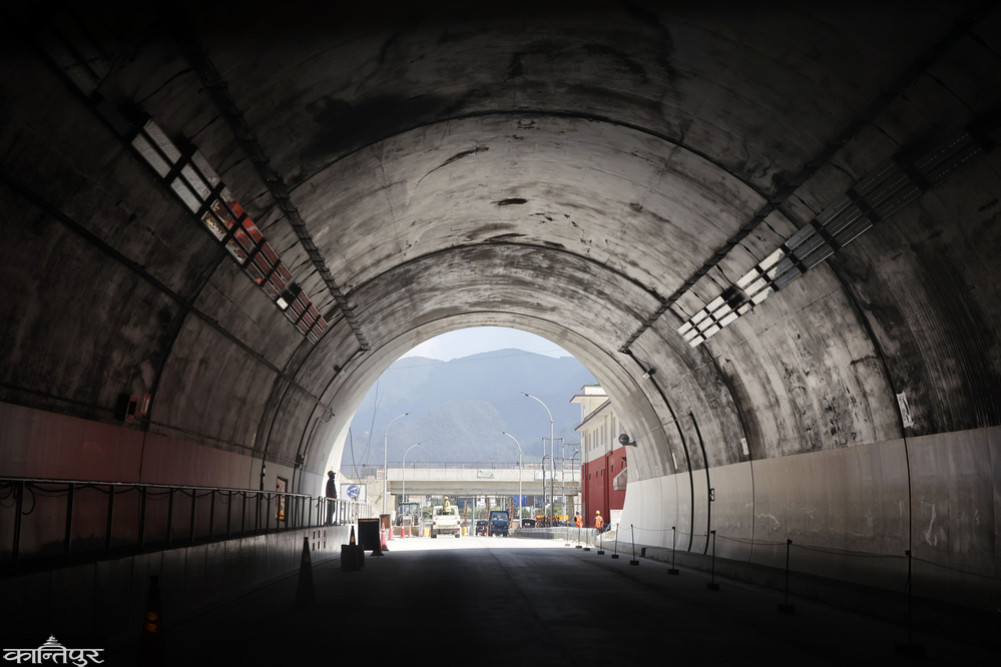
The formal inauguration of the Nagdhunga-Sisne Khola Tunnel is taking place today. It is regarded as the country’s first well-organized transportation tunnel.
The tunnel is set to be inaugurated in the presence of Minister for Infrastructure Development Sunil Lamsal, Japanese Ambassador to Nepal Mayeda Toru, the President of the Japan International Cooperation Agency (JICA), and other senior officials.
After the inauguration, the construction side will hand over the tunnel to the Government of Nepal. The inauguration program is scheduled for 10:25 this morning, with the Minister for Infrastructure Development as the chief guest.
According to the program, Minister Lamsal, the Japanese Ambassador, and the JICA President will drive vehicles through the tunnel to officially open it for traffic. According to the details, ambulances, security vehicles, and other essential vehicles will be allowed entry in the first phase.
For a few days, the tunnel will be fully tested before being opened to all types of vehicles. After testing the safety and traffic management, other vehicles will be allowed to operate. During the testing period, vehicles using the tunnel will not have to pay any fees.
When vehicles operate in the 2,688-meter-long tunnel, a specified fee must be paid. According to the Department of Roads, cars and vans entering Kathmandu will pay Rs 65 and exiting will pay Rs 60. Minibuses, trucks, and tippers entering Kathmandu will pay Rs 115 and exiting will pay Rs 80. Similarly, buses and trucks entering Kathmandu will pay Rs 260 and exiting will pay Rs 200.
Likewise, pedestrians, two-wheelers, and three-wheelers will not be allowed to enter the tunnel. Vehicles carrying flammable substances such as diesel, petrol, gas, and vehicles carrying explosives are also prohibited from entering.
The project includes two tunnels: a main tunnel and a rescue tunnel. Vehicles will operate in the main tunnel, while the rescue tunnel will be used for rescue operations. The tunnel was constructed by Japan’s Hazama Ando Corporation.
According to project consultant engineer Ramesh Prasad Koirala of Nippon Koei, the tunnel is equipped with fire engines, emergency rescue, CCTV cameras, communication, and security systems for safety, smooth traffic flow, and human security.
Similarly, continuous oxygen supply and other essential services have been provided. The tunnel starts from Totipakha in Dahachok, Chandragiri Municipality–1, Kathmandu, and ends at Sisne Khola in Dhunibesi Municipality, Dhading, to the west. It is expected to save nearly an hour of fuel and road users’ time compared to the current highway, which is prone to traffic jams, steep inclines, and winding roads.
The construction of the tunnel involved a concessional loan of Rs 21 billion from the Government of Japan and an investment of Rs 6 billion from the Government of Nepal. A contractor has already been selected and mobilized for the operation and management of the tunnel. Security personnel and other technical staff are conducting regular monitoring and inspections.
Arrangements have been made for vehicles using the tunnel to pay via electronic means. Although the initial target was to complete construction in 42 months, the project period was extended due to the COVID-19 pandemic and other complications.