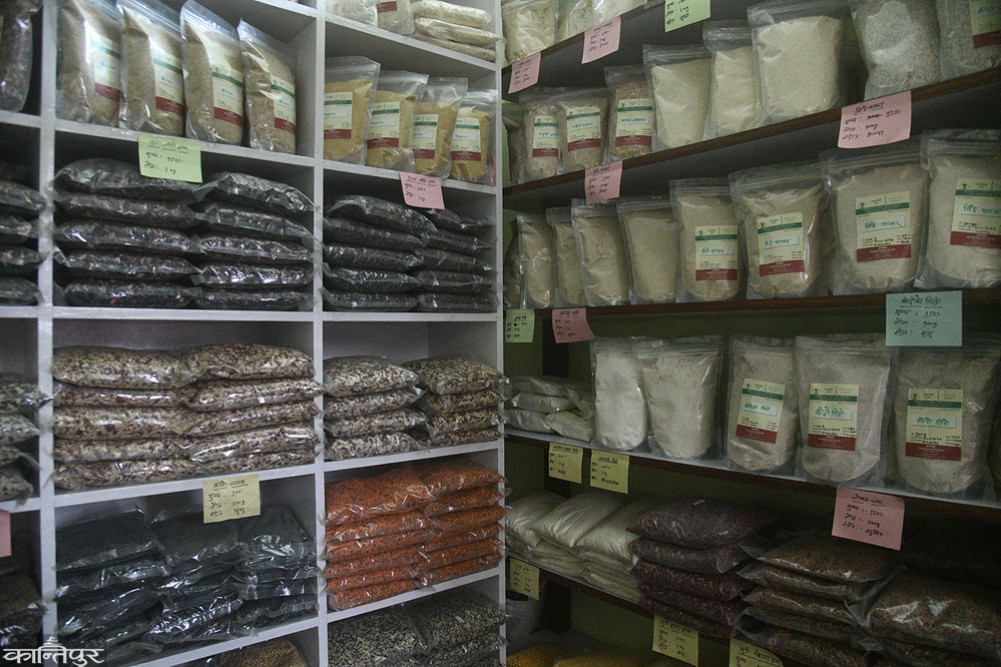
There is a growing trend in the market of selling consumable goods with claims such as 'pure', 'natural', '100 percent natural', or 'organic'. However, a large portion of these products have not been certified by any recognized authority, and government agencies do not have their own integrated laboratories.
We use Google Cloud Translation Services. Google requires we provide the following disclaimer relating to use of this service:
This service may contain translations powered by Google. Google disclaims all warranties related to the translations, expressed or implied, including any warranties of accuracy, reliability, and any implied warranties of merchantability, fitness for a particular purpose, and noninfringement.
Jumla beans, honey from Surkhet’s cliff bees, ginger from Salyan, or potatoes from Mustang—just hearing these names, which are available year-round in Kathmandu’s markets, makes consumers’ mouths water. But are the products you buy truly organic, certified as Himalayan soil’s own organic produce? Neither sellers nor consumers have the answer to this question.
In urban grocery stores, villages from Nepal’s far corners have become powerful agricultural ‘brands’. For example, Jumla’s Marsi rice and beans, Surkhet’s cliff bee honey, Pokhara’s Jethobudho rice, Khopasi/Kavre’s khuwa, Ilam’s tea, Gulmi’s coffee, cardamom from Panchthar and Ilam, Mustang’s black lentils, mudeko potatoes, turkey or quail eggs, and so on.
“Urbanites seeking organic and indigenous flavors are ready to buy these goods regardless of price. The beautiful labels and tempting names printed on the packages empty consumers’ pockets. But whether the product truly comes from the soil of that village is a difficult question to answer today,” said Bhupendra Niranjan, General Manager and Food Inspector at Nepcert, one of Nepal’s organic certification bodies, to Kantipur. According to him, consumers in the market tend to trust the ‘tag’ on the product more than its actual quality.
According to officials from the Department of Agriculture, Department of Food Technology and Quality Control, and other regulatory private bodies, the trend of selling products in the market claiming to be ‘pure’, ‘natural’, ‘100 percent natural’, or ‘organic’ is increasing. However, a large portion of these have not been certified by any recognized body. Due to weak monitoring and certification practices, the credibility of such claims is often questioned.
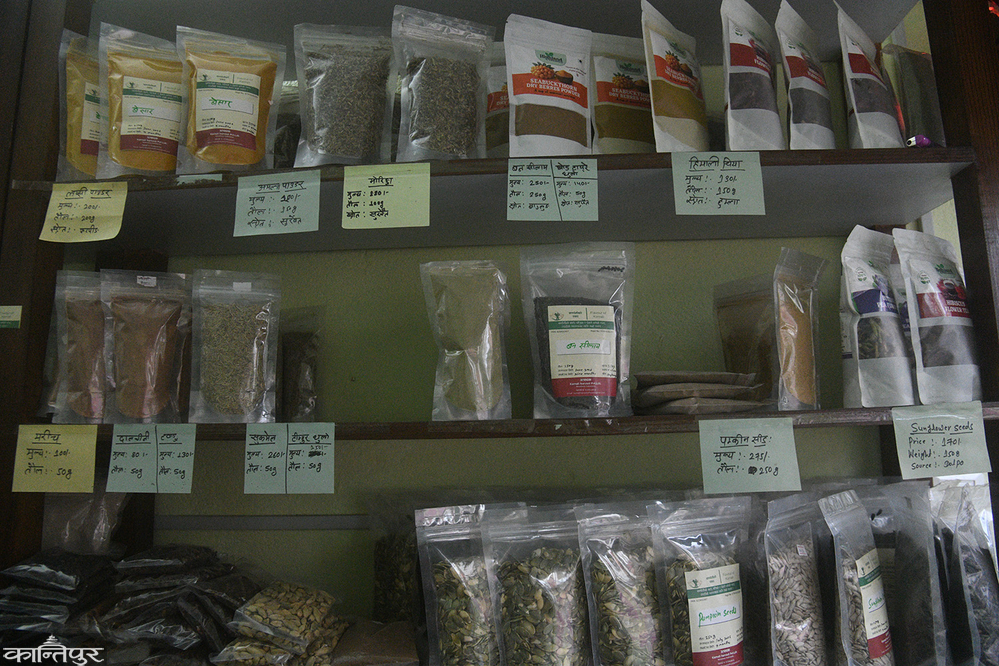
Regarding the confusion among consumers about organic products, Ram Bhakta Adhikari, acting chief of the Agricultural Development Office in Jumla, shared an interesting example on Friday. “About 3,600 tons of beans are produced annually in Jumla. Of that, only about 55 tons are exported outside the district. But in Kathmandu’s supermarkets, online stores, and vegetable shops, ‘Jumla beans’ are available year-round,” he said.
Adhikari’s statement raises a serious question. “How is it that organic beans, of which only a limited quantity leaves Jumla, are being sold as ‘Jumla beans’ in Kathmandu’s markets throughout the year?” According to him, although beans from various districts reach Kathmandu, the trend of selling them as Jumla’s produce is increasing. “We are also surprised.
Not all organic beans sold in Kathmandu can be from Jumla. Most of the beans produced here are consumed within the district itself. Jumla beans are known for their taste and quality. But under that name, produce from other districts may be sold,” he told Kantipur from Jumla. His remarks raise serious questions not only about Jumla beans but also about the authenticity of other agricultural products being sold in the market as ‘organic’ or under the name of some famous district.
The Department of Food Technology and Quality Control has urged consumers not to rely solely on labels when purchasing food items sold as ‘organic’ in the Nepali market. The department has stated that one should check whether products claimed to be organic have valid certification, and that businesses making false claims will be prosecuted according to the law.
Dr. Bal Kumari Sharma, spokesperson and senior food research officer at the Department of Food Technology and Quality Control, said that to be called organic, a product must have a certified certificate. “Just writing ‘organic’ does not make a product organic. For that, one must obtain organic certification from the relevant body, and the certified logo or mark must be on the product’s label,” she said. According to her, the Department of Food Technology and Quality Control does not issue organic certificates in Nepal. Such certification is arranged through private certification institutions, which are regulated and registered by the Department of Agriculture.
Dr. Sharma said that during market monitoring, if a product is found labeled as ‘organic’, the department asks for its basis and certificate. “If the business has a valid certificate, there is no problem. But if ‘organic’ labeling is found without certification, it is considered misleading the consumer and legal action is taken,” she said. According to her, although the current legal provisions do not mention the word ‘organic’ under a separate heading, action can be taken under provisions related to false claims, misleading labeling, and fraud.
According to Dr. Sharma, the department’s main responsibility is to monitor the quality, safety, and labeling of food products. The department collects samples of food items sold in the market, conducts laboratory tests, checks the validity of labels and claims, monitors based on complaints, and takes legal action if necessary. She said the department also checks whether special claims such as organic or halal have the relevant certificates. If such claims are found without evidence, the department initiates necessary action.
Dr. Sharma urged consumers not to trust products just because they are labeled ‘organic’, and suggested buying only those with a certified logo, certificate, and proper labeling. “Consumers should not trust just because it says organic. They should choose products with valid certification. If there is any doubt, complaints can be filed with the department,” she said.
According to her, the department also monitors the market based on complaints received. The department will release statistics in a few days on how many complaints were received about this in the last fiscal year. She informed that if consumers have doubts about the label, quality, or safety of any food item, they can report it to the department. According to the department, the credibility of organic products depends on proper certification, transparent labeling, and effective monitoring, so consumers, businesses, and regulatory bodies all need to be responsible.
Regarding organic produce, Nepal has formulated the ‘Procedures for Granting Affiliation to National Organic Agriculture Certification Bodies, 2069’. This is the only regulatory framework prepared by the Government of Nepal (Ministry of Agricultural Development). This procedure legally affiliates, monitors, and regulates certification bodies to maintain the quality and credibility of organic agricultural produce, food items, and processed products sold, distributed, and exported in Nepal.
In Nepal, certification of organic produce is not done by government bodies, but through private and professional institutions listed by the government. Currently, eight certification bodies in Nepal provide organic certification services according to national and international standards.
These include Organic Certification Nepal, Nepcert Kathmandu, Sakura Herbs and Agro Pvt. Ltd., Certification of Environment Standards Nepal Pvt. Ltd., Himalayan Certification Nepal, Nepal Organic Certification International Surkhet, IMO Kathmandu, and Environment Food and Agriculture Certification Pvt. Ltd.
According to Nepcert’s General Manager and Food Inspector Niranjan, there are very few large agencies in Nepal that provide international-level certification. There are even fewer inspectors to conduct such checks.
According to Yam Kumari Shrestha, Senior Horticulture Development Officer at the Agriculture Productivity Division of the Department of Agriculture, these institutions are listed and affiliated with the department. The department regularly monitors them, renews their affiliation, and collects details of the products they have certified. “We monitor the certifying institutions during their renewal. We also collect details of which products they have certified as organic,” Shrestha said.
According to her, among the organic certified products in Nepal, tea and coffee have the largest share. After that come herbs, timur (Sichuan pepper), ginger, and some vegetables. She said these items are mainly exported to international markets, so the demand for certification is higher. “After COVID-19, organic certification activities have decreased somewhat. Even now, tea and coffee are the most certified, as they are export-oriented products. After that come herbs, timur, and ginger,” she said. In the case of animal products, Shrestha said the practice of organic certification in Nepal is extremely limited.
“There is no organic certification for eggs and meat. Among dairy products, only one item from DDC has been certified organic,” she said. According to her, a few years ago, cardamom also received organic certification. “Cardamom was certified once, but now its certification is no longer valid,” she said.
The department or certification bodies do not have their own integrated laboratories. They have products tested in private laboratories as needed. Private labs charge high fees for testing. According to her, in Nepal’s own market, producers must keep strict diaries and paper records, which is a very cumbersome process for ordinary farmers. On top of that, farmers themselves have to bear additional costs of up to 15,000–16,000 rupees for organic certification, training, and a single basic lab test.
But even after so much effort and investment, the main reasons why farmers do not get organic certification, even when they can get a ‘premium price’ from traders or consumers, are the complex process, financial burden, and market uncertainty. “For small farmers with two to four kattha of land, it is not possible to get certification alone,” she said. “If even one out of a hundred members in a group violates the rules and uses chemical fertilizers or pesticides, the entire group’s certificate is at risk of being revoked.”
In addition, every farmer must keep detailed records of their land, fertilizers used, seeds, and sales, but there is no guarantee of buyers. Lack of technical knowledge about strict standards such as maintaining a soil buffer zone, discipline in storage and transportation, and lack of support from local governments or supporting bodies in the certification process and costs are also reasons why farmers do not want to get involved in the hassle of certification, according to food inspectors.
These eight bodies charge separate fees for certification. According to Bhola Shrestha, Director of Organic Certification Nepal, organic certification costs at least 60,000 to 150,000 rupees.