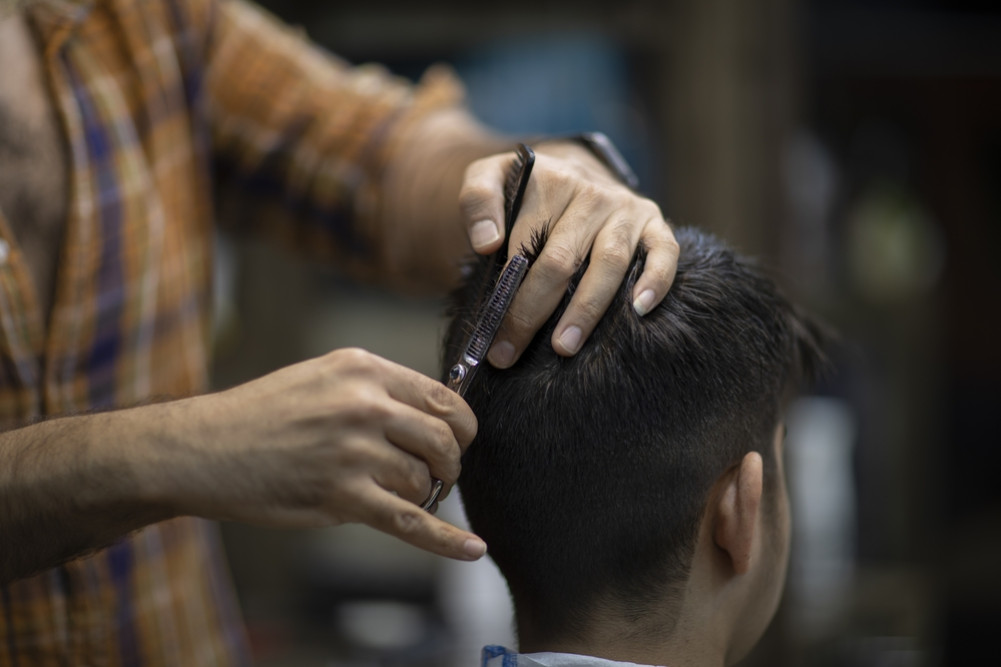
The tenth amendment to the Education Regulations has prohibited forcibly cutting students' hair without their consent, but many schools and colleges are still continuing with the old practice.
We use Google Cloud Translation Services. Google requires we provide the following disclaimer relating to use of this service:
This service may contain translations powered by Google. Google disclaims all warranties related to the translations, expressed or implied, including any warranties of accuracy, reliability, and any implied warranties of merchantability, fitness for a particular purpose, and noninfringement.
Samriddha Karki, an 18-year-old studying in grade 11 at a private school in Kathmandu, was once forced to cut his hair against his will. Every three to four weeks, teachers and the discipline in-charge (DI) would line up students and inspect their hair.
If hair was found to be long, various punishments were given. These included calling home, not allowing entry into class, and sometimes even confiscating ID cards. Karki said, “They put a lot of mental pressure on me because of my hair.” But he did not accept it. “Whether I cut my hair or not makes no difference. It neither improves nor worsens my studies,” he said.
After that, he filed a complaint on this issue with the civic platform ‘SpeakUp Nepal’. In the very first month, 250 people signed in support of his complaint and memorandum. According to Kritika Ghimire, project manager of ‘SpeakUp Nepal’, the platform transforms ordinary complaints into campaigns.
Ghimire, Prince Shah, Sahara Bhandari, and others launched the platform. According to its policy, complaints with more than 250 signatures are automatically forwarded to the relevant government agencies. Karki’s case surpassed the 250 mark in the first month. “At that moment, we realized this was not just one student’s experience. Hundreds of people were reporting similar problems,” said Ghimire.
After this, the complaint was institutionally submitted to various agencies for 19 months. It went through the Kathmandu Education Office, the Center for Education and Human Resource Development, and finally reached the Ministry of Education, Science and Technology. Ultimately, on 19 Asar 2083 (early July 2026), the tenth amendment to the Education Regulations prohibited schools and colleges from forcibly cutting students’ hair without their consent.
The government should not encourage this. Hair should not be made a matter of prestige. An institution should be allowed to make its own rules and regulations. - Nawaraj Bhatt, Kathmandu Chairperson of PABSONThis bans discrimination or harassment based on hairstyle, physical appearance, or makeup. It broadens students’ rights to personal appearance and also declares physical and mental harassment in the name of school discipline illegal.
However, even after the amendment was passed, many schools and colleges in and around Kathmandu continue the old practices. Karki said, “Many schools still do not comply. Some colleges have stopped the old practice, but informally, they still pressure students.”
According to Aryan (name changed), a student at Budhanilkantha School, her school has no formal rules regarding appearance. But teachers ask female students to tie their hair, not wear makeup, and not apply mehendi. She likes to wear light makeup such as mascara and lip gloss. Although there is no humiliating environment at school regarding this, teachers occasionally single her out in front of other students. She said, “Makeup is about feeling good for yourself. It shouldn’t be such a big issue.”
Bharat Prasai, a 39-year-old father of a 9-year-old student, said the practice of monitoring students’ appearance has existed for a long time. He said there has never been any clear or uniform standard on this issue. He recalled his own school days, when teachers would pull students’ hair to measure its length.
From a parent’s perspective, he sees no harm if hair falls below the neck or forehead, or if girls wear makeup. He said, “I don’t think there’s any problem with this.” He believes teachers should not have the authority to monitor students in this way.
According to Ghimire, the biggest challenge was convincing people that this issue deserved policy attention. She said, “Many had accepted this as a normal part of school discipline for years,” she added, “The focus is on whether forcibly cutting hair is an appropriate disciplinary practice. It took us a long time to explain that we were not trying to challenge hairstyle or school discipline.”
Ghimire said the campaign took a long time to advance due to legal review, coordination among various agencies, and procedural aspects of policymaking. According to her, during the 19 months, neither ‘SpeakUp Nepal’ nor the main complainant faced significant opposition or ridicule at school. Even in places with differing opinions, most interactions with schools, officials, and parents were respectful.
According to Ghimire, the next goal of ‘SpeakUp Nepal’ is to ensure this protection not just in regulations but by having it approved by Parliament and included in the Education Act itself. She added, “The success of this will not be measured only by policy change. It will be measured by whether students across Nepal actually experience this change in their daily school life.”
Not everyone agrees with this law. Nawaraj Bhatt, chairperson of the Kathmandu district chapter of the umbrella organization of private schools, PABSON, said that issues of hair, dress, and cleanliness should be matters between schools and parents. He argued that the state should not make laws on this.
“The government should not encourage this. Hair should not be made a matter of prestige,” he said. “An institution should be allowed to make its own rules and regulations.” He said that three other umbrella organizations representing Nepal’s private education sector (HISSAN, APEN, and NPABSON) also share the view that the government should not intervene in this matter.
He argued that instead of solving any problems, this change has made students more rebellious. “Just the other day, students at my school refused to cut their hair. When they were told to cut it, they raised their voices on social media, saying this rule is against them,” Bhatt said. “This encourages students to become rebellious, and after this ban, practical problems will arise.”
Kalpana Oli Sitoula, school in-charge at Pathibhara Academy in Bhaktapur, said that rules regarding appearance are only a part of the broader disciplinary structure set by schools. She said that while schools used to make the same rules for all students, now individual counseling is gradually gaining importance.
“In a collective environment, we can’t always say yes to everything,” she said. While not directly defending the practice of forcibly cutting hair, she said it will take time for schools to adapt to this change. “Problems will continue for a year or two,” she said. “We have been following one system, and when shifting to another, a kind of transition period is natural.”
Sitoula said she does not believe the change should be opposed just because it is new. “If this law has been made, we must implement it,” she said. “We teachers also need to change along with the students.” She said that hair alone does not determine everything, but attention should be paid to other aspects such as practical activities.
Shiv Kumar Sapkota, spokesperson for the Ministry of Education, said that those who violate the rules will face legal consequences. “Once this becomes a legal provision, any violation is punishable,” he said. “If someone does not implement it, a case can be filed in court or administrative action can be taken.”
He said that local governments are responsible for monitoring this. He also clarified that schools have not been given any grace period to adapt to the rules. “There is no need for a time limit,” he said. “It has been implemented from the day it was published in the Nepal Gazette.”
Child rights activist and Deputy Director of Voice of Children, Raju Ghimire, claimed that the law is weak because it was introduced as a regulation approved by the Cabinet, not as an Act passed by Parliament. “This is not an Act, so although it is assumed to be binding, it may not be,” he said.
He accused the government of not holding broad consultations while drafting the policy. “The government should have consulted organizations like ours. But it made a unilateral policy. If the policy is one-sided, such reactions will come,” he said. “To effectively implement the rules, it is necessary to raise awareness about this.”