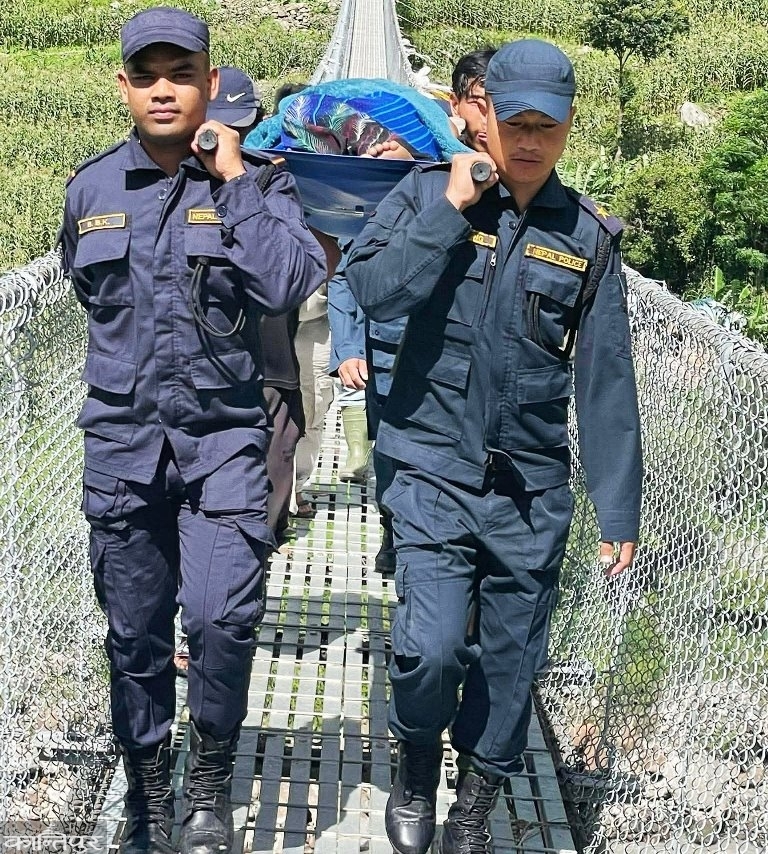
With the road network yet to be expanded, it is not even easy to carry patients on stretchers to the health post along the narrow paths of Chumnubri Rural Municipality. Reaching the scattered settlements requires hours of walking, and sometimes the police have to be called for help in carrying patients.
We use Google Cloud Translation Services. Google requires we provide the following disclaimer relating to use of this service:
This service may contain translations powered by Google. Google disclaims all warranties related to the translations, expressed or implied, including any warranties of accuracy, reliability, and any implied warranties of merchantability, fitness for a particular purpose, and noninfringement.
For two days, police assisted in transporting patients to health facilities using stretchers along the narrow paths of northern Gorkha. On Thursday, police carried 28-year-old Srijana Gurung of Chumnubri–3, Pangsang, who was in labor, for nearly an hour and a half to the Sirdibas health post.
Gurung, who was walking to the Sirdibas health post, experienced health complications midway. After her relatives informed the Sirdibas police post, a police team placed her on a stretcher and took her to the health post. She gave birth after reaching the post. Both mother and child are now in stable condition.
In geographically remote Chumnubri Rural Municipality, where the road network has not been expanded, even the footpaths are narrow. It is not easy to carry patients on stretchers to the health post. Here, stretchers have become like ambulances, and the police have become a lifeline. It takes hours of walking to reach scattered settlements.
On Thursday afternoon, 29-year-old Pema Khando Lama of Chumnubri–4, Chhak village, gave birth to a stillborn child. After her health condition became critical following a home delivery, health workers from Larkebazar health post reached her home.
When she could not be rescued by helicopter late in the evening, additional medication was needed for her treatment. After health workers coordinated with the Larkebazar health post, a police team from the Area Police Office Larkebazar walked for three hours and reached Chhak village with medicine at 1 a.m.
When her health did not improve by Friday afternoon, Pema was rescued by chartered helicopter under the Gandaki Province Ministry of Health’s Pregnant and Postpartum Risk Rescue Program. The police team also assisted in taking her to the helipad.
Due to bleeding, her condition became critical and she was taken to the Pokhara Institute of Health Sciences for further treatment, said Manoj Lamichhane, Chief Administrative Officer of Chumnubri Rural Municipality.
After Pema, who gave birth at home, became critically ill, health workers from Larkebazar health post reached her home and provided treatment on Thursday, he said. “She had given birth at home. We only learned late that her condition was critical. Health workers treated her at home until Thursday night,” he said. “For further treatment, we coordinated a helicopter and sent her to Pokhara.”
The rural municipality has urged pregnant women to give birth in health institutions, undergo regular checkups, and remain in contact with and follow the advice of health workers. He said that police accompany health workers in the rescue of patients in critical condition. “Yesterday (Thursday) too, the police carried a pregnant woman to Sirdibas health post. Today (Friday) as well, the police carried her to the helipad,” he said. “Because it is a remote area, rescue must be done quickly. With police assistance, it is faster and easier.”
Previously, on the 18th of Asar, police in northern Gorkha also carried 26-year-old Chhewang Bhuti Lama from Chumnubri–4 to the health post. Police also rescue those affected by natural disasters and those who fall ill suddenly.
On the 17th of Asar, police rescued Kopila Pant, who suddenly fainted and collapsed on the way from Sirdibas to Lho in Chumnubri–3. Pant was also taken to Philim health post with the help of a stretcher.
Because patients in critical condition often need to be rescued by helicopter, the police are the first to be notified, says Som Prasad Gurung of Chumnubri–3. “If someone falls ill, they go to the health post. Serious cases cannot be treated here. It takes two to three days to carry someone on a stretcher,” he said. “You have to inform many places to get a helicopter.” He said that because settlements are scattered in difficult terrain, there is no alternative to notifying the police post for emergency rescues.
On the Manaslu trekking route, falling rocks often injure pedestrians. Locals in this area are compelled to pay high fees to transport the injured to Kathmandu by helicopter in emergencies. “It takes time to gather people when needed. Whatever the problem, we villagers also join the rescue with the police,” he said. “Police posts are also far apart. If an incident occurs, villagers carry the person and inform the police.”
DSP Raj Kumar Shrestha of the District Police Office Gorkha said that there are many rescues of disaster victims, natural calamity victims, and patients in critical condition in the northern region. “In northern Gorkha, incidents of sudden illness and injuries keep occurring,” he said. “Since the start of this month of Asar, police have carried four patients to health facilities. Police are always there in every joy and sorrow.” DSP Shrestha said that due to the difficult geography, police always remain alert for quick and efficient deployment in emergency rescues.

