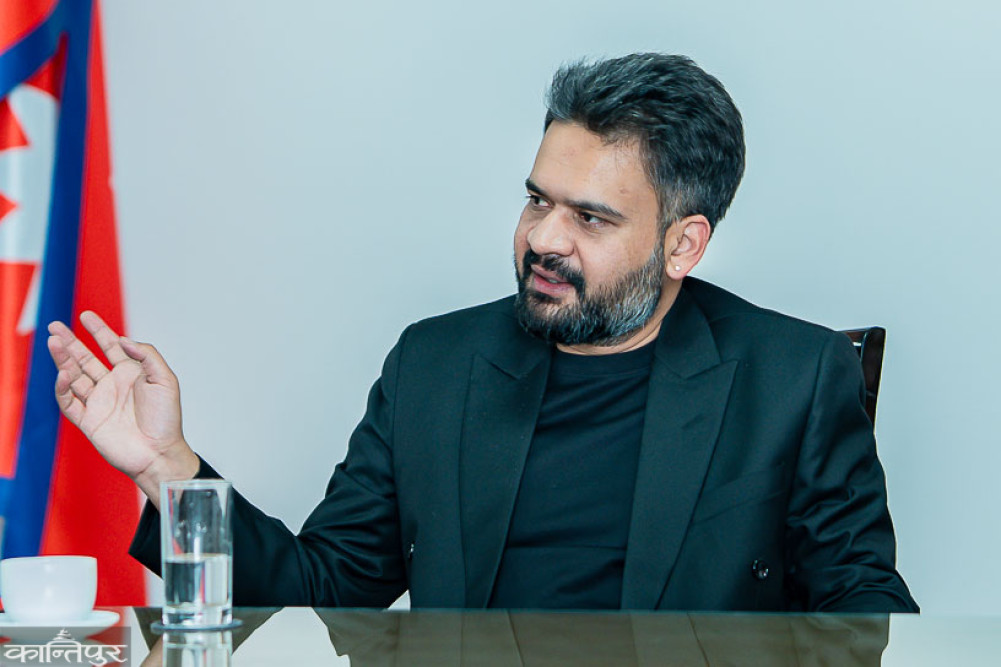
In the discussion, industrialists drew the Prime Minister's attention to the problems seen in export promotion and possible solutions.
We use Google Cloud Translation Services. Google requires we provide the following disclaimer relating to use of this service:
This service may contain translations powered by Google. Google disclaims all warranties related to the translations, expressed or implied, including any warranties of accuracy, reliability, and any implied warranties of merchantability, fitness for a particular purpose, and noninfringement.
Prime Minister Balen Shah has stated that the government is committed to addressing the problems faced by export-oriented industrialists and entrepreneurs in order to expand the international market for Nepali products. Prime Minister Shah expressed this view during a discussion with representatives involved in Nepal’s major export-oriented industries and businesses at the Office of the Prime Minister and Council of Ministers on Friday.
During the discussion, industrialists drew the Prime Minister’s attention to the problems seen in export promotion and possible solutions. In the discussion, Balram Gurung, President of the Nepal Carpet Manufacturers and Exporters Association, said that although the main markets for Nepali carpets are the United States and Europe, new regulations in the US have made exports difficult. According to him, the US has made certification from the Consumer Product Safety Commission mandatory from July 8, but since such facilities are not available in Nepal, there have been problems exporting carpets.
He also said that the laboratory of the Department of Weights and Measures was damaged during the “JEN-JI” movement, so testing facilities are not immediately available. Gurung requested that, until an alternative arrangement is made, a one-year exemption (grace period) from such testing be granted by sending a diplomatic note to the US Customs Department through the Ministry of Foreign Affairs. Prime Minister Shah has directed the relevant ministry to implement this request immediately.
Gurung also said there are problems with quarantine certification for wool imported from China and other countries for carpet production. He said that the current system, which allows testing only on the 5th, 15th, and 25th of each month, causes delays in importing raw materials, increasing costs for industrialists. “Since quarantine certification for wool is done only three times a month, there are delays in importing raw materials. Therefore, we have requested the Prime Minister to arrange for testing and certification at least two days a week,” he said.
Prime Minister Shah has directed the relevant agencies to conduct quarantine certification work two days a week. Gurung also demanded the formation of a Carpet Development Board under the Ministry of Industry. Prime Minister Shah appeared positive on this matter. In addition, he said the government would play a role in expanding sheep farming in Karnali and Sudurpaschim to increase meat and wool production.
Similarly, Home Prasad Ghimire, President of the Nepal Plywood Manufacturers Association, said that although Nepali plywood is of high quality, industrialists are facing problems due to some legal and policy provisions. According to him, about 40 billion rupees have been invested in 85 plywood industries in Nepal. However, he said that since the raw material “veneer” required for plywood production is being exported to India at a low customs rate from Nepal, domestic industries are facing problems. Prime Minister Shah said the government is positive about increasing customs duties on raw material exports to discourage such exports.
Dhan Prasad Lamichhane, President of the Nepal Pashmina Industries Association, said that although there is sufficient grazing land in the Himalayan region, sheep farming in such areas is facing problems due to the Forest Act. He demanded the establishment of collection centers for wool and natural fibers at the local level and processing centers at the provincial level for pashmina production.
Prime Minister Shah said the government is ready to facilitate necessary discussions to amend the Forest Act and to establish collection and processing centers.
Resham Bahadur Pokharel, President of the Nepal Dog Chew Manufacturers Association, also said that due to legal obstacles, they have not been able to produce and export as expected. Since dog chews are classified under dairy products, he demanded that they be categorized as “pet food” industries and that the import of necessary “skimmed milk powder” for such industries be facilitated. Prime Minister Shah said that after studying the matter, appropriate action would be taken if deemed necessary. Prime Minister Shah said that cooperation between the government and the private sector is necessary to solve the problems of export-oriented industries.
He said that export promotion should be prioritized to expand the international market for Nepali products, increase foreign currency earnings, and create employment within the country. According to his secretariat, Prime Minister Shah said the government would take the initiative for necessary policy reforms and facilitation, giving priority to addressing the problems and suggestions raised by industrialists for the development and expansion of export-oriented industries.
Participants in the discussion included Home Prasad Ghimire, President of the Nepal Plywood Manufacturers Association; Balram Gurung, President of the Nepal Carpet Manufacturers and Exporters Association; Dhan Prasad Lamichhane, President of the Nepal Pashmina Industries Association; carpet and plywood exporter Dewanand Sarawagi; and Resham Bahadur Pokharel, President of the Nepal Dog Chew Manufacturers Association.