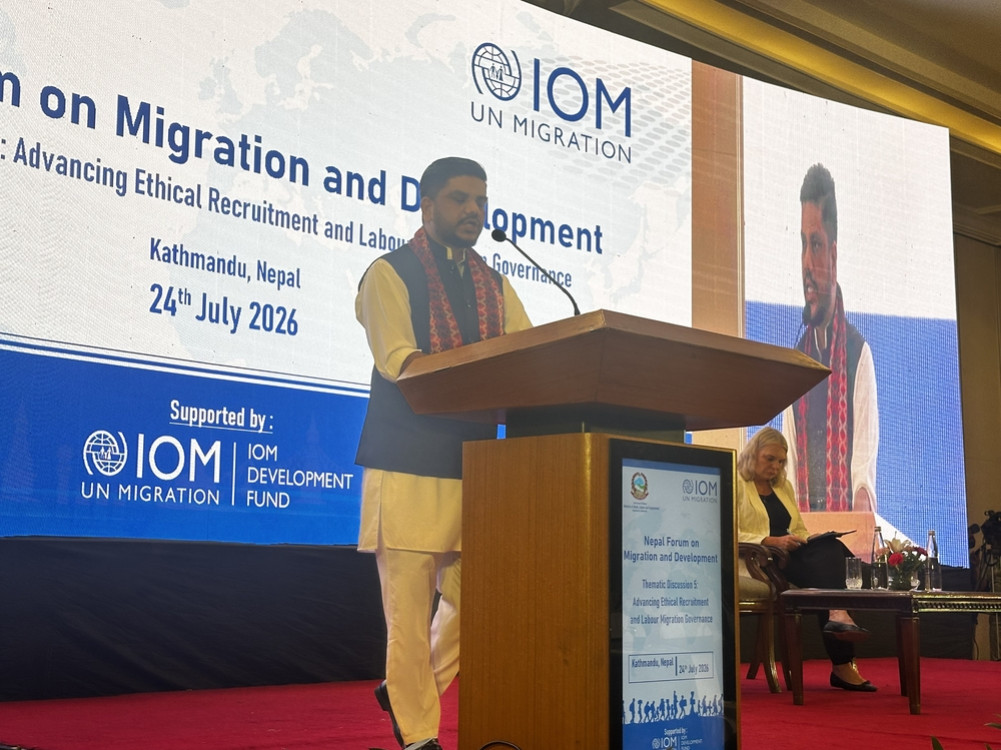
“There is a free visa–free ticket policy on paper, but in practice, most people going abroad are paying large sums,” said Labor Minister Yadav. “That is why we are developing a fact-based and scientific approach to regulate recruitment costs.”
We use Google Cloud Translation Services. Google requires we provide the following disclaimer relating to use of this service:
This service may contain translations powered by Google. Google disclaims all warranties related to the translations, expressed or implied, including any warranties of accuracy, reliability, and any implied warranties of merchantability, fitness for a particular purpose, and noninfringement.
The government has initiated the process of reviewing the ‘Free Visa, Free Ticket’ policy, which has been in effect since 2015, in order to control the illegal recruitment fees and expenses that Nepali workers going for foreign employment are forced to pay. Minister for Youth, Labour and Employment Ramji Yadav stated that the government is simultaneously advancing policy, legal, and administrative reforms to end the high recruitment costs imposed on workers.
Addressing the Nepal Forum on Migration and Development (NFMD) conference organized by the Ministry of Labour and IOM in Kathmandu on Friday, Minister Yadav informed that a high-level task force has been formed to regulate recruitment costs. According to him, the task force is studying the effectiveness, practicality, and implementation aspects of the Free Visa–Free Ticket policy.
“On paper, there is a Free Visa–Free Ticket policy, but in practice, most people going abroad are paying large sums,” he said. “That is why we are developing a fact-based and scientific approach to regulate recruitment costs.”
Minister Yadav acknowledged that the tendency to extract exorbitant amounts from workers going for foreign employment still persists, depicting it as one of the most serious problems in the labour migration sector. He said that workers are still compelled to take loans at high interest rates, sell land, or sell family jewelry to go for foreign employment, and that this situation has yet to end.
He said that a study conducted by the Ministry of Labour through the Labour Assistance Desk at Tribhuvan International Airport for several weeks found that many workers are even afraid to disclose the amounts they have paid. “Many did not want to reveal the actual expenses for fear of losing their jobs,” he said. “But most of the workers who come to us seeking help only do so after they have been cheated.”
Minister Yadav said that the government is amending the Foreign Employment Act to make the recruitment process more transparent and monitorable. He mentioned that the amended Act will provide incentives for those who comply with the rules and strict penalties for violators.
The government has also prioritized the digitization of the recruitment process. According to Minister Yadav, once the amended Act is implemented, the entire recruitment process will be based on a digital system, making the process transparent, accountable, and traceable.
He also emphasized the need to control the role of unauthorized agents to solve the problem of recruitment fees. “We are reducing off-the-record contacts between recruitment agencies and workers, and seeking to expand direct and transparent relationships between employers and recruitment companies,” he said.
Minister Yadav noted that currently, only a very small proportion of workers going abroad from Nepal go through the ‘ethical recruitment’ process. Although there are no exact statistics, he estimated this number to be around 7 percent. “I have personally met many such workers who have not had to pay any recruitment fees,” he said. “This shows that ethical recruitment is possible.”
He stated that ultimately, the government’s long-term goal is to reach the ‘employer pays model’, in which the employer bears all recruitment-related expenses. “Our common objective is to create a situation where workers do not have to pay recruitment fees,” he said. “To achieve this, joint efforts from the government, employers, recruitment agencies, and international partners are necessary.”
Minister Yadav said that Nepal will also expand the ethical recruitment system by learning from the practices of countries like the Philippines, which have succeeded in reducing recruitment fees. He added that the government has advanced policies to encourage responsible employers and recruitment agencies and to make the foreign employment sector more professional and organized.
He also expressed the government’s commitment to implement practical suggestions from the conference to make foreign employment safe, organized, and worker-friendly.