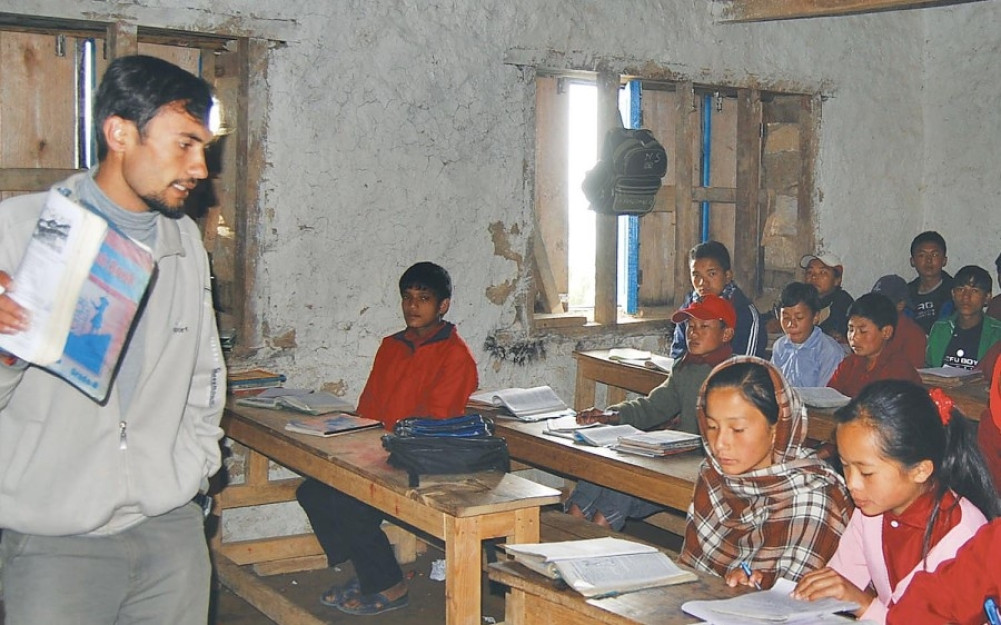
The government collects more than 2.5 billion rupees every year from students in grades 9 to 12 as registration, examination, and academic certificate fees, and has also set fees under other headings.
We use Google Cloud Translation Services. Google requires we provide the following disclaimer relating to use of this service:
This service may contain translations powered by Google. Google disclaims all warranties related to the translations, expressed or implied, including any warranties of accuracy, reliability, and any implied warranties of merchantability, fitness for a particular purpose, and noninfringement.
The government has been collecting fees from students at the school level under more than a dozen headings, contrary to the Constitution and the law. By the time a student reaches grade 12 from grade 9, they are compelled to pay the state more than 5,000 rupees in various fees.
Each year, between 400,000 and 600,000 students enroll in each grade from 9 to 12. Calculating this way, the state collects over 2.5 billion rupees annually from students just for registration, examination, and academic certificate fees. In addition to these, the government has set various other fees, which is against the constitutional provision of free education.
Article 31 of the Constitution states, “Every citizen shall have the right to compulsory and free education up to the basic level (grade 8) and free education up to the secondary level (grade 12) from the state.” To implement this constitutional provision, the Compulsory and Free Education Act, 2075, and the Regulations, 2077, have also been issued. However, the collection of fees from students has not been stopped.
According to the National Examination Board, the government collects a registration fee of 300 rupees from each student in community and private schools who reach grade 9. When these students reach grade 10, schools collect an application fee of 500 rupees per student and submit it to the government.
According to the Board’s Information Officer, Narayan Pokhrel, in grade 11, a subject registration fee of 400 rupees per student is charged. Statistics show that around 400,000 students enroll in grade 11 each year. After paying fees in grades 9, 10, and 11, students are again charged an examination application fee of 800 rupees each in grade 12.
The Board collects this amount. After passing the examination, the government also collects fees from students to obtain academic certificates for grades 10 and 12. The principal of a community school in Kathmandu said that the government itself instructs schools to collect and submit registration, subject registration, examination application, and certificate fees from students. “According to the Constitution and the law, the Ministry of Education should prohibit community schools from collecting any fees from students, but the examination board and the Office of the Controller of Examinations under the ministry instruct us to collect fees,” he said.
Every day, students can be seen lining up at the central and provincial offices of the Board to obtain or correct academic certificates. For this, some schools collect the fees from students and forward them to the Board. Some schools, however, charge students more than the government-mandated amount and spend the extra money at the school, according to parents’ complaints. Students and parents also complain that private schools charge more than the fees set by the Board.
This year, Sneha Rupakheti, a student who passed grade 12 from a community school, said she paid 1,500 rupees to obtain her transcript, migration, and provisional certificate. She also spent 1,500 rupees to obtain her grade 10 certificate. She said she paid 2,000 rupees in total for registration, examination application, and subject registration fees from grades 9 to 12.
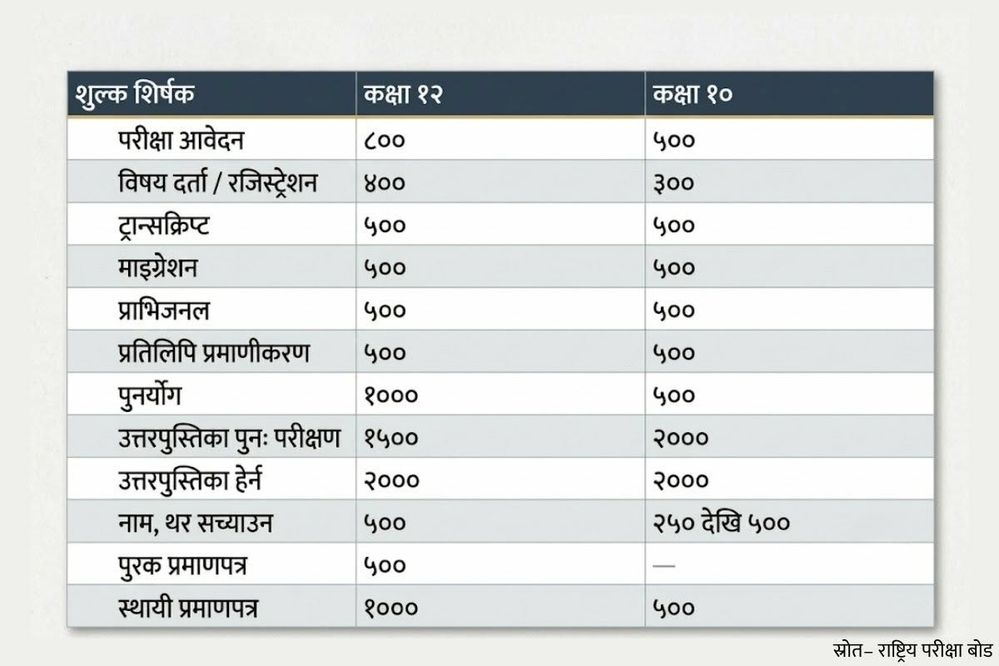
According to information provided by the Board, there are 20 different fee headings in grades 11 and 12. For a supplementary certificate, a fee of 500 rupees is charged, and for each copy of an academic certificate, a fee of 500 rupees is collected from students. In addition, a separate fee of 1,000 rupees is charged for a permanent certificate. To authenticate an original certificate, the Board collects a fee of 500 rupees. The Board has stated that a fee of 500 rupees is set for the authentication of mark sheets, grade sheets, and certificate copies.
If dissatisfied with the results, a fee of 1,000 rupees is set for re-totaling. This year, 32,000 students in grade 12 paid the fee and applied online for re-totaling. Even when errors are made by Board staff, answer sheet examiners, or teachers, students are required to pay the fee and apply for re-totaling. In the SEE, 34,000 students applied for re-totaling this year. Of these, the results of more than 1,800 students were changed. For re-totaling in the SEE, a fee of 500 rupees per subject is charged.
If still dissatisfied after re-totaling and wishing to view the answer sheet, a fee of 1,500 rupees is set for grade 12. If still dissatisfied after viewing the answer sheet and requesting a re-examination, a fee of 2,000 rupees is set. To correct the name, surname, or date of birth on a certificate, a fee of 500 rupees is charged. According to Board Information Officer Pokhrel, a fee of 500 rupees is set for searching for a symbol number, and 50 rupees for a bill copy.
For viewing and re-examining answer sheets in the SEE, a fee of 2,000 rupees each is charged. To correct the name, surname, date of birth, or English date of birth on SEE certificates, a fee ranging from 250 to 500 rupees is set. For grade 10, a fee of 500 rupees per certificate is charged for grade sheets, original certificates, migration, original certificate verification, copy verification, and obtaining a copy of a lost certificate. School staff say that this amount is deposited directly into the government’s revenue account. A fee of 500 rupees is set for certificate integration.
Board Member Secretary Jung Bahadur Aryal said that the Board has been collecting fees based on its decisions for years. “The amount collected from students in grades 11 and 12 is deposited directly into the Board’s account. All Board operations, staff management, exam administration, result publication, and related activities are funded from this amount. The government does not provide a separate budget,” he said. “However, the amount collected from students in grades 9 to 12 is deposited into the government’s revenue account.”
The government collects 180 million rupees in revenue just from registration fees in grade 9. When these students reach grade 10, 250 million rupees are collected as examination application fees. Throughout the year, the Office of the Controller of Examinations alone collects around 600 million rupees in revenue. About 350 million rupees are collected in the SEE, and the remaining amount is deposited in the Ministry of Finance’s revenue account, according to staff.
The Compulsory and Free Education Act states that providing education up to the secondary level is the responsibility of the state. Section (4) of the Act states, “It shall be the responsibility of the state to provide education up to the secondary level to every citizen.” The regulations formulated in 2077 after the enactment of the Compulsory and Free Education Act contain a provision that no fees shall be collected.
In Poush 2081, then Education Minister Bidya Bhattarai made a decision that fees should not be collected from students. The proposal was sent to the Ministry of Finance after being approved by a meeting of the National Development Problem-Solving Committee, chaired by the Prime Minister. However, it could not be implemented. “On one hand, there is talk of free education, but on the other, government bodies themselves are collecting fees. There was discussion about immediately stopping registration fees in grades 9 and 11 and gradually making decisions regarding examination and certificate fees,” she said. “Later, I was also removed from the post of Education Minister. The decision could not be implemented.”
According to former Education Minister Bhattarai, at that time, the ministry had proposed and decided that a single registration would suffice and would be free. “Local governments and schools are prohibited from collecting fees in the name of free education, but the federal government itself is collecting money,” she said. “That’s why I had also initiated a framework for implementing the Compulsory and Free Education Act.”
Officials at the Ministry of Education say that the decision not to collect fees in 2081 could not be implemented because the Ministry of Finance rejected it. Shiva Kumar Sapkota, Joint Secretary and Spokesperson for the Ministry of Education, said that the provisions regarding government-collected fees should be amended in accordance with the Compulsory and Free Education Act. “The ministry has also been moving forward with the process of removing fee-related provisions. But since this is also a matter of revenue collection, it is not related only to the Ministry of Education,” he said.
The Office of the Auditor General has been raising questions about the collection of fees. The Auditor General’s annual report for 2081 also mentions that although there is a provision for free education up to the secondary level, the Board has collected fees from secondary-level students under headings such as registration, examination, and certificates. Across the country, 27,010 community and 8,941 private schools are in operation. According to Ministry of Education statistics, 5.2 million students study in community schools and 3 million in private schools. The Ministry of Education has stated that fees are being collected from students in both types of schools under these headings.
Education expert Vinay Kumar Kusiyait says that successive governments have failed to implement the Compulsory and Free Education Act. “According to the constitutional provision, no one is allowed to collect any fees from students up to grade 12,” he said. “Governments have failed in this regard. No government has taken responsibility, accountability, or ownership to ensure free education.” He commented that due to the inability to allocate the necessary budget for the education sector, the government itself is compelled to collect fees from students and parents. “Extremely poor, Dalit, children from backward areas, and children with disabilities study in community schools. Everything should be made free and scholarships should be provided to encourage them to study,” he said.