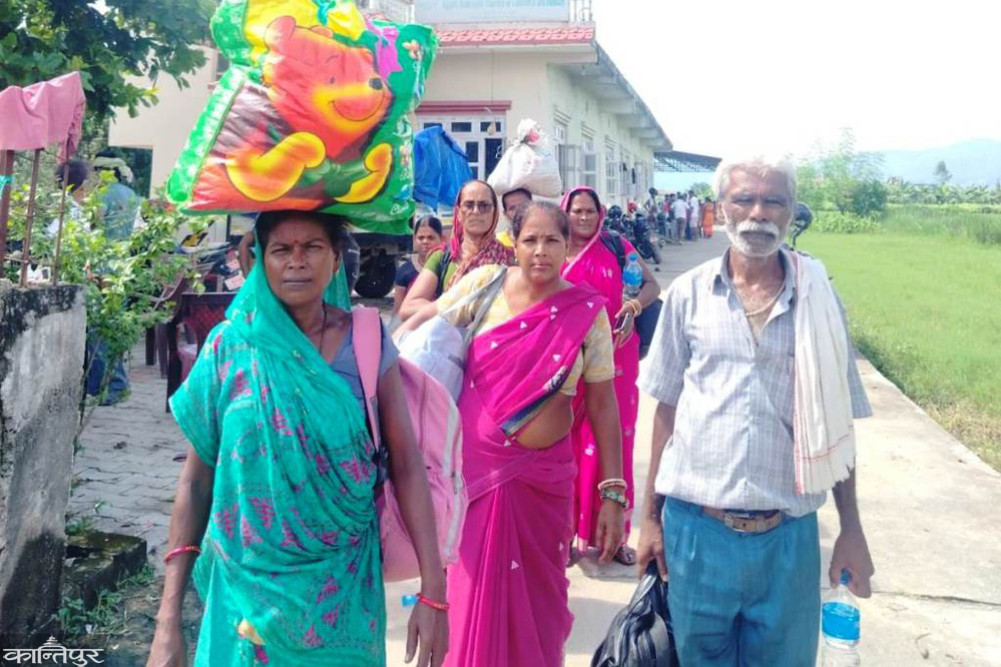
Meter interest victims have expressed relief at this government announcement, but they have emphasized that the announcement must be implemented effectively.
We use Google Cloud Translation Services. Google requires we provide the following disclaimer relating to use of this service:
This service may contain translations powered by Google. Google disclaims all warranties related to the translations, expressed or implied, including any warranties of accuracy, reliability, and any implied warranties of merchantability, fitness for a particular purpose, and noninfringement.
The Cabinet meeting on Wednesday approved the nine-point agreement reached with victims of unfair lending (meter interest) and declared as illegal all forged documents related to meter interest (such as fake promissory notes, checks, and mortgages). Victims who had become homeless or were embroiled in legal cases due to fake promissory notes have expressed relief at the government's announcement.
The Cabinet meeting stated that it had approved the agreement reached with the protesting parties in response to the demands of citizens affected by unfair lending (meter interest). Shivshankar Mahato, Bhojpura in-charge of the movement of victimized farmers and laborers against meter interest, said that the government's decision would raise awareness among those who, under the pretext of urgent need, provide money and then use promissory notes to evict people from their homes. "The government has started implementing the agreement reached with us," he said. "There are still many points that need to be implemented. We welcome the government's decision."
Mahato said that although the Cabinet has made a decision, it must be given concrete form by enacting a law. According to him, in Madhesh Province alone, more than one hundred thousand promissory notes are in the hands of moneylenders. He said that promissory notes have been made for up to four times the amount actually borrowed by the victims. Most have even registered their houses and land in the names of the moneylenders in addition to the promissory notes. Using these promissory notes, the moneylenders have combined the interest with the principal, showing an unpayable amount and rendering people homeless. Some victims, after arrest warrants were issued against them, began a "Justice March on Foot" from Tritiyagachhi in Janakpur, Dhanusha, on 25 Asar, seeking justice.
After the march, which was headed toward Kathmandu, reached Nijgadh in Bara, Home Minister Sudhan Gurung traveled from Kathmandu for talks. He arrived at the building of the Industry and Commerce Association in Nijgadh, where the victims were staying, on 30 Asar. Gurung held discussions with representatives of the victims for three days in Bara. During that time, it was agreed to hold decisive talks in Kathmandu. Subsequently, on 1 Shrawan, a meeting was held in the capital between leaders of the protesting meter interest victims and a government team led by Pushkar Sapkota, Secretary at the Office of the Prime Minister and Council of Ministers. It was in this meeting that the nine-point agreement was reached. Afterward, the victims ended their protest and returned home.
Most of the victims who participated in the march from Janakpur were marginalized, farmers, and members of impoverished communities. They complained that even for small loans, the moneylenders had evicted them from their homes. Those who had borrowed from moneylenders said they never hesitated to pay back the principal and reasonable interest. Following the government's decision on Wednesday, fake promissory notes made for double or triple the loan amount, signatures and stamps taken on blank checks, and forced registrations/mortgages will now be invalid.
Although signing the agreement and its approval by the Cabinet are significant achievements, the main issue now is its effective implementation, said Laxmi Ghimire, a leader of the movement against meter interest. "The government's decision is a matter of happiness," she said, "but whether it will be implemented or not is still the main issue. We are continuing our struggle."
Ghimire said that the long-term solution to this problem would be for the state to create an environment where the poor do not have to turn to moneylenders and can easily obtain loans from banks. Meter interest victims have suggested that the District Administration Office and police should work impartially, without being influenced by moneylenders. After spending nine nights on the streets, the meter interest victims who have returned home now hope to regain their lost property and dignity.
The government had pledged to take a proposal to the Cabinet to declare meter interest an economic crime and to enact special legislation for its control. The agreement reached in Kathmandu on 1 Shrawan states that the Ministry of Home Affairs will prepare a draft of a special act to control meter interest within three months. The proposed act will include provisions for establishing a separate tribunal to hear meter interest cases, returning property to victims, and ensuring appropriate compensation. The agreement also states that, for loan transactions certified through ward offices, proof of the legal source of funds and banking transactions will be mandatory. It was also agreed that those who invest money obtained through corruption or other criminal means in meter interest will face strict legal action.