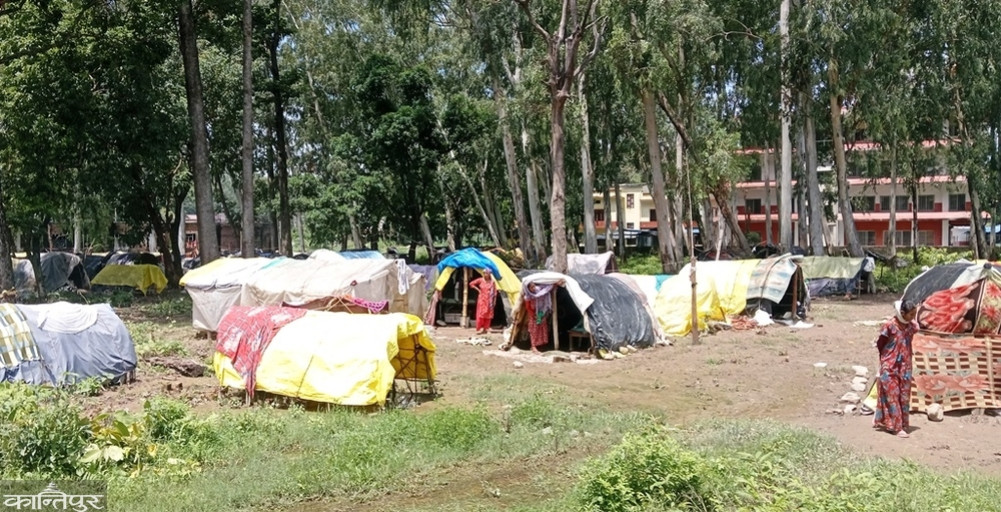
Hundreds of families displaced during the expansion of Shuklaphanta National Park are still living a miserable life in shacks, awaiting government rehabilitation.
We use Google Cloud Translation Services. Google requires we provide the following disclaimer relating to use of this service:
This service may contain translations powered by Google. Google disclaims all warranties related to the translations, expressed or implied, including any warranties of accuracy, reliability, and any implied warranties of merchantability, fitness for a particular purpose, and noninfringement.
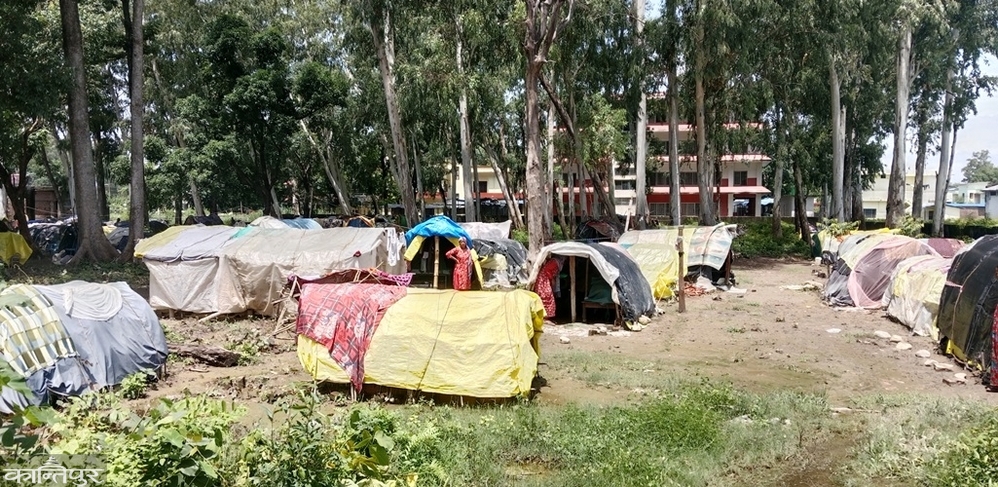
Huts have been built in various places on government land in front of the Division Forest Office, Mahendranagar. Inside those huts, beds are sometimes made on the ground, while in others, cots are placed. When it rains at night, all the clothes get soaked from both the sky and the ground.
Krishna Singh Bista, 56, who was displaced during the expansion of the then Shuklaphanta Wildlife Reserve (now a park), is living in a similar situation. He has been living in a hut here for about 6 months and is also participating in the movement demanding the rehabilitation of the displaced people from the reserve. But he still has no hope of rehabilitation. 'We have to live hungry and without food, we cannot burn firewood on rainy days,' "We have to sleep hungry," said Bista. "On the one hand, there is the fear of snakes in the hut, and on the other hand, water leaks and all our clothes get wet.''
Bista had one and a half bighas of land in Tarapur, Pipladi VDC-1. After being displaced in 2058 during the expansion of the reserve, he and his family have been living in various places. Now, he has settled his family in Daiji, Bedkot Municipality. He is wandering in the hope of rehabilitation.
"My father passed away in the hope of rehabilitation, I have also become old, now it is time for my sons to join in this," said Bista. "We have been displaced for three generations, but no matter how many governments come, they do not listen to our demands."
Duradevi Mahara, who was displaced from Tarapur, says that she is comfortable in her hut, whether it rains or shines. She said, ‘Sometimes snakes enter the hut, sometimes it fills with water, how can we live in such a situation?’ She has put plastic in the hut. But because of the holes in various places, water leaks. She says that if you cover your head, it leaks to your feet, and if you cover your feet, it leaks to your head.
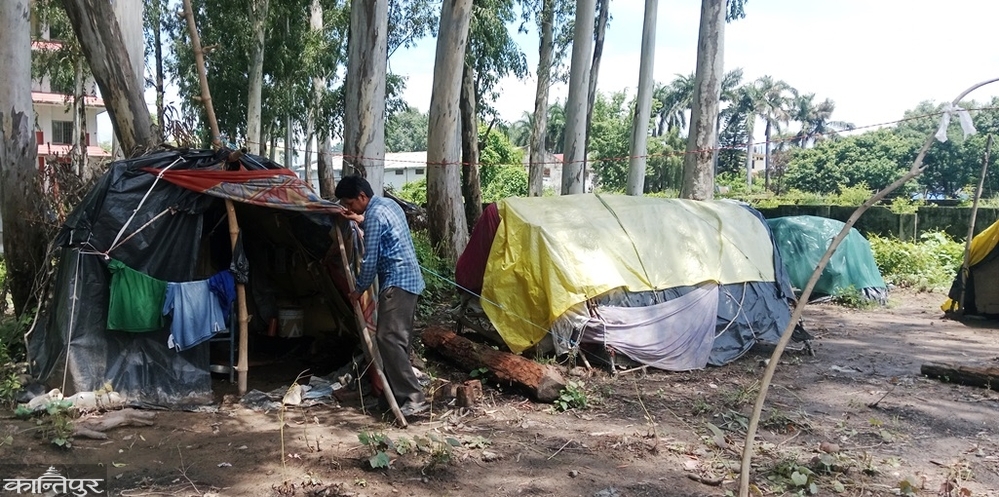
It has been more than 6 months since she started living in a hut on government land in front of the Division Forest Office. She works all day and earns money from it to make ends meet. But Mahara said that she has been unable to work due to the rain for the past few days, and now she has to go hungry. ‘Now we have to live hungry, there is no firewood, no ration,’ she said, ‘How can we live in this mud, how can we cook food, all our clothes are wet.’
Dilram Dagoura, who was displaced from Bhatpur and is now living in a hut in Mahendranagar, said that he has been demanding rehabilitation for twenty-five years. ‘But no one has listened to us, now there is no hope from the government,’ he said, ‘All his land has gone to the reserve, I have raised a family of nine by farming. But the government does not listen.’
Dagoura had 5 bighas of land in Bhatpur. He used to earn his living from that farming. Sometimes he also worked as a wage laborer. But now his family is living in a hut in Jhalari of Shuklaphanta Municipality, while he is living in a hut in Mahendranagar. ‘We are risking snakes and insects even in this rain, hoping that we will somehow manage,’ said Dagoura, ‘We have been living here for a long time, and now there is nothing to eat.’ He has been bringing flour and rice from the Jhalari to eat. Sometimes he has been working as a laborer in Mahendranagar to earn rations.
More than 300 families of displaced people have built huts on the land of the herbal office in front of the Division Forest Office. They have been living here since last Magh. ‘It was fine in winter, but now it is impossible to live here,’ said Hikmat Chaudhary, who was displaced from Hirapur in 2058 BS. ‘In this rain, there is no place to eat or live, who will see our suffering?’
The displaced people who sat on a sit-in in front of the District Administration Office in Magh last year for rehabilitation work have started living in this area by building huts. They are still here. Since there is a hostel and an old dilapidated government building nearby, some of the displaced people have been living in the same houses.
‘When it rains a lot, we all move into these houses, and when it rains a little, we stay in huts,’ said Bista. ‘How can we live if the huts are filled with water, at such a time, we all go into those old houses.’ According to him, even after starting to live in the area, everyone from the leaders of all political parties to the current MPs have reached out. Everyone has been assuring rehabilitation. ‘There is hope that the current government will do something, but now that hope is also diminishing,’ said Bista, ‘Nothing has happened regarding us, how can we believe it?’
The displaced people living here have been protesting from time to time to exert pressure. On Monday alone, they had taken out a rally in Mahendranagar Bazaar. The rally had reached and ended in front of the district administration. Even before that, various protest programs, from sit-ins, have been held at the district administration.
The expansion of the eastern area began after the then Royal Hunting Reserve was declared the Shuklaphanta Wildlife Reserve in 2033. By 2058, settlements were evacuated from the expanded areas of the park. The problem of displacement that began in 2033 has not yet been resolved.
The eastern area of the reserve, which had an area of 150 square kilometers, was expanded to 305 square kilometers. Shuklaphanta was upgraded from a reserve to a national park in 2073. Initially, the displaced people were resettled by providing land in various places, while those displaced in 2058 have not yet been resettled.
Various commissions and task forces have been formed since 2037 for the resettlement of the displaced. So far, 32 commissions have been formed. The commissions and committees, which are formed with a period of 3 months to a year, have not yet been able to identify the exact number of displaced people.
Although 32 commissions have been formed for resettlement, the actual number of displaced people has not been confirmed yet. Some have submitted reports that the number of displaced people is 2,473, while others have submitted reports that the number is lower.
The 32nd commission, recently formed under the coordination of former Court of Appeals Judge Jayanand Paneru, has shown that the number of families to be resettled is 2,027. Earlier, in 2071, the commission of former Court of Appeal judge Thakur Prasad Sharma had submitted a report stating that the number of displaced persons remaining to be rehabilitated was 1,480 and that they should be rehabilitated. The previous commission had fixed the number of displaced persons at 2,473.
The two subsequent commissions have taken the number determined by Sharma as the basis. The commission, coordinated by Surendra Bam, formed after Sharma, had recommended that 10 kattas of land or Rs 6 million be given to each family of the displaced persons determined by Sharma's commission.
The 32nd commission led by Paneru had submitted its report on 26 Poush 2081. The commission has suggested that 1 million rupees be given as relief to each family living in parks and forest areas and that they should be removed from the forest area immediately, 700,000 rupees to families living outside the forest area, and 500,000 rupees to families who have land titles but are not able to use the land.
Various commissions and task forces formed so far have distributed more than 4,042 bighas of land to 5,200 families in various places in the district. They have been rehabilitated by giving them land in Bagphanta of Bhimdatta Municipality-19, Pipraiya of Ward No. 13, Dhaka of Beldandi, Laxmipur of Rampur Vilasipur, Simalphanta of Shuklaphanta Municipality and Sundarpur of Bedkot.