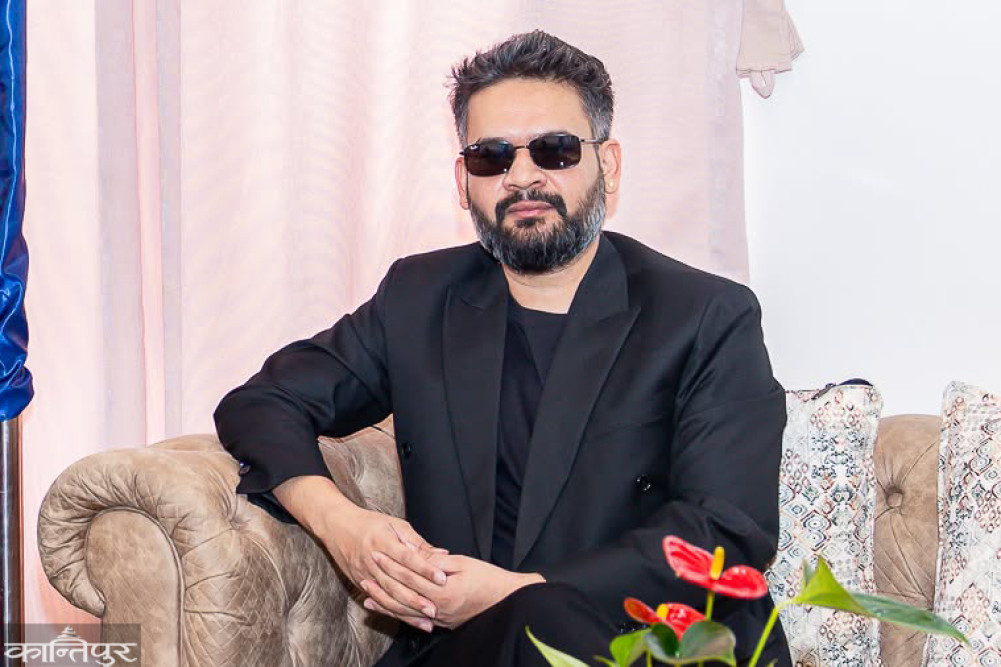
During a three-day visit to Nepal last month, Shah had a one-on-one meeting with Asian Development Bank President Masato Kanda.
We use Google Cloud Translation Services. Google requires we provide the following disclaimer relating to use of this service:
This service may contain translations powered by Google. Google disclaims all warranties related to the translations, expressed or implied, including any warranties of accuracy, reliability, and any implied warranties of merchantability, fitness for a particular purpose, and noninfringement.
Prime Minister Balendra Shah is scheduled to meet the Indian and Chinese ambassadors one-on-one this week. The Ministry of Foreign Affairs is coordinating the meeting.
PM Shah is scheduled to meet Indian Ambassador Naveen Srivastava and Chinese Ambassador Zhang Maoming on the same day to convey the message that both India and China are equally important to Nepal.
An aide to the PM said, "The Prime Minister has started meeting various stakeholders in the last two weeks. Now we have come to the conclusion that we should also communicate with foreign ambassadors and diplomats." He added, "Keeping in mind Nepal's foreign policy priorities, it is natural to start this meeting with the ambassadors of our two neighbors, India and China."
Earlier, after assuming office, PM Shah had been refusing to meet with foreign embassy officials one-on-one. Instead, he held joint meetings with ambassadors in Kathmandu on April 26 and June 12. Nepali diplomats and foreign affairs experts praised the transparent exercise.
The only exception was Asian Development Bank President Masato Kanda. Shah had met Kanda privately during a three-day visit to Nepal last month.
Meanwhile, in a change from his previous style of avoiding meetings with domestic stakeholders, Prime Minister Shah has started meeting regularly with the business community, including industrialists, traders, and construction entrepreneurs, in recent weeks.
Prime Minister Shah had also refused to meet senior US diplomats who had visited Nepal earlier. He had also declined requests from the US Embassy in Kathmandu to meet with US Assistant Secretary of State for South and Central Asian Affairs Samir Paul Kapur and US President's Special Envoy for South and Central Asia Sergio Gore.
Similarly, Sarah B. Rogers, the US Undersecretary of State for Public Diplomacy, did not have the opportunity to meet the Prime Minister during her visit. In the past, it was customary for newly elected Prime Ministers to meet with foreign ambassadors in person at the Prime Minister's Office or their official residence within a few days of assuming office.