A total of 357,023 cases were pending in courts across the country. Of these, 196,474 have been disposed of, while 160,549 cases are pending, according to the Supreme Court.
We use Google Cloud Translation Services. Google requires we provide the following disclaimer relating to use of this service:
This service may contain translations powered by Google. Google disclaims all warranties related to the translations, expressed or implied, including any warranties of accuracy, reliability, and any implied warranties of merchantability, fitness for a particular purpose, and noninfringement.
The courts across the country were the most affected by the Gen-G movement that took place on 23 and 24 Bhadra. The Supreme Court, High Courts and District Courts were affected, which has affected the administration of justice. In 2082/083, only 55 percent of the cases were finalised across the country.
A total of 357,023 cases were pending in courts across the country, of which 196,474 cases have been finalised, while 160,549 cases are pending, according to the Supreme Court.
The least number of cases were finalised in the Supreme Court. While 29.46 percent of the cases were decided in the Supreme Court, 70.36 percent of the cases were settled in the higher courts. Similarly, 55.61 percent of the cases were concluded in the district courts. In the last fiscal year, 65.69 percent of the cases were finalised, there was a decrease of about 10 percent in 2082/083.
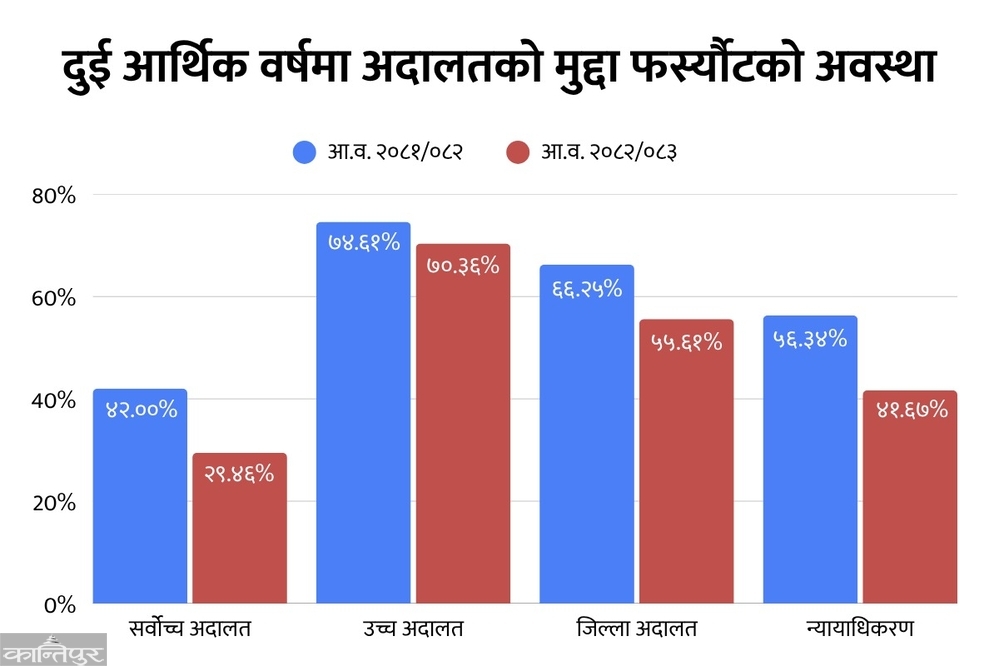 In 2081/082, 42 percent of cases were disposed of in the Supreme Court, 74.61 in the High Court and 66.25 percent in the District Court.
Similarly, 41.67 percent of cases were disposed of in the Tribunals. In 2081/082, 56.34 percent of cases were disposed of. Thus, the rate of disposal of cases has decreased in the Supreme Court, High Court, District Court and Special Courts and Tribunals.
The Gen-G movement caused a loss of about 84.5 billion rupees across the country. Out of this, the judiciary suffered the most damage. About 936 thousand files and documents were burnt to ashes during the movement.
Many missiles and courts were burnt in the Gen-G movement. Due to that, the hearings were almost halted. The damage to the servers also affected the hearings in all the courts across the country. - Arjun Koirala, Spokesperson, Supreme Court 23 courts across the country were affected due to the movement, where a loss of more than 2 billion rupees was incurred. The Supreme Court, Special Court, 7 High Courts and 14 District Courts were damaged. 10 courts were completely destroyed, 9 were partially damaged and 4 were moderately damaged.
Supreme Court Spokesperson Arjun Koirala said that the courts could not function effectively for about four months after the Gen-G movement, which affected the outcome of the case disposal. ‘Many missiles and courts were burnt in the Gen-G movement. Due to that, the hearings were almost halted. The damage to the servers also affected the hearings in all the courts across the country,’ he said, ‘This is why the court could not dispose of the cases as per the target set by the court.’
In the Patan High Court, however, the direct physical impact of the Gen-G movement was not seen. However, the hearings could not be held for about two months due to problems in the server operation. Acting Chief Justice Lal Bahadur Kunwar said that the work could not be completed fully due to the problems in the server.
Special Court Chairman Sudarshan Dev Bhatta also said that the special court could not finalize as many cases as expected because it was affected by the Gen-G movement. ‘Due to the movement of 23 and 24 Bhadra, its impact and the transfer of judges, the success as per the target could not be achieved,’ Bhatta said, ‘It took time to rehabilitate the court as the damaged building of the special court, information technology related equipment, servers and other essential equipment for the operation of the court were destroyed due to vandalism and arson.’
He said that the court could be rehabilitated within three to four months due to everyone’s cooperation and then a special campaign was launched as per the annual action plan to expedite the finalization of cases.
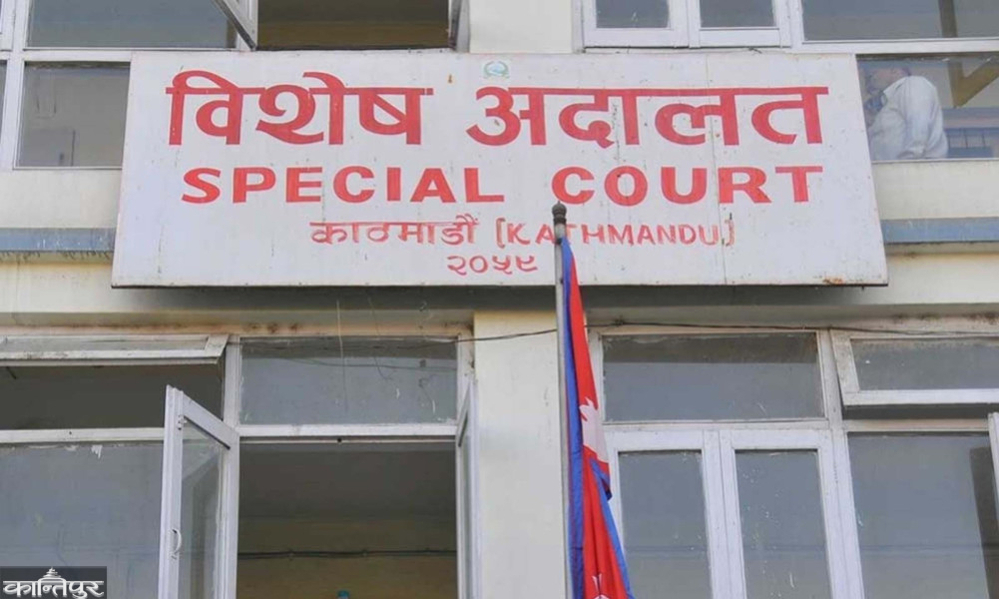
Out of 261 cases registered in the special court, 155 (59.38 percent) have been finalized. Now only 106 cases are yet to be finalized.
Judge who has decided the most
Judge Tek Narayan Kunwar became the one who made the most decisions in the High Court this fiscal year. While in the Special Court Kathmandu, he achieved success in e-court and digital transformation in case finalization, and he worked at the same pace even after reaching the High Court in Janakpur.
After Kunwar, Judges Tikaram Acharya, Jagat Bahadur Thapa, Somkant Mainali, Narishwar Bhandari, Jagdish Ghimire, Gokarna Dangi, Krishna Prasad Subedi, Rajuram Silwal and Kailash Prasad Subedi managed to make it to the top 10 in the High Court.
In the District Court, Judge Rajendra Singh Bhandari of the Kanchanpur District Court was the best. After Bhandari, Madhav Prasad Ghimire, Hari Prasad Sharma Upadhyay, Kapilmani Gautam, Bishnu Prasad Gautam, Roshan Gajurel, Manoj KC, Durga Bahadur Bhusal, Manoj Kumar Srivastava and Bhuvan Singh Thapa have been included in the list of best judges.

