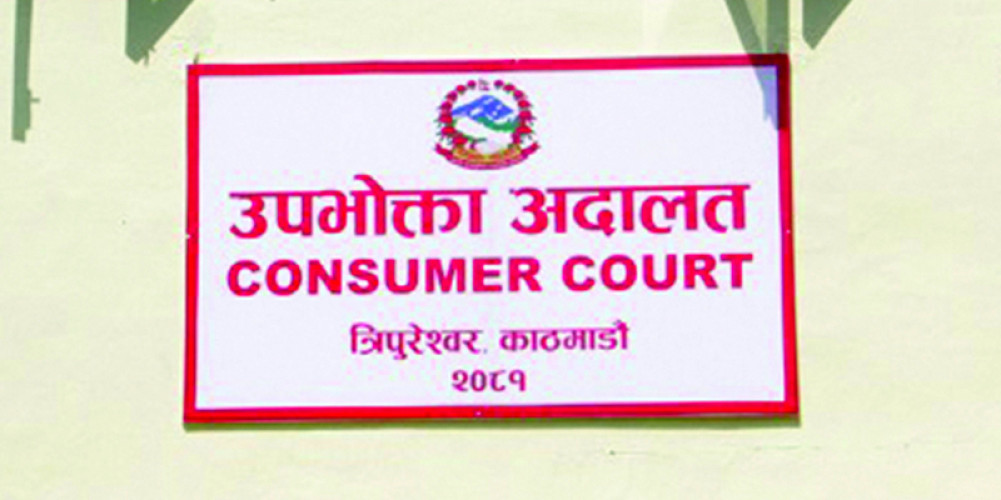
Verdicts in 23 out of 45 cases, compensation worth crores of rupees, Supreme Court's directive to expand courts in all seven provinces still not implemented
We use Google Cloud Translation Services. Google requires we provide the following disclaimer relating to use of this service:
This service may contain translations powered by Google. Google disclaims all warranties related to the translations, expressed or implied, including any warranties of accuracy, reliability, and any implied warranties of merchantability, fitness for a particular purpose, and noninfringement.
Preeti Thapa of Lalitpur filed a case in the Consumer Court on 10th Shrawan last year, alleging that the cabin crew of the plane poured hot coffee on her and behaved indecently during a transit flight from Doha to Kathmandu on Qatar Airways. The court decided her case and ordered a compensation of Rs 26.19 million on 7th Jestha.
Similarly, a compensation of Rs 11 million was awarded in the case filed by Rajina Manandhar, the wife of Sajil Shakya, who died after being electrocuted in the swimming pool of Hotel Square in Jhamsikhel, Lalitpur. Shakya died in Shrawan 2080. At the same time, Rajina had registered a case in the Lalilpur District Court. Later, Manandhar had filed a petition in the Patan High Court to transfer the case to the Consumer Court, which was accepted in Falgun this year.
These two decisions made by the Consumer Court are the most important so far. The court, which came into operation on 2 Chaitra 2080, has already resolved more than half of the cases registered in its first year. Of the 45 cases registered till the fiscal year 2082/2083, 23 have been decided and four have been resolved through out-of-court settlement.
The court stated that most of the cases registered in the last fiscal year were related to medical negligence, disputes related to the purchase and sale of goods and services, and complaints related to vehicles. According to the court's data, 12 cases were related to medical negligence and 12 were related to the purchase and sale of goods and services. Similarly, 11 cases were related to vehicles, 5 were related to internet services and repairs, 2 were related to tourism, and 1 each was related to house construction, banking, and air services.
Consumer rights activists have said that the Consumer Court, established as a special court, has played an effective role in providing speedy justice to consumers, but consumer rights activists have also said that government agencies have not been able to adequately utilize the Consumer Court against businesses that violate consumer protection laws.
General Secretary of Consumer Protection Forum-Nepal Bishnu Prasad Timilsina informed that the Consumer Court has made effective decisions on consumer protection in a short period of time and that consumers have received compensation of more than Rs 10 million so far. 'The possibility of being sued in the Consumer Court has also made traders aware before engaging in unfair business practices,' he said. 'Such cases should not be limited to fines alone, but should be registered in the Consumer Court, so that those who violate the law face strict legal action.'
He said that although the effectiveness of the court is increasing, the current situation is not sufficient. He said that currently the court only hears a limited number of consumer disputes and its jurisdiction is limited to the Kathmandu Valley, so that consumers from other parts of the country cannot easily get justice.
According to him, consumer cases that were pending in the district courts for years are now being resolved in the consumer courts within two to three months. He said that although this has helped in providing justice to consumers quickly, there is a need to expand the reach of the courts across the country.
On 8 Falgun 2078, the Supreme Court, while deciding on a writ petition filed by the Consumer Interest Protection Forum-Nepal, had directed the government to establish consumer courts in all seven provinces. But even after more than a year of the consumer courts being operational, no consumer court has been established in any province. The policy and program of the fiscal year under the leadership of the newly formed government includes a plan to establish consumer courts in all seven provinces.
Timilsina pointed out the need to expand consumer courts to the local level in the future for the speedy resolution of consumer disputes, control of consumer fraud, black marketing and other unfair business activities.
According to Timilsina, the Department of Commerce, Supplies and Consumer Protection and the Department of Food Technology and Quality Control have only imposed general administrative fines on businessmen who violate the rules during monitoring. He said, "If the monitoring team finds expired food products or products containing substances harmful to health, general fines alone are not enough. Such cases should be prosecuted in the consumer court."