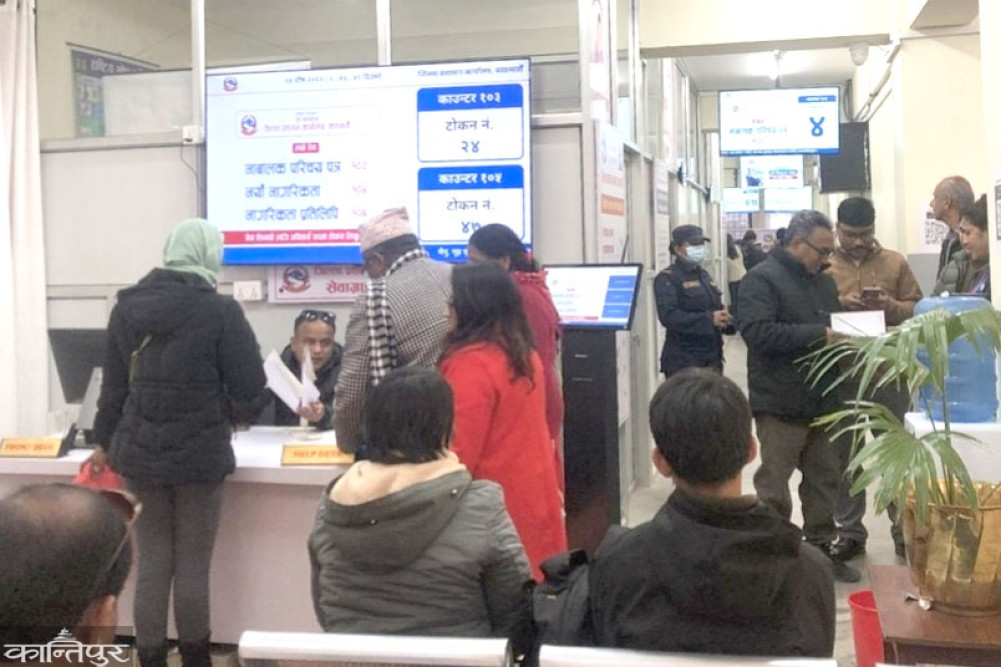
Digital systems have always faced problems in offices that are crowded with daily service recipients, such as the Department of Land Administration, Transport, and National Identity Card and Registration.
We use Google Cloud Translation Services. Google requires we provide the following disclaimer relating to use of this service:
This service may contain translations powered by Google. Google disclaims all warranties related to the translations, expressed or implied, including any warranties of accuracy, reliability, and any implied warranties of merchantability, fitness for a particular purpose, and noninfringement.
It was 9 am last Thursday. A long line of service recipients was visible in the premises of the Land Administration Office in Bhaktapur. Carrying their land deeds, citizenship and bank documents in their hands, the service recipients were waiting to see when their turn would come. Everyone was in a hurry to finish their work and return home. Even though the service recipients were in a hurry, the service provided by the office seemed slow. Time passed, but the work of the office did not progress.
When service recipients reached the office window and asked, 'Why is there no work?'
The only answer they got from the staff was, 'The system is not working.' The service recipients waited in the hope that the system would work. But there was no change in the system and the work would be done.
One of the service recipients who faced such a problem was advocate Sharmila Parajuli. She said that she has been visiting the Land Administration Office in Bagbazar, Kathmandu for four consecutive days to update the land records of her clients. She says that she was sometimes told that it was 'closing', sometimes 'crowded', sometimes 'no electricity' or 'the system is not working'.
'I went for four consecutive days but nothing was done, my time was wasted so much, now there is no decision on when the work will be done,' she expressed her surprise, 'How can the government create Digital Nepal in this style? Sometimes the internet is not working and sometimes the server is down, sometimes there is no electricity, in such a situation where it takes four days to do a single task, how can the office be called technology-friendly?'
Ramesh Parajuli (name changed) of Madhyapur Thimika had been visiting the office since Wednesday to buy two annas of land. He had returned the previous day when the system was not working and reached at 9 am on Thursday. When he arrived, the small number of service recipients was increasing, but the service did not start.
'I stayed until the office closed. There were people who came to get the service from all over the place, but the server did not work even after running for two hours,' he said. 'The staff sent me to come only on Monday because there is no work on Friday.' He claims that he saw work being done inside the office by showing a problem with the system.
Service recipients like him are suffering due to the lack of organized service flow in places where there is a crowd of service recipients.
A similar scene was seen in land revenue offices across the country when problems repeatedly arose in the digital system related to land administration at the end of the fiscal year. The Department of Land Management and Records issued a public notice last Thursday stating that there was a technical problem in the public access system (Public Access Module) that has been in operation since 31 Asad.
According to the department, the problem in the system was caused by a problem in the request form system used by accounting professionals and banks and financial institutions. Due to this, services such as land withholding, release, transfer of names, and passes were affected. Harisharan Thapa, the department's computer officer, said that the problem was not in the department's internal system but in the module used by service recipients. 'It is estimated that the problem has appeared due to excessive load at the end of the financial year,' he said, 'There is not just one problem in the system. If one problem is solved, another problem appears. The system is constantly being improved and monitored because problems continue to arise.'
The government has been putting forward the concept of 'Digital Nepal' for years. Services such as online forms, electronic records, digital maps, e-services, and electronic withholding systems have been started in offices. It is expected to increase transparency through online services, eliminate middlemen, and eliminate the need for service recipients to visit the office. However, in practice, when the system itself is disrupted, service recipients are facing more problems. In offices that have to do daily work such as the Land Revenue, Transport Management Department, National Identity Card and Registration Department, and local municipalities, there are repeated problems with the digital system.
Service recipients have had to suffer due to repeated problems in the system of national identity cards, personal incident registration and other registration services under the National Identity Card and Registration Department. Service recipients have been complaining about problems such as online forms not opening, OTP not coming, applications not being submitted, and the server not running when they reach the office.
Last Thursday, Tripti Guragain faced a similar problem. She, who has a permanent home in Morang, filled out the form for her 55-year-old mother's identity card. However, the OTP code did not come. She called the department several times to understand the problem, but it did not pick up. ‘They say online, but it is neither easy to fill out the form, nor do they respond, it is easier to carry the file,’ she said.
Nirajan Shrestha, Information Officer of the Registration Department, admitted that service recipients have not been able to get service on time due to increasing problems with the software in recent times. ‘The system sometimes works, sometimes it is slow, sometimes it does not work at all,’ he said. ‘Even after the system is built, it works well for some time and then gradually deteriorates.’
He said that the capacity of digital software was brought into operation targeting users and that problems have started appearing frequently due to the large number of service recipients in the software.
Due to the systemic problems seen at the Land Service Center in Kageshwori Manohara Municipality, service recipients have complained that they have to go to the service center repeatedly even for simple work. A few days ago, Nirmala Karki from Kandaghari released a video on TikTok expressing her dissatisfaction with the service delivery problems seen in the municipality. In the video, she said that it has been more than 48 hours since she went to the municipality to get a document, but there has been no work. She raised the question, saying, "Should we just sit there because the system is not working or should we also find a solution?"
Karki had gone to the municipality to get a recommendation for a housewarming party. She told Kantipur that she had to go for 4 days because the system was not working. She went on the first day and returned after the system was not working, and faced the same problem on the second and third days as well. "I got tired of having to go to the office repeatedly for the same work. The first day the system was not working, and on the second day too, I got tired of having to wait for hours with the same problem, so I made a video and posted it," she said. She said that the employees did not give a clear answer whether the system was working or not.
Purushottam Subedi, Chief Administrative Officer of Kageshwori Manohara Municipality, said that the problem arose due to the excessive pressure towards the end of the fiscal year. He said that the service recipients could not be provided with timely services due to system problems. ‘The system was not working properly, even when I tried to work in the office until 12 midnight, I could not work,’ he said. The municipality has been running the Local Consolidated Fund Management System (Sutra) and there have been problems with it, he said.
Chief Administrative Officer Subedi said that the local level cannot improve or correct the Sutra system as it is operated under the Office of the Comptroller General. ‘The reins of the system are with Malenika, those who come here to get services question the municipality, but nothing is in our hands,’ he said, ‘Until the government increases the server capacity, it will not be possible to work smoothly, and problems are being seen repeatedly.’