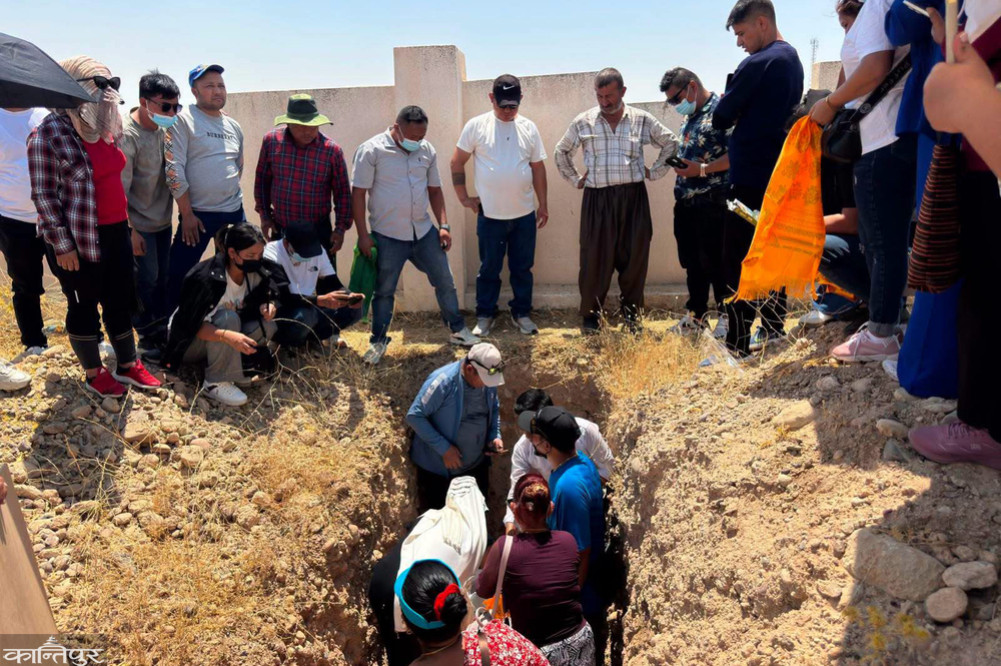
The Kurdistan administration has set aside burial grounds in the Erbil and Sulaimani regions to bury the bodies of Nepalis, and so far, seven Nepalis have been buried here.
We use Google Cloud Translation Services. Google requires we provide the following disclaimer relating to use of this service:
This service may contain translations powered by Google. Google disclaims all warranties related to the translations, expressed or implied, including any warranties of accuracy, reliability, and any implied warranties of merchantability, fitness for a particular purpose, and noninfringement.
Kharimaya Ghale received a video call from Erbil, the capital of the autonomous Kurdistan region of Iraq, at 2 pm last Friday, where she had to watch an unwanted scene.
Nepalis there had contacted her to show her the funeral of her only child, 38-year-old son Lekhman. The Kharimaya family watched the scene of the body being buried in a grave in Goyar, Erbil, from their home in Pachok, Dordi Rural Municipality-5, Lamjung. At that time, Kharimaya was accompanied by Lekhman's wife Ganga, two young sons and relatives.
Lekhman, who had reached Iraq two years ago, died on Chaitra 14 during treatment. Kharimaya wanted to bring her son's body home and bury it. But there was no one to bring her son's body from there. 'Anyone who says they can't do it says they can't. Our jobs will be over, we won't be able to come back to Iraq.' The mobile phone of the agent who sent the body to Iraq was switched off,' Kharimaya told Kantipur in disappointment, 'Finally, we had to keep it there.'
Those who were in contact with Kharimaya had told her that it would cost a lot of money to send the body from there to Nepal. 'I wanted to bring it home and say goodbye according to my own religion, but they started telling me that it would cost a lot of money to send it from there. My daughter-in-law and I could not visit ten places,' she said, 'Now the rest will be done according to our customs.'
Nepalis have lost their lives in Iraq due to accidents, fate or health problems. This was not the first incident where the body could not be sent to Nepal and was cremated in the same cemetery. There are other graves in Goyar where Lekhman's body was buried, where the bodies of other Nepalis have also been buried. Depending on the location in Iraq, it costs 500,000 to 900,000 rupees to send the body to Nepal. As the administrative process becomes more complicated for that, Goyar has become the funeral place for Nepalis there.
The body of 39-year-old Meena Kumari KC of Makawanpur was also buried near where Lekhman was cremated. Her children and relatives watched the farewell ceremony of Bagmati Rural Municipality-5 on video.
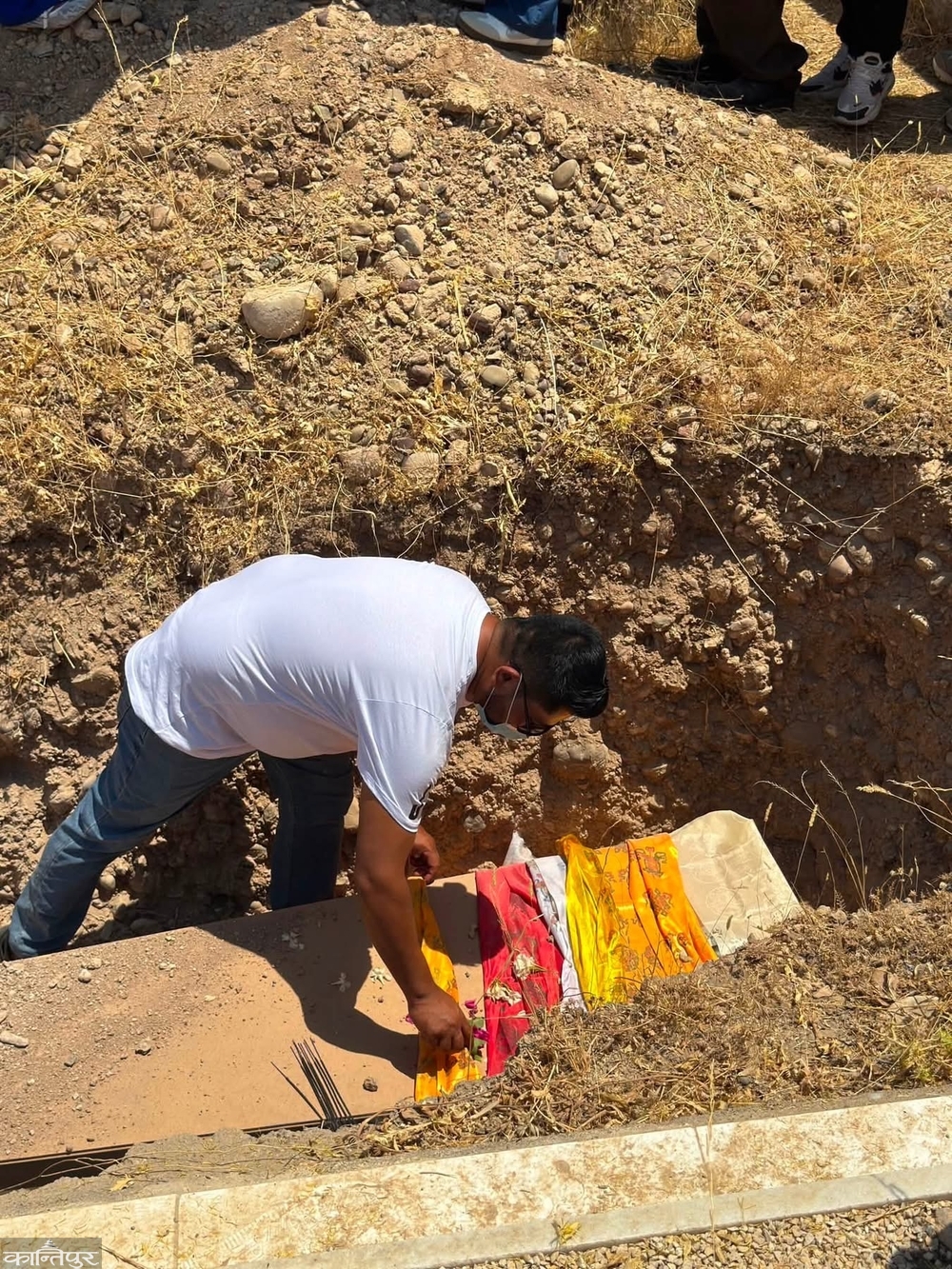
Meena, who had reached Iraq 7 years ago, was found dead in her own room on 24 Kartik 2082. The local police are investigating the matter. A Nepali has been arrested on suspicion of murder.
Like Kharimaya, Meena's family has also taken the initiative to bring her body back home. Three days after the incident, Bagmati Rural Municipality-5 Chairman Vijay Kumar Bhlon sent a letter to the Ministry of Foreign Affairs requesting that necessary steps be taken to bring back the body. ‘I request you to take the necessary diplomatic steps to bring KC’s body back to Nepal and hand over the body to the family of the deceased,’ Vlon wrote in a letter to the foreign ministry. ‘As the family of the deceased is financially weak, I request you to facilitate as much relief and compensation as possible.’
After failing to raise the necessary funds to bring the body, Meena’s body had to be buried in the Goyar cemetery. According to Binod Shrestha, president of the Non-Resident Nepali Association of Iraq, the Kurdistan administration has set aside burial grounds for Nepalis and Indians in the Erbil and Sulaimani regions. The body of Nikesh Gurung, 22, from Gorkha, who died on 17 Chaitra 2078, was cremated in Sulaimani.
Since it was not possible to send the bodies of Nepalis who died during the COVID-19 pandemic, the burial grounds were separated by building walls and fences. Shrestha said that the bodies that could not be sent to Nepal due to financial and administrative reasons are now being cremated here. According to him, the bodies of 7 Nepalis have been buried here so far. ‘To perform the last rites here, you have to pay a fee of 200 dollars and get permission from the local administration.’ We collect this fee from the Nepali community,’ he said, ‘In addition, there is a separate cost to plaster the grave and make a name plate.’
He said that the financial burden has also increased as the number of Nepalis dying in Iraq has increased recently. ‘If there are one or two people, the Nepali community can collect the money.’ When there are many, it becomes impossible,’ he said, ‘It costs about 3,200 dollars (about five hundred thousand rupees) to send one body.’ Where will the family of the deceased come up with such a sum?’
On Ashad 30, the body of 24-year-old Sanchamaya Lopchan of Sindhupalchowk, Jugal Rural Municipality-2 was cremated in Baghdad.
Like Lekhman and Meena Kumari, the family had rushed to bring Sanchamaya’s body to Nepal. Relatives of the deceased in Baghdad also coordinated with their employers on this issue several times. It is not yet clear whether Sanchamaya’s death was a murder or a suicide. The local police have informed the Nepali Embassy in Kuwait that an investigation is underway in this case.
Tika Bahadur Bishwakarma of the Non-Resident Nepali Association in Baghdad said that Sanchamaya’s body was said to have been cremated here after the family agreed to cremate it in Baghdad. ‘It costs $6,000 (922,000 rupees) to send the body from Baghdad to Nepal.’ Since the family could not raise the money, it was not decided who would bear the cost,' he said, 'The body becomes unrecognizable when kept in the morgue for a long time.' She was found dead in Asoj 2081 and was cremated 21 months later.
Bishwakarma said that sending the body from here to Nepal is very complicated. 'It is easy to rescue people here, but it is very difficult to send the body. It takes time for the letter from the family to reach Baghdad via Kathmandu, Kuwait. Only if you become a responsible employer, it will be easier,' he said.
The Foreign Employment Board does not bear the cost of sending the body if a Nepali dies without a work permit. ‘If the employer does not bear the cost of sending the body in the case of a work permit, the board will pay,’ an official at the Nepali Embassy in Kuwait told Kantipur. ‘We have been saying that the government should set up a separate fund at the embassy to look after Nepalis who are unemployed. After that, the burden will not fall on the families.’
The government itself has not made a separate budget arrangement to bring back the dead bodies. The Ministry of Youth, Labor and Employment has made an attempt to address Nepalis who have been abroad for a long time without obtaining a work permit through the draft bill to amend the Foreign Employment Act-2064. The draft states, ‘This fund will collect voluntary contributions from Nepali citizens who have gone abroad for employment without obtaining a work permit and for other purposes, contributions made by individuals, national and international organizations, and the amount provided by the government.’
Labor expert Ganesh Gurung says that the nature of the problems of Nepalis in Iraq is different. He says that Nepalis also used to reach Iraq via the Gulf countries during Saddam Hussein's rule. 'Due to the economic sanctions at that time, the demand for South Asian workers in international organizations, contractor companies and reconstruction projects in Iraq increased,' he said. 'During this period, Nepalis started reaching Iraq via India, Jordan and the Gulf countries. During this period, more than 30,000 Nepalis worked in the Baghdad area alone.'
On 16 Bhadra 2061, after an Iraqi rebel group killed 12 Nepalis, the Nepalese government banned them from going to Iraq, citing security reasons. But despite the ban, the illegal Nepali people have not stopped reaching Iraq. Thousands of Nepalis have not been able to return home for a decade because they are not allowed to return home.
The Iraqi market is now open for Nepali workers, but with the entry routes closed, workers are trapped in a vicious cycle of spending huge amounts of money on 'settings' and taking 'illegal routes' and not being able to return on leave. The Cabinet meeting on December 11 decided to open up work permits after pressure increased to document a large number of Nepalis. ‘Citizens who have received an official visa (residency card) will be granted work permits if they submit an application with the original and photocopy of the residency card when they come to Nepal,’ the decision states.
However, after the Ministry of Labor started issuing work permits only to workers working in companies, domestic workers working in Iraq have felt discriminated against. According to the department, 203 people, including 7 women, have received work permits after the Cabinet decision. Director General of the department, Meera Acharya, said that work permits have been issued to those working in establishments (companies) in Kurdistan. ‘We have not yet spoken clearly about domestic workers. We are discussing this with the ministry,’ she said. ‘Iraq is not in the directive made to issue work permits to domestic workers. It seems that it should be amended and Iraq should be added.'
The Finance and Commerce and Labor and Consumer Affairs Committee of the Parliament had issued a six-point directive in 2076 Magh to manage domestic workers. These include that destination countries should enact separate laws for domestic workers, labor agreements should be signed with those countries, a strong mechanism should be created to implement them, domestic workers should be provided with skills and language training in their home countries, and it should be ensured that there is no discrimination among workers.
The Non-Resident Nepali Association in Iraq has been demanding that all those working regularly be given work permits. 'We had demanded that all Nepalis who are in Iraq and working regularly should be given work permits. The decision of the Council of Ministers also clearly mentions granting work permits to those who have obtained residency cards,' said the Iraqi president of the association, Shrestha. 'The department itself has been discriminating against Nepali citizens.'
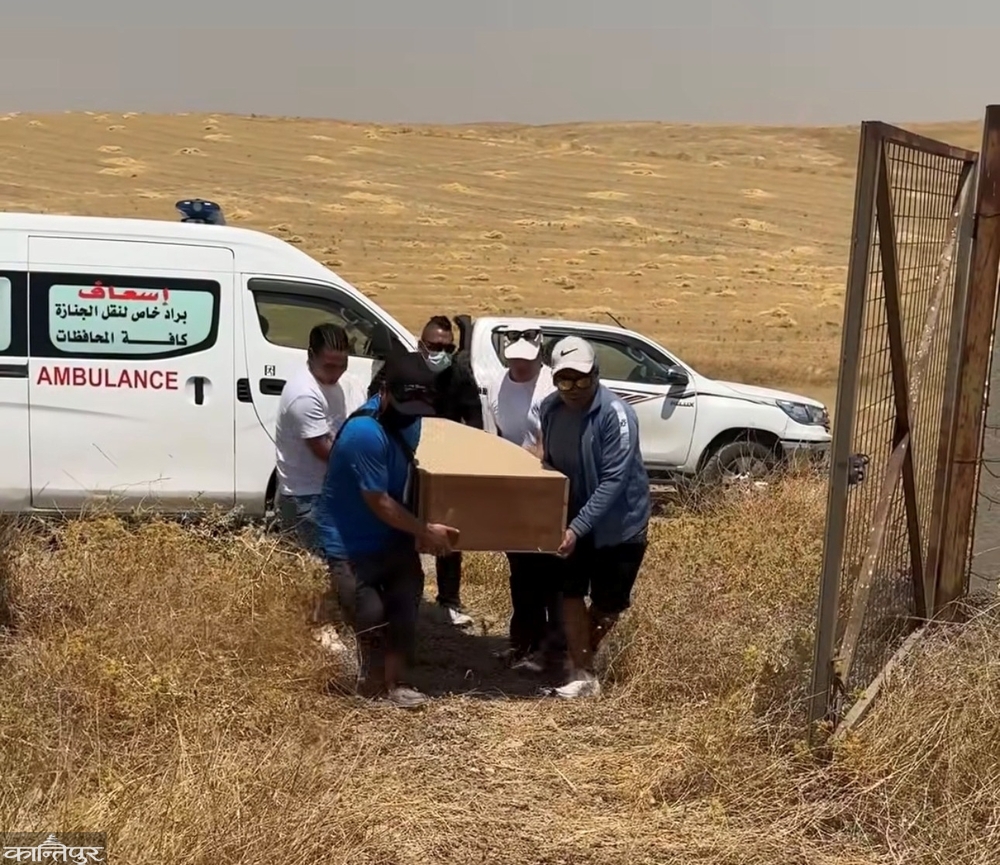
Mina Magar, 35, from Taplejung, who has been working in an Iraqi's house in Sulaymaniyah, Kurdistan, for 12 years, said that she was kept outside her legal status. 'If you return to Nepal on leave, you cannot come back to Iraq, you have to make arrangements. There is no guarantee of the arrangements either,' she said. 'On the other hand, if something happens to us, there is neither the state nor the family. Our lives are stranded abroad, which we are seeing.'
It is estimated that about 30,000 Nepalis are working in Iraq. There are about 25,000 in Kurdistan alone, and more than 4,000 in Baghdad and the surrounding areas, according to Nepalis there. They work in various sectors, from oil and gas, construction, hotel and restaurant, hospital, airport, marketing, domestic workers to multinational companies, with a monthly salary of $500 to $1,200 (roughly Rs. 200,000). More than 11 billion rupees in remittances enter Nepal from Iraq alone annually.