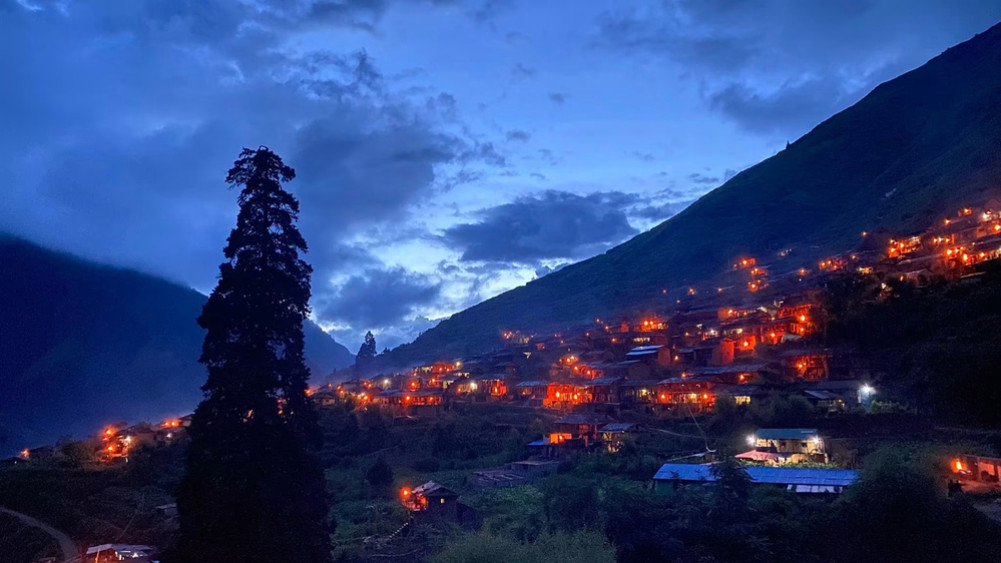
This custom is celebrated in rural areas of Rukum with the belief that it cures diseases in the body.
We use Google Cloud Translation Services. Google requires we provide the following disclaimer relating to use of this service:
This service may contain translations powered by Google. Google disclaims all warranties related to the translations, expressed or implied, including any warranties of accuracy, reliability, and any implied warranties of merchantability, fitness for a particular purpose, and noninfringement.
The custom of throwing firewood is observed on the occasion of Sawan Sankranti in various villages of Rukum East and West. This custom is observed in rural areas of Rukum with the belief that it will cure diseases in the body.
On this day, especially, a lamp (wood from a tree) is lit and its ashes are thrown. Dev Bahadur Khatri, 83, of Sisne Rural Municipality-3, Pokhara, Rukum East, said that in the past, this custom was observed to prevent the itchy disease 'luto' from spreading.
‘They throw firecrackers from house to house by placing okkhar, saro and chala leaves, kurillo and pete siundi etc. on kettuke leaves and lighting a match in the middle and shouting ‘Kaine-kuine, luto-puto, kaine-kuine laija hey, kaleraks...’, said Khatri. ‘It would be especially fun to celebrate the firecrackers after planting maize and rice in the aul and the cattle reached the lake.’
Since maize and rice can be planted by Asar, this festival is now celebrated mainly to prevent sores and scabies on the body, said 77-year-old Jang Bahadur Khadka of Sisne-2. ‘Earlier, after the lake rose from the aul (valley), the firecrackers were lit in rows in the barns on the hills.’ By doing this, it was also known where the shepherds had reached.' Khadka recalls the past, 'The previous day, the same lamp that was brought from the Salleri forest and placed in the middle of the forest was lit and the Rangko was thrown.'
Even now, according to Khatri from Pokhara, who celebrates the festival in the village by following these rituals.
Since Saune Sankranti is the first festival of the year, it is celebrated with priority. In the villages inhabited by the Magar community in the east of Rukum, this day is also considered special. The indigenous people of the villages including Maikot, Hukam, Taksera, Kankri, Lugum celebrate Saune Sankranti by throwing Rangko.
In Lagum, in the evening, near the main door of the house, various rain-fed crops such as maize, beans, potatoes and sagun are offered local alcohol, and the face is warmed by the heat of the fire. ‘There is a popular belief that if you do this, the body will lose its cold.’ Pun says, ‘In addition, on this day, a plant called Dhankilo is kept in the 4 corners of the house. It is celebrated by playing the cow’s horn.’
In Rukum East and West as well as in various districts of Karnali, the festival of Sankranti is celebrated in a grand manner.’ Although popular beliefs differ, the custom of burning fire and throwing firecrackers in every household is almost the same.