The full text of the Supreme Court's order dated December 20 on issues related to elephant welfare was released on Thursday.
We use Google Cloud Translation Services. Google requires we provide the following disclaimer relating to use of this service:
This service may contain translations powered by Google. Google disclaims all warranties related to the translations, expressed or implied, including any warranties of accuracy, reliability, and any implied warranties of merchantability, fitness for a particular purpose, and noninfringement.
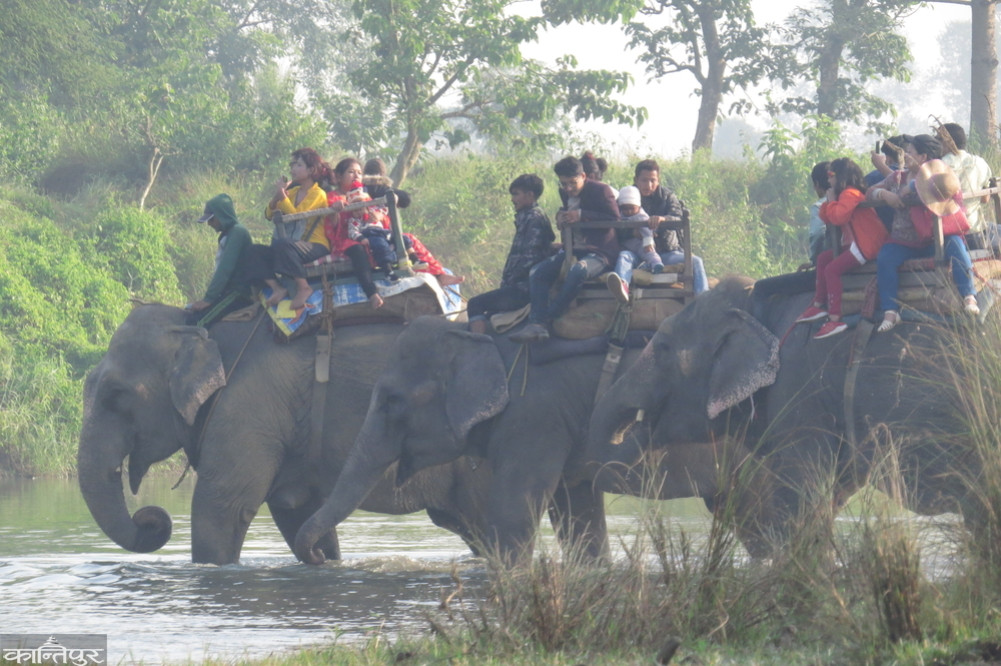
Elephant safaris are very popular among tourists. In recent years, although European tourists have shown interest in elephant safaris, Nepalis and other foreigners enjoy riding elephants in the forest. However, the Supreme Court has directed the government to find an alternative to elephant safaris. The full text of the Supreme Court's order on the issue related to elephant welfare on Poush 2 was released on Thursday.
On behalf of the Janhit Sankaran Manch, advocate Sanjay Adhikari and others had filed a writ petition on Bhadra 29, 2078 demanding that elephants should be protected, not tortured, purchases and sales should be recorded, illegal transportation should not be carried out, not kept in chains, and that arrangements should be made to stop elephant riding in tourism areas and only observe them. In which, Judge Hari Prasad Phuyal had ordered.
The court has directed the government to reconsider the traditional practice of elephant safaris, prioritizing the conservation and welfare of domesticated elephants, and to develop an ethical and environmentally friendly tourism system in line with international standards. The court has ordered that elephants should be treated as sensitive creatures rather than as tools for entertainment or commercial use.
The Supreme Court has also held that the practice of carrying tourists on elephants' backs during elephant safaris is also incompatible with the principles of modern animal welfare. The court said that elephants should not be subjected to heavy loads for long periods of time, be used for continuous work, and be deprived of rest, food, and social needs.
The order states that this will seriously affect the physical and mental health of elephants. The court has explained that elephants should be respected not only as a means of tourism, labor, or entertainment, but as sensitive wild animals with high intellectual capacity. The court also reminded that it is the legal and moral obligation of the state to ensure their natural behavior, social needs and dignified existence. The court said that the concept of 'elephant-friendly walks', 'bush walks' and 'observation-only', which is practiced abroad, should be gradually implemented in Nepal. The court has directed the government to make necessary legal and policy arrangements to gradually transform elephant safaris into an ethical and environmentally friendly tourism model in Nepal in accordance with international animal welfare standards.
In addition, the government has been ordered to protect wildlife migration routes and restore habitats for the protection of wild elephants. It has been emphasized that elephants should be provided with positive training, sufficient open space, natural diet, social contact and necessary veterinary services. It has ordered the establishment of retirement and rehabilitation centers for old and disabled elephants, the implementation of chain-free management, and arrangements to allow them to live freely in their natural environment.