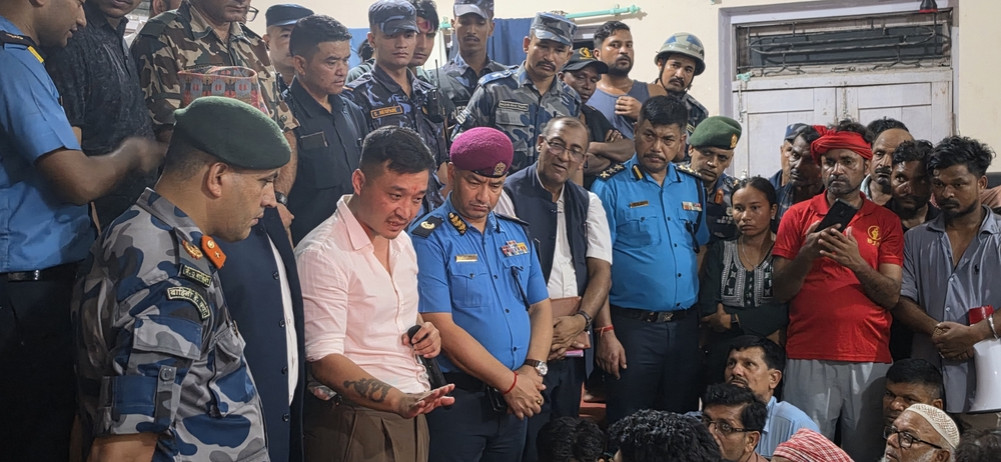
Home Minister Gurung, who entered the negotiation venue without any fanfare or lengthy security cordon, appeared like an ordinary citizen among the victims.
We use Google Cloud Translation Services. Google requires we provide the following disclaimer relating to use of this service:
This service may contain translations powered by Google. Google disclaims all warranties related to the translations, expressed or implied, including any warranties of accuracy, reliability, and any implied warranties of merchantability, fitness for a particular purpose, and noninfringement.
Nijgadh, Bara
The movement of meter-billing victims who are walking towards the federal capital Kathmandu in search of justice has now reached Nijgadh, Bara, and has taken a new turn. Home Minister Sudhan Gurung arrived from Kathmandu on Tuesday morning to meet the victims who have been resting at the Chamber of Commerce and Industry meeting hall in Nijgadh since Monday night. He himself reached the venue of the talks to directly hear the complaints of the poor, farmers and workers who are living under the fear of high interest rates, fake loans and evictions from moneylenders.
Home Minister Gurung, who entered the venue of the talks without any formal pomp or long security cordon, presented himself as an ordinary citizen among the victims. Sitting in a way that was convenient for the victims present in the hall, he listened to their pain, the abuses of moneylenders and legal complications one by one. He used to sit on the floor and listen to the victims. During the talks, he noted the victims' statements and details of the incident in his diary. While the victims were telling their problems, he would ask questions in between and try to get to the bottom of the incident. He was interested in how the moneylenders were inflating the amount by making fake Tamsuks, what kind of support was being provided by the local administration and where the weaknesses of the law were. He kept reminding the victims not to think like the old parties. During the dialogue, he would try to reassure them by saying, "I am here, I am with you."
Intensive talks were held in Nijgadh on Tuesday night until late. The atmosphere of the talks seemed serious at times, and at other times it became lighthearted due to the Home Minister's different style. He would try to make the victims laugh from time to time. During the talks, he adopted a different and somewhat informal style from the traditional government negotiation team.
The Home Minister was informed about the six-point demands on behalf of the victims. He called the Prime Minister and the Chief Secretary from the negotiation venue and informed them about it. He questioned the victims on each point. He also consulted with the higher levels over the phone from time to time. Although there were three rounds of talks on the first day, no conclusion could be reached. The fourth round of talks was scheduled for Wednesday at 12 noon and was considered decisive.
Meanwhile, his videos of meeting locals in Simara on Wednesday morning, inspecting contaminated water from industries, visiting temples in Parsa National Park, and swinging children on swings at some places went viral on social media.
He reached the talks venue again at 8 pm on Wednesday. Then the victims submitted a draft with 6 points of demand. The Home Minister studied each point of the draft and sent it to Chief Secretary Govinda Bahadur Karki. After some time, he left the talks venue and waited for a decision from the higher level.
At around 10:30 pm, he re-entered the talks venue and started speaking with a microphone. Initially, he requested that a negotiation team be formed on behalf of the victims to negotiate with the government and requested that they come with him. Claiming that this was the first time in the history of Nepal that a minister himself had come to the talks venue, he urged them not to impose the responsibility of the previous government on them.
‘It has been three months since the government was formed, your problems have been there since then,’ he said, ‘The government itself has come to your doorstep. Now the Prime Minister is above me. We do not take responsibility for the old government. When did the old government come to your pain? The Home Minister has come to say that you are in trouble.’
His main target was the old political parties. He made sharp comments saying that feudal remnants like meter badges have been encouraged due to the past governments and old political forces. He repeatedly reiterated that they are not old parties like the Congress, UML and Maoists.
He tried to make the victims who have been trapped in the exploitation of moneylenders and legal complications for years laugh through various anecdotes and jokes. Assuring that he would wipe the tears of the victims, he tried to relieve the protesters present at the talks, even for a few moments, from mental stress. A member participating in the talks said that he cleverly used the sentiment against the old parties to win the victims over to his side and distance them from the weaknesses of the past state machinery.
In the talks that lasted until late on Wednesday night, representatives of meter-badge victims reiterated their old demands. Their stance was that the fake Tamsuk should be canceled, legal action should be taken against meter-badge moneylenders to the fullest extent, the land grabbed by the moneylenders should be returned, and the false cases filed against the victims should be withdrawn. In the discussions that lasted until late at night, an attempt was made to find a consensus on resolving some technical and legal complications.
He remained in Simara on Thursday. Since afternoon, he had been working to coordinate the talks between the Prime Minister's Office and the meter-badge victims and prepare the points of the agreement on a long-term solution through a decision of the Council of Ministers. At 4 pm, he went to the Buddha Air counter at Simara Airport and bought tickets for the members of the negotiation committee and flew them to Kathmandu. Home Minister Gurung claimed that the government is fully committed to addressing the demands of the meter-badge victims and that the ministry will form a special task force to work for this.