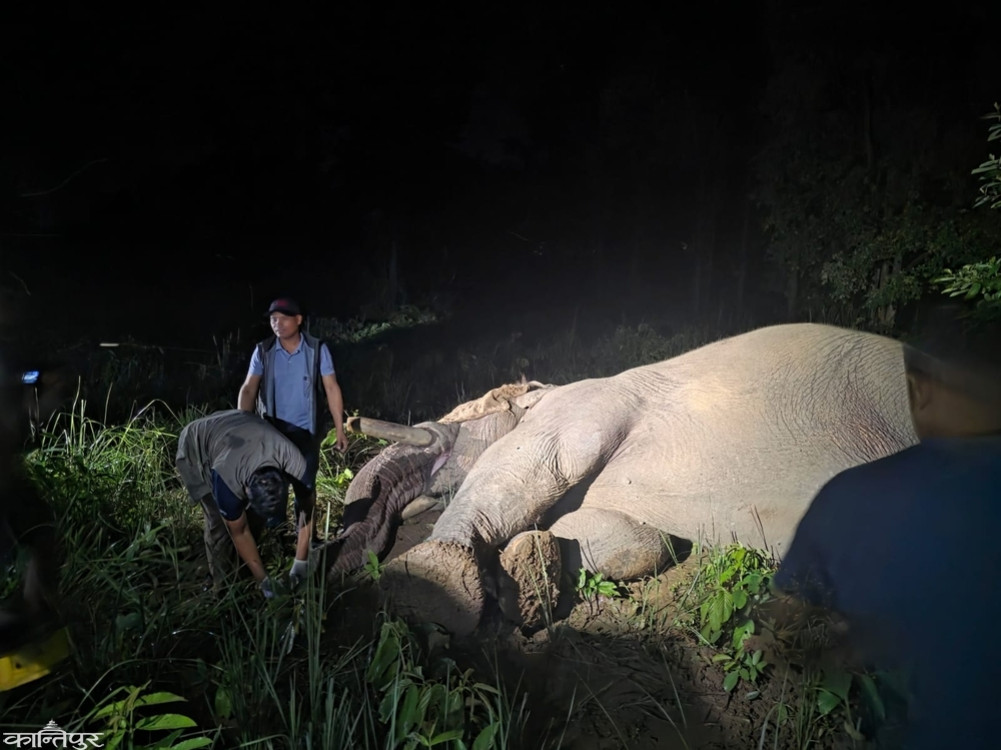
Conservation Officer Abinash Thapa Magar, who is also the park's information officer, said that after 'Dhurbe' was found near the Sukhibhar post in the western area of the park at 10:30 last night, a satellite technology-based collar was placed for monitoring by darting.
We use Google Cloud Translation Services. Google requires we provide the following disclaimer relating to use of this service:
This service may contain translations powered by Google. Google disclaims all warranties related to the translations, expressed or implied, including any warranties of accuracy, reliability, and any implied warranties of merchantability, fitness for a particular purpose, and noninfringement.
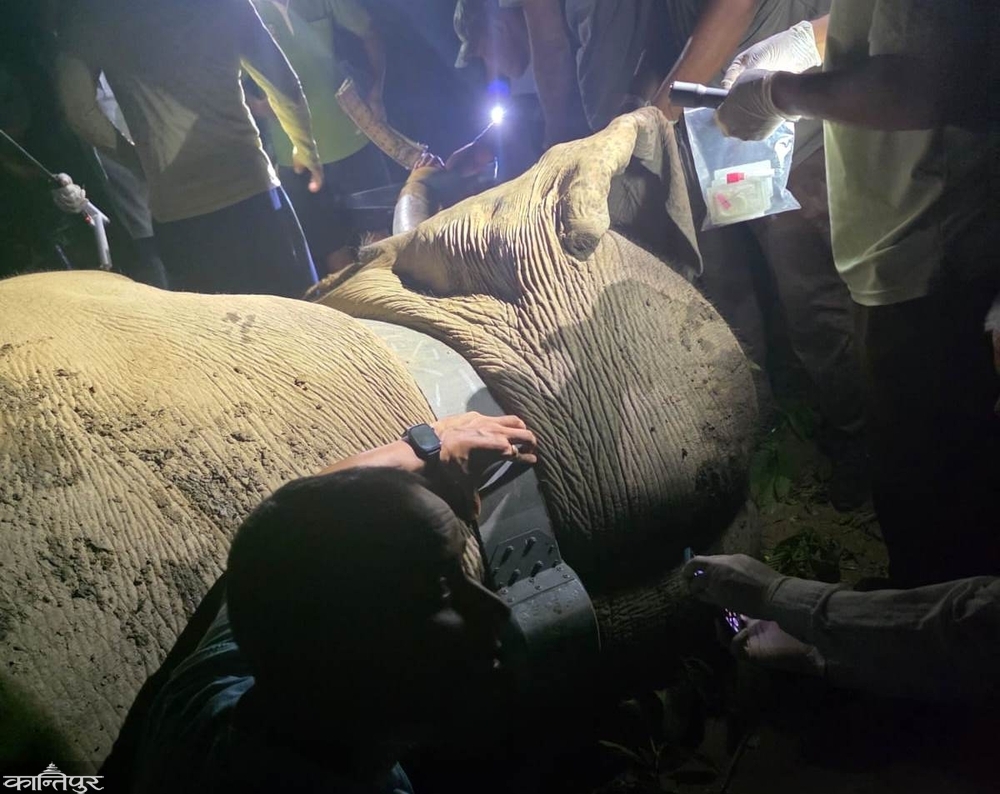
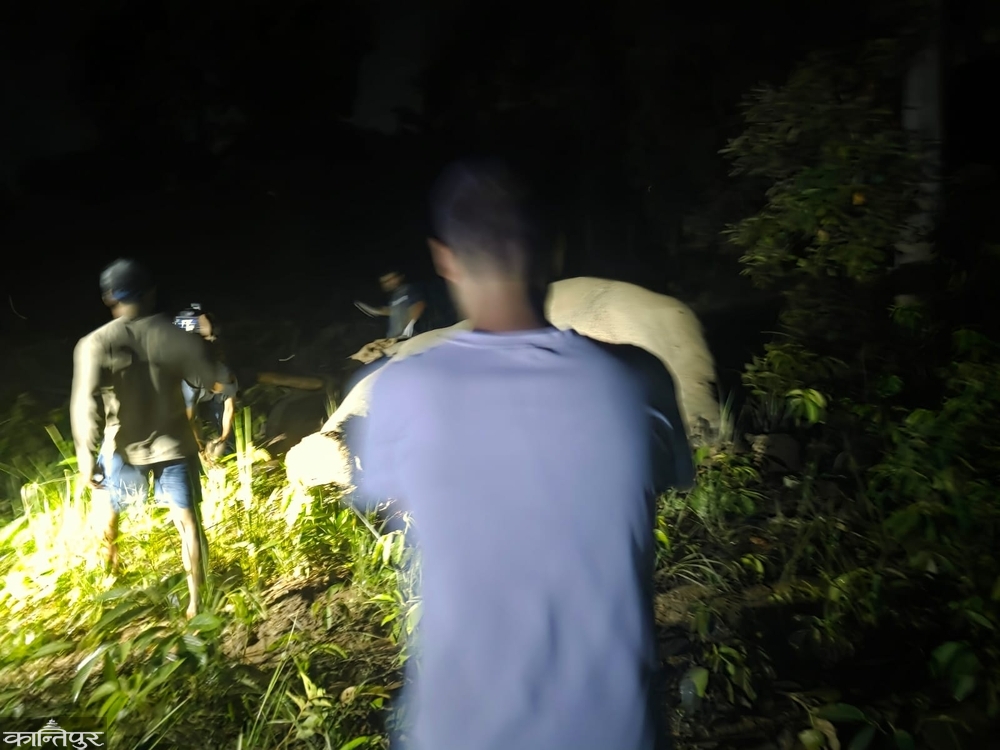
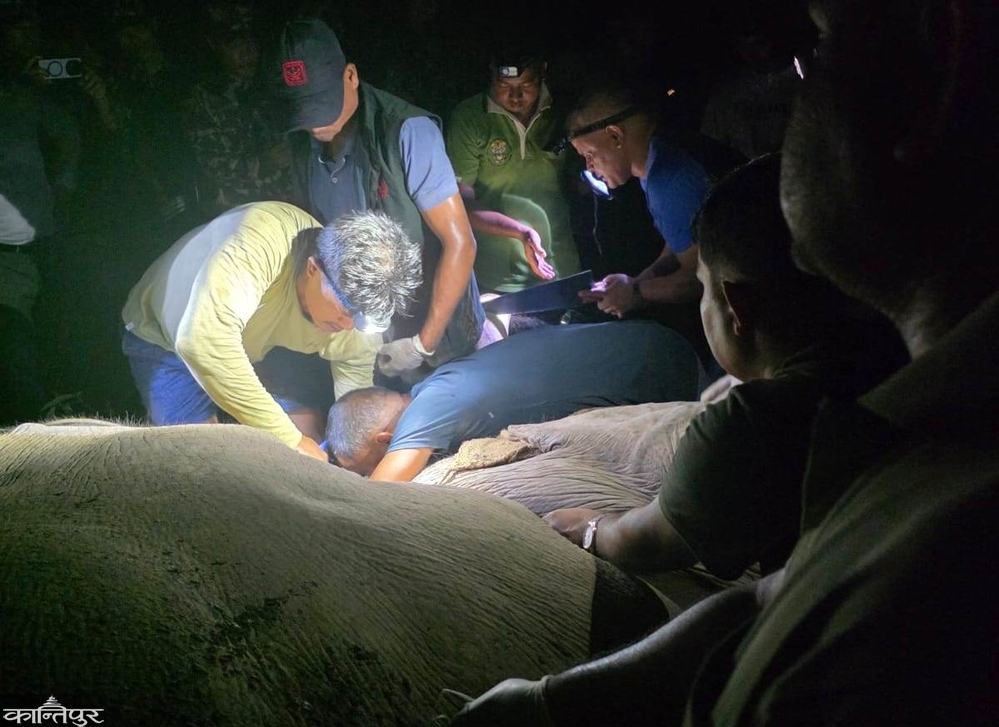
A team of the Chitwan National Park has found the wild male elephant 'Dhurbe', which was being sought after killing two people, on Wednesday night. Conservation Officer Abinash Thapa Magar, who is also the park's information officer, said that after 'Dhurbe' was found near the Sukhibhar post in the western area of the park at 10:30 last night, a collar based on satellite technology was put on it for monitoring.
After placing such a 'collar' on the elephant's neck, the park staff will be able to check the elephant's whereabouts on their computer or mobile phone from time to time. He said that if the elephant comes near the settlement, the park team will be mobilized immediately to return it to the forest. He informed that the elephant's tusks have also been cut off.
The elephant 'Dhurbe' had attacked 25-year-old Ashika Bote and her four-year-old son Bharat Bote of Jagatpur Belhattha, Bharatpur Metropolitan City-23, at midnight on Asad 20. Both of them died on the spot due to the attack. After the killing of two people, the pressure to control the elephant increased. Even though the team was mobilized immediately, it took 10 days to find the elephant.
‘The adverse weather of the rainy season, dense forest and overgrown bushes made it difficult.’ Along with the park team, the team of the new Gorkha Battalion deployed for park security was on regular patrol. Technicians from the National Trust for Nature Conservation Sauraha office were also constantly on duty,’ said Information Officer Thapa Magar. This is the fourth time that such a collar has been placed on the neck of ‘Dhurbe’.
‘Dhurbe’ has attacked and killed people not only in Chitwan National Park and its surroundings but also in the past, reaching as far as Bara Parsa. According to the details provided by the park, the first incident of this elephant killing a human was recorded in 2066 Mangsir. Since then, 25 people have died in attacks by the 'Dhurbe' elephant in incidents up to Asad 20, said Information Officer Avinash Thapa Magar.
From Kartik 2069 BS to mid-Mangsir 2069 BS, this elephant had killed four people in Chitwan Madi alone. After 'Dhurbe' killed 15 people from 2066 BS to mid-Mangsir 2069 BS, a radio collar was placed on the elephant's neck for the first time in Mangsir 2069 BS to monitor it and take it under control if necessary. The Chitwan administration had decided to kill the "Dhurbe" elephant at that time after it started killing people continuously.
After that, the elephant, which suddenly disappeared, was seen in Sukhibhar, the western area of the park, in the winter of 2073 BS. After that, the seemingly peaceful "Dhurbe" started to reach not only the western part of the park but also the eastern part and the northern part of the Barandabhar forest, a satellite-based collar was placed in Baisakh 2077. After that, the park administration also placed a satellite collar on the neck of "Dhurbe" in Mangsir 2080. This is the fourth time that the collar has been hung on the neck of "Dhurbe".
The collar that was placed last time was provided by Conservation Officer Avinay Pathak for PhD studies on the elephant. This collar can be used to obtain the location of the elephant even in 15-minute intervals. Earlier, it used to come at an interval of one hour.