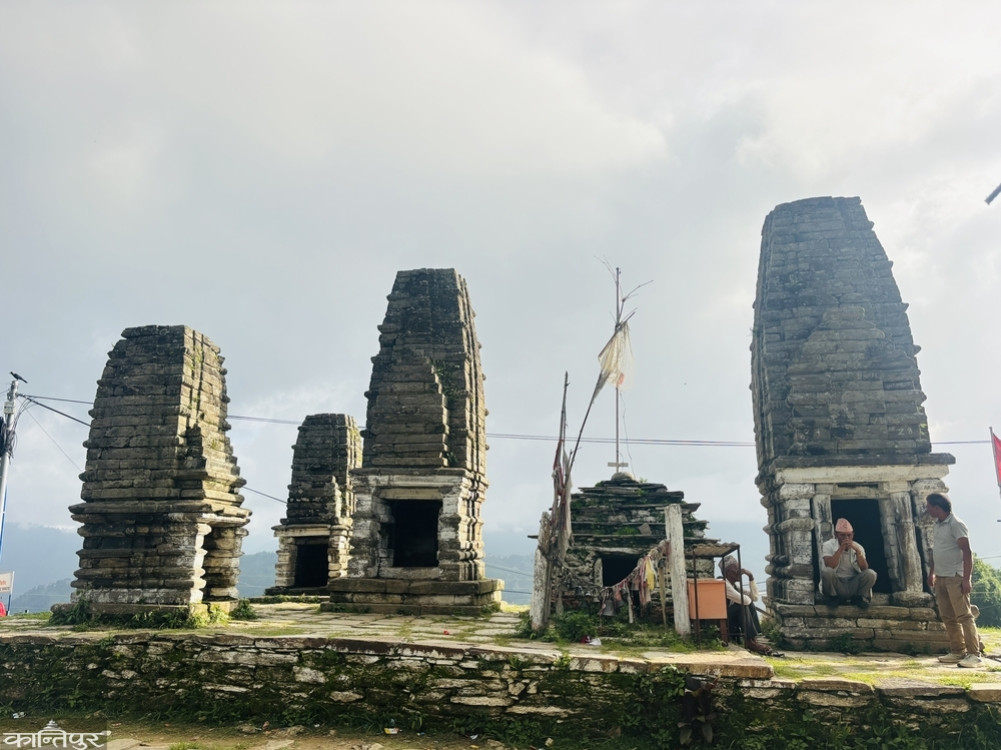
The Department of Archaeology, while classifying Nepal's historical monuments and heritage sites based on their historicity, artwork, and antiquity, has given high priority to Panchadeval, considering it to have high historical and archaeological value, like the historic palace areas of the Kathmandu Valley.
We use Google Cloud Translation Services. Google requires we provide the following disclaimer relating to use of this service:
This service may contain translations powered by Google. Google disclaims all warranties related to the translations, expressed or implied, including any warranties of accuracy, reliability, and any implied warranties of merchantability, fitness for a particular purpose, and noninfringement.
Panchadeval, a historical and archaeological heritage located in Achham's Panchadeval Binayak Municipality, is in the throes of conservation and administrative confusion. This area, which is considered an invaluable link for understanding the ancient architecture of Nepal and the development of the Nepali language, has a history of nearly 700 years and is awaiting proper management and conservation.
It is mentioned that the ancient inscription engraved on the front of the temple in the middle of the Panchadeval complex was written by the famous historian and yogi Naraharinath. As mentioned in the inscription, it is said that this temple was built in Shaka 1212, i.e. 1337 BS, by the then Malla King Akshay Malla with the aim of spreading the message of family and self-interest and social unity.
Ambika Chalaune, the head of Panchadeval Vinayak Municipality, says, 'The Department of Archaeology did not agree to rebuild a dilapidated temple, but instead we will cover the expenses from the municipality.' There is a history of the involvement of a famous artist named 'Jairaj Prasad' and a skilled sculptor named 'Nagdev' for its construction. Despite its long history, it is currently facing a crisis due to lack of coordination between the local level and the Department of Archaeology under the Union Government. Amid administrative and technical misunderstandings, this vibrant history of the Malla civilization is gradually becoming dilapidated.
'This year too, we had set a budget of 5 lakhs. We transferred the money after it was not possible to do the work,' Chalaune said, 'One of the five temples has already been destroyed. According to locals, it collapsed in the 1990 earthquake.' The Department of Archaeology refused to accept the idea of rebuilding a dilapidated temple, saying that the municipality would pay for it.’ She said that the locals believed that the municipality had done nothing to protect the Panchadeval, but they were unable to explain that it was not under the jurisdiction of the municipality.
‘The department is asking us to bring photos, drawings and sketches of what the old structure was like.’ We don’t have anything like that. We can’t do anything ourselves, the Department of Archaeology doesn’t do anything on its own,’ said the mayor.
Meanwhile, the Department of Archaeology under the Union Government has classified this historic Panchadeval in Achham as a ‘A’ category heritage. The department, while classifying Nepal’s historical monuments and heritage sites based on their historicity, artwork and antiquity, has given high priority to Panchadeval and considered it to have high historical and archaeological value, like the historical palace areas of the Kathmandu Valley.
Director General of the Department of Archaeology, Saubhagya Pradhananga argues that the Department of Archaeology cannot build another temple based on what was said verbally. Evidence is needed. Such a thing cannot be built by imagining. Director General of the Department of Archaeology, Saubhagya Pradhananga, said that she understood the condition, importance and sensitivity of this area by conducting on-site monitoring herself. She said that Panchadeval is the jewel of the Far West and it is still in its original form. ‘It is not about making it better by mixing cement and enamel. What is there now is about preserving it. It is better to preserve the old structure than to make it look shabby by putting up a new structure,' said Director General Pradhananga. 'If the municipality sends a cost estimate and drawing design, we will agree to work and send our technicians.'
She said that the Department of Archaeology cannot build another temple in the same place based on what was said verbally. 'One of the five temples is not visible, we can only build it if we have a photo or sketch of what the old structure was like,' said Director General Pradhananga. 'Evidence is needed. You cannot build something like this by imagining it. There is private land around it and there is no place to build gardens.'
Stakeholders say that these conflicting statements and claims of the local government and the Department of Archaeology have only increased procedural complexity rather than increasing the life of historical heritage. On the one hand, the municipality is complaining that it has not been able to do the work even though it has a budget, while on the other hand, locals say that the department is in crisis due to concerns that archaeological originality will be destroyed by working without evidence and technical designs.