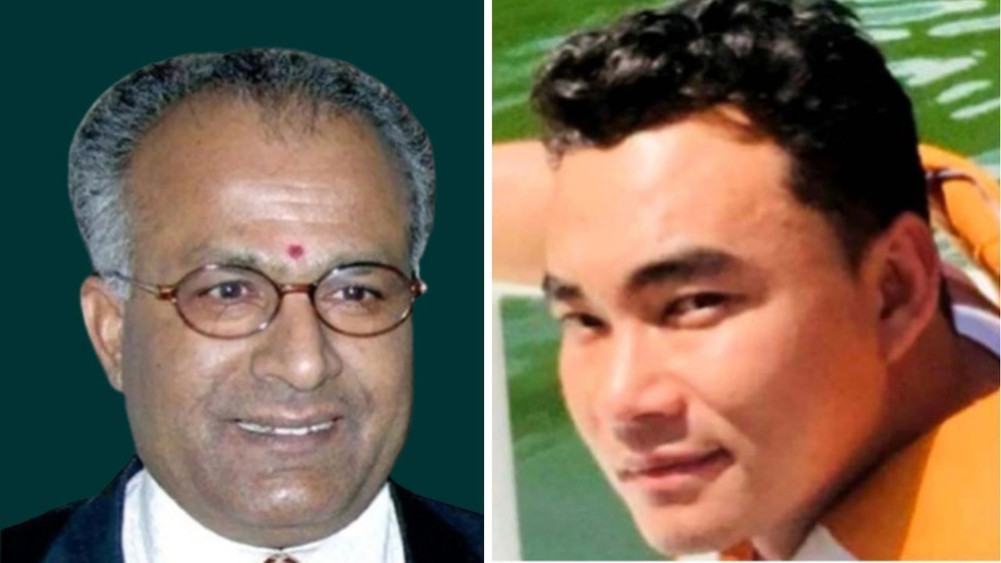
Prateek Thapa was acquitted by the court and released, while Bechan Jha was released after completing his prison term.
We use Google Cloud Translation Services. Google requires we provide the following disclaimer relating to use of this service:
This service may contain translations powered by Google. Google disclaims all warranties related to the translations, expressed or implied, including any warranties of accuracy, reliability, and any implied warranties of merchantability, fitness for a particular purpose, and noninfringement.
Bechan Jha and Prateek Thapa, who were arrested in the case of trying to send a Nepali youth to the US by pretending to be Bhutanese refugees, have been released from prison.
Jha was released after completing the prescribed prison term, while Thapa was released after being acquitted by the court. According to Krishna Chapagain, jailer of the Central Prison, Sundhara, Jha was released on Thursday based on a letter from the District Court, Kathmandu, while Thapa was released a week ago.
The court had sentenced Jha to one year in prison and a fine of Rs 10,000. But he has already spent almost 2 years in prison.
The court had acquitted Thapa on the ground that the charges against him were not sufficient. He is also the son of former Home Minister Ram Bahadur Thapa Badal. He was arrested from Kathmandu on 14 Asad 2081.
Police arrested Jha from the Nepal-India border area of Kanchanpur and brought him to Kathmandu, and after investigating, a supplementary case was filed against him on 29 Shrawan 2081.
Refugees who had been displaced from Bhutan and entered Nepal had settled in Jhapa and Morang in the 1990s. The Bhutanese refugees living in the camps were sent to countries including the US, Australia, Germany, New Zealand, Finland, and Canada under the third-country resettlement program.
The government had formed a study task force to manage the approximately 6,500 refugees remaining in Nepal without going to third-country resettlement. The gang had forged the report prepared by it and tried to turn Nepali youth into fake Bhutanese refugees.