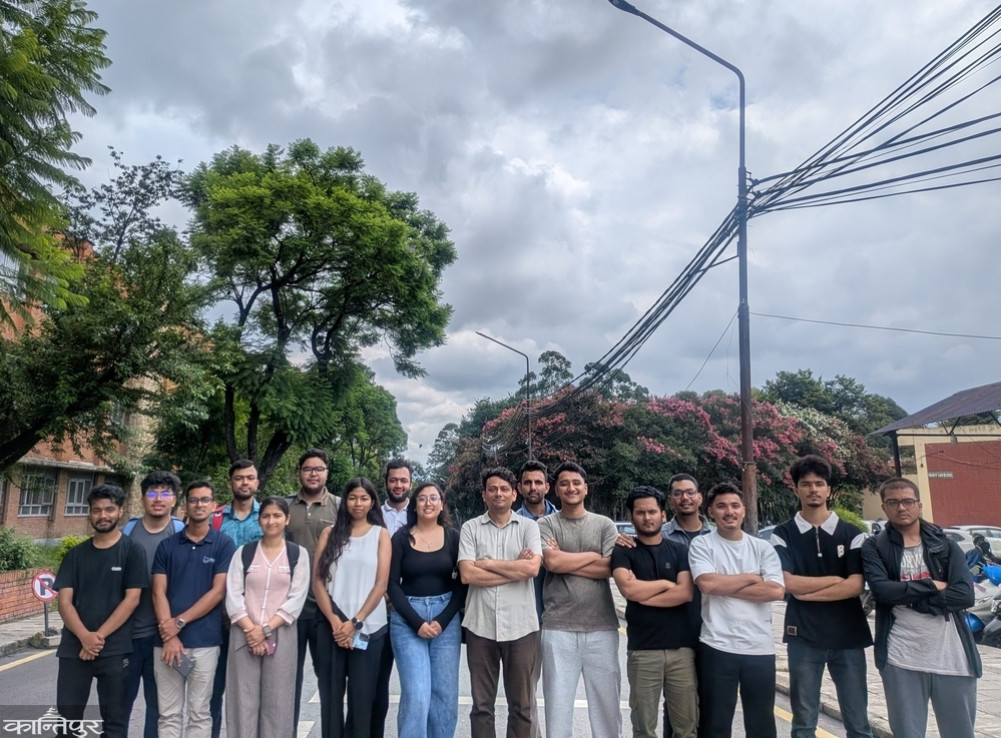
According to Dr. Sudeep Bhattarai, Principal Associate Professor of the Department of Mechanical and Aerospace Engineering, this year's selected students are currently participating in initial orientation and training in Bengaluru.
We use Google Cloud Translation Services. Google requires we provide the following disclaimer relating to use of this service:
This service may contain translations powered by Google. Google disclaims all warranties related to the translations, expressed or implied, including any warranties of accuracy, reliability, and any implied warranties of merchantability, fitness for a particular purpose, and noninfringement.
Twenty-one students from the Pulchowk Campus, the Institute of Engineering Studies under Tribhuvan University, have been selected to start their international careers at the center in Bengaluru, India.
According to Dr. Sudip Bhattarai, Principal Associate Professor of the Department of Mechanical and Aerospace Engineering, this year's selected students are currently participating in initial orientation and training in Bengaluru. Since Bengaluru is the entry point for new engineers from the Asian region at Airbus, Nepali students also start their careers from there after being selected.
'This year, 21 students have been selected. They have already reached Bengaluru and started working,' he told Kantipur on Tuesday, 'Even before this, students from our program have been regularly going to Airbus.'
According to him, Pulchowk Campus had started the Bachelor in Aerospace Engineering program for the first time in Nepal in 2018. Although the first batch of studies were delayed due to the COVID-19 pandemic, the first group graduated in 2023. Since then, Airbus has been recruiting Nepali aerospace engineers on a regular basis.
The first batch of graduates joined Airbus in 2024. At that time, 6 students were selected. Then, 17 more joined Airbus in 2025. With 21 students selected this year, about 44 Nepali students have joined Airbus in three years.
According to Bhattarai, initially, Airbus used to select students in direct coordination with the department. Now, the process is becoming more systematic and institutionalized.
Airbus trains the selected students in Bengaluru in the initial phase. He said that the company will arrange for travel, accommodation and initial management. After that, they can work in various projects and countries as per the needs of the company.
The department says that the attraction of students towards the aerospace engineering program is also increasing. Under the program, which enrolls 48 students every year, 12 get the opportunity to study on full scholarships while 36 study by paying fees. Currently, about 250 students are studying in this program. Since two batches had to be conducted in the same year due to Covid, now five batches are studying together.
Although students have started reaching international companies, the lack of skilled teachers in the department is still a challenge, Bhattarai said. Although there are four permanent positions in the department, only one permanent teacher is currently working. Other teachers are working on contracts, while current and retired experts from Nepal Airlines Corporation, Buddha Air, Himalaya Airlines and the Civil Aviation Authority of Nepal are teaching part-time.
'International companies have started accepting the potential of students,' he said, 'but to continue it in the long term, additional investment in manpower, research and infrastructure is required.'
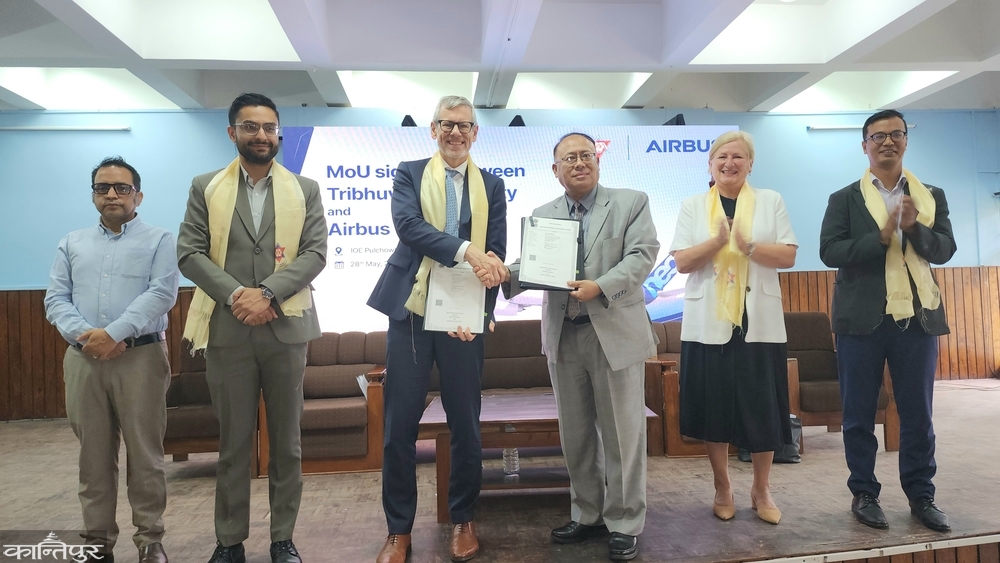
Meanwhile, on 28th Jestha, Airbus and Tribhuvan University signed a Memorandum of Understanding (MoU) for long-term cooperation for aerospace manpower development in Nepal. Airbus South Asia President and Managing Director Jurgen Westermeier and the then Vice Chancellor of Tribhuvan University Prof. Dr. The MoU, signed by Sushil Bahadur Bajracharya, has laid the foundation for collaboration in the areas of aerospace and aviation education curriculum development, research, training, digital technology, artificial intelligence (AI), machine learning, cybersecurity, industry-university collaboration, internships and student placement.
According to Bhattarai, although Airbus had already started recruiting Nepali students, the MoU has institutionalized it. 'Earlier, there was coordination at the individual level,' he said, 'Now, with the formal collaboration between the university and Airbus, it has become the basis for moving forward in the long term, including curriculum, capacity development, joint training and collaboration with the industry.'