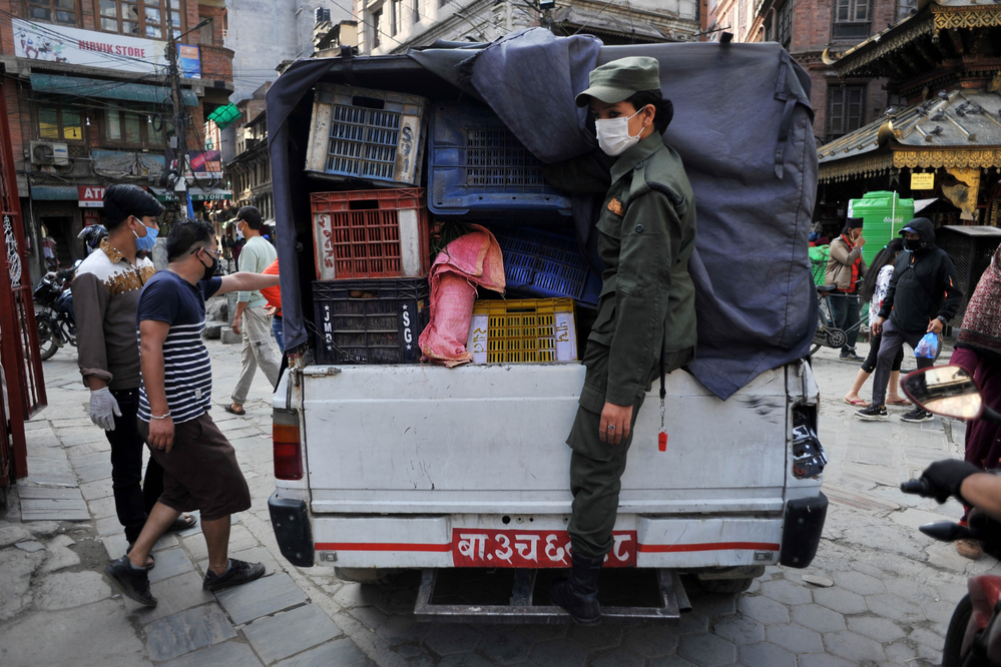
The law does not give the municipal police the authority to use force, they are only supposed to facilitate work within the city, but many incidents, including Ganesh Nepali's self-immolation, show that the municipal police are exercising power similar to that of the Nepal Police beyond their jurisdiction.
We use Google Cloud Translation Services. Google requires we provide the following disclaimer relating to use of this service:
This service may contain translations powered by Google. Google disclaims all warranties related to the translations, expressed or implied, including any warranties of accuracy, reliability, and any implied warranties of merchantability, fitness for a particular purpose, and noninfringement.
The death of Ganesh Nepali, who set himself on fire in front of the Passport Department in Tripureshwor, has once again brought to the fore the debate over the behavior and jurisdiction of the municipal police operating at the local level. While the question of whether the municipal police have the authority to apply a 'wheel lock' while the driver is sitting on a motorcycle is being raised, it seems that they have been practicing riot control and taking people under control like the Nepal Police, going beyond their jurisdiction.
After a 'wheel lock' was applied to Ganesh's motorcycle, 25, who was waiting for a ride on Thursday afternoon, he poured petrol on his body and set it on fire, and died on Friday less than 24 hours later. This is not the first time that the municipal police have used force beyond the limits prescribed by law and in an aggressive manner.
The municipal police have come into the spotlight since the current Prime Minister Balendra Shah was elected mayor of Kathmandu Metropolitan City on 12 Jestha 2079 as an independent candidate. This was seen to a head when he chased away road and sidewalk businessmen.
The municipal police had beaten up street businessman Badri Devkota in the third week of Falgun 2080. He was beaten up and taken to the Teku Municipal Police Office on charges of doing business on the street. Earlier, 10 municipal police officers were injured in a clash between sidewalk traders and the municipal police.
Nowhere in the law does the municipal police have the authority to lathi-charge or arrest. ‘Even if there is a problem with road management, it should be referred to the traffic police, but the municipal police have been lashing out at businessmen and seizing their belongings, which is wrong,’ says senior advocate Raju Chapagain. ‘The responsibility of the municipal police is to facilitate the work of the metropolis and to provide understanding.’
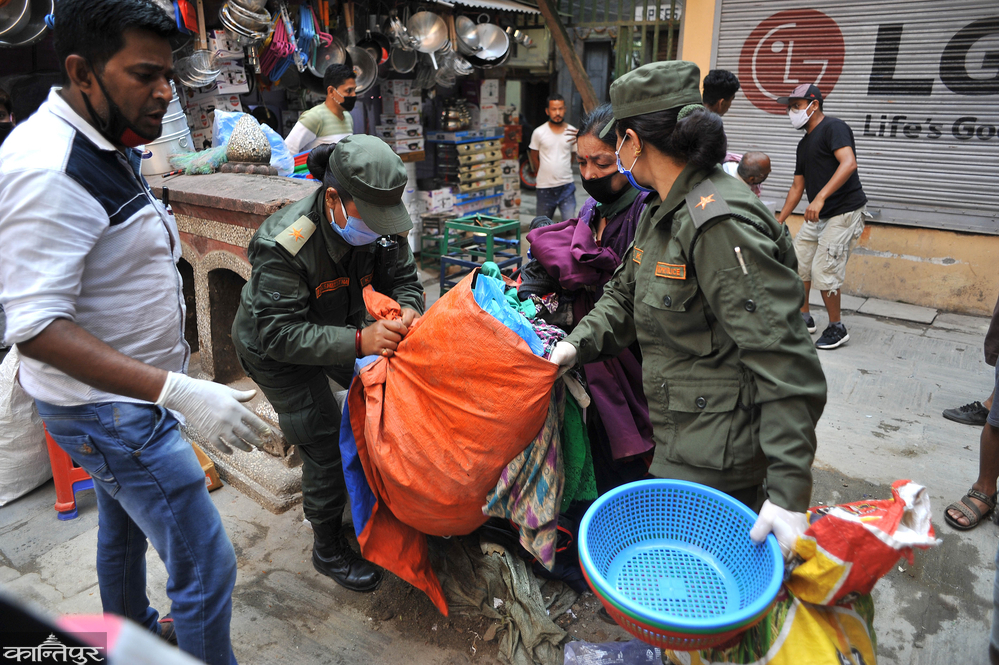 The Constitution of Nepal has given the local level the right to form and manage the municipal police. Accordingly, the Municipal Police Act, 2080, enacted by the Kathmandu Metropolitan City, clearly states its functions, duties and rights. There is no mention in it that the municipal police can lathi-charge or take control of citizens. This act was also enacted only after Balendra Shah became mayor. It states that the responsibility of the city police is to protect and safeguard the movable and immovable property, buildings, land, parks, machines, and equipment of the metropolis.
The city police has come into the spotlight since the current Prime Minister Balendra Shah was elected mayor of Kathmandu Metropolitan City as an independent candidate on 12 Jestha 2079. Its peak was seen when it chased away street and sidewalk entrepreneurs. The responsibilities include security management of meetings, ceremonies, traditions, festivals, and festivals held within the metropolis, supervision and management of markets and vehicle parking lots, monitoring, regulation, and action related to the cleanliness of the metropolis, implementation of agreements and decisions made by the metropolis, and protection of public property.
It also includes provisions for performing other tasks specified by the metropolis, but it is said that while doing such work, coordination should be done with the metropolitan mayor, deputy mayor, chief administrative officer, concerned ward chairperson, and departmental head as needed. 'The city police shall not use force in accordance with the law anywhere
There is no concept, this body will be used purely to facilitate work within the city,' says former DIG of Nepal Police Purna Chandra Joshi, 'Even when there is a commotion or action within the city, the district police should be called.'
Videos of the city police deployed when Shah was mayor, taking away goods from street vendors, went viral on social media. Its impact was also seen in municipalities outside Kathmandu. 'It is natural that lessons can be learned from the work done by the city police in the country's capital,' says senior advocate Chapagain, 'Kathmandu Metropolitan City earned only 6.7 million rupees by confiscating the goods of street vendors in one and a half years, which helped spread the wrong practice elsewhere.'
When he became mayor, he was seen being ruthless towards those street vendors, and a team including young activist E had to protest in front of the gate of the mayor's office in front of the National Assembly on 2 Asho 2080. Before that, groups including E, Raksha Bam, Praveen Kafle had staged street demonstrations and sit-ins, but when their voices were not heard, E decided to stand in front of the mayor's office. After standing for 199 hours, a four-point agreement was reached between the metropolis and E, which included returning the confiscated goods to the owners and streamlining the business in the informal sector. However, the metropolis did not fully implement the agreement made with E. At that time, the city police force itself admitted that its employees had behaved indecently and took action against 12 employees. Seven contract city police were dismissed from their jobs, while five permanent city police were suspended.
Immediately after reaching an agreement with the group including the protesting E regarding street vendors, the city police launched a campaign to remove the street vendors from Kathmandu. The city police had launched a campaign to remove the street vendors from Kathmandu, saying that the city council meeting had decided to keep and manage street vendors only in places other than residential areas.
In the meantime, on 27 Magh 2081, three street vendors and two city policemen were injured in a clash between the city police and street vendors. A team of city policemen had reached the street vendor collection center with a bulldozer. The situation got out of control after the street vendors protested.
The concerned collectors and vendors had protested on 20 Falgun 2081 against the city police's policy of immediately removing street vendors, and accused Mayor Shah of telling the poor not to live in Kathmandu. On 9 Asoj 2081, the city police had also taken into custody street singer Manjadaras (MJ) Tamang, who was collecting donations for the treatment of 13-year-old Subhita Khadka by singing in Basantapur, Kathmandu. The city police, who took him into custody along with his microphone and loudspeaker, later released him along with his materials. Earlier, the metropolis had issued a notice asking people not to beg or make people beg in public places.
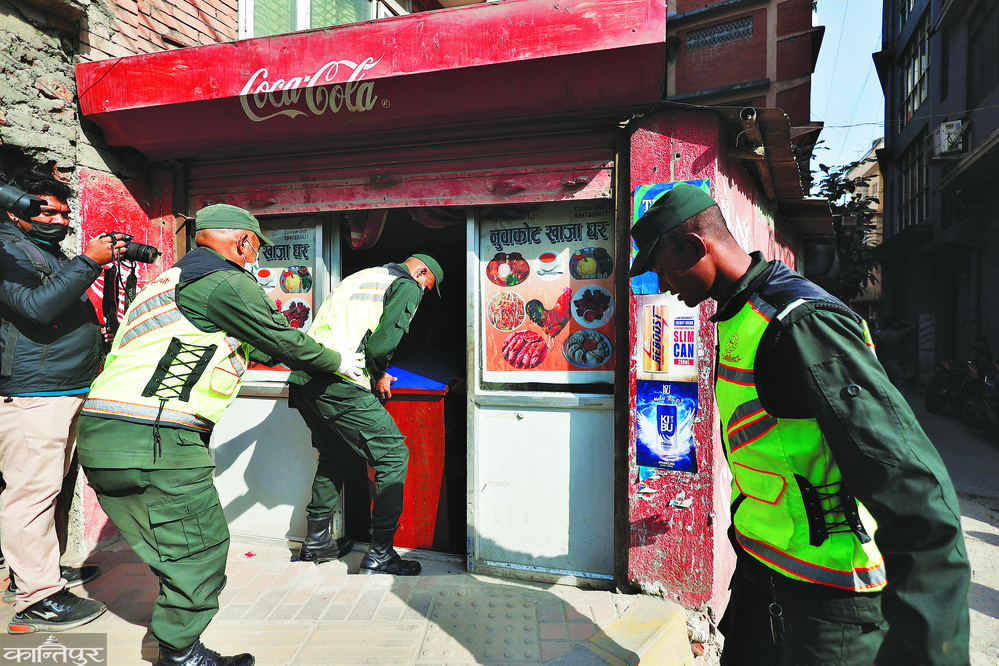
 Later, after a dispute between the then Mayor Shah and Kathmandu's Chief Administrative Officer Saroj Guragain, the city police stopped Guragain from entering the office four months later. When he was going to the office, the city police created an obstacle at the gate on the instructions of Mayor Shah, and Deputy Mayor Sunita Dangol and other ward chairmen had to facilitate.
Three months after Shah was elected as the mayor of Kathmandu, the then chief of the city police, Dhanpati Sapkota, was removed. Superintendent of Police (SP) Rajunath Pandey was given the responsibility in his place. The city police started becoming aggressive after Pandey took over the leadership of the city police. When Balendra Shah resigned from the post of mayor of Kathmandu and entered national politics through the Rashtriya Swayamsevak Sangh (RSS), the then chief of the city police, Pandey, also resigned.
He is also currently an RSSSP MP. Pandey, who entered the election contest against Kulman Ghising in Kathmandu-3, had sought votes by calling himself Shah's soldier. Speaking on the 33rd foundation day of the city police force on 14 Bhadra 2082, the then mayor Shah had openly praised the city police led by Pandey.
He mentioned that sometimes watching the work of the city police felt like watching a Hollywood movie, saying, ‘I remember a funny thing from when I was young, we used to watch Hollywood movies. When I watched the work of the New York City Police, I felt like I was only watching a movie about what city police should be like in various cities of the country including Kathmandu, but now when I watch your work, it feels like watching a movie. That is a happy thing.’ Shah had tried to clear the slums of Kathmandu while he was mayor. For that, he had met with the Home Ministers Narayan Kaji Shrestha, Ravi Lamichhane and others and sought their help. However, after not receiving any help from the central government, the city police were also given training in riot control. However, this is a right that only the Nepal Police and the Armed Police Force have.
At that time, the city police were also provided with equipment including helmets, safety guards, and sticks to control riots. The then city police chief and current MP Rajunath Pandey says that in the past, they had to be beaten up because the Nepal Police did not cooperate even when the squatters were being removed. ‘My head was cracked at that time, this is a matter of self-defense, not to politically embarrass anyone,’ he added, ‘The law enforcement agencies should be strengthened further.’
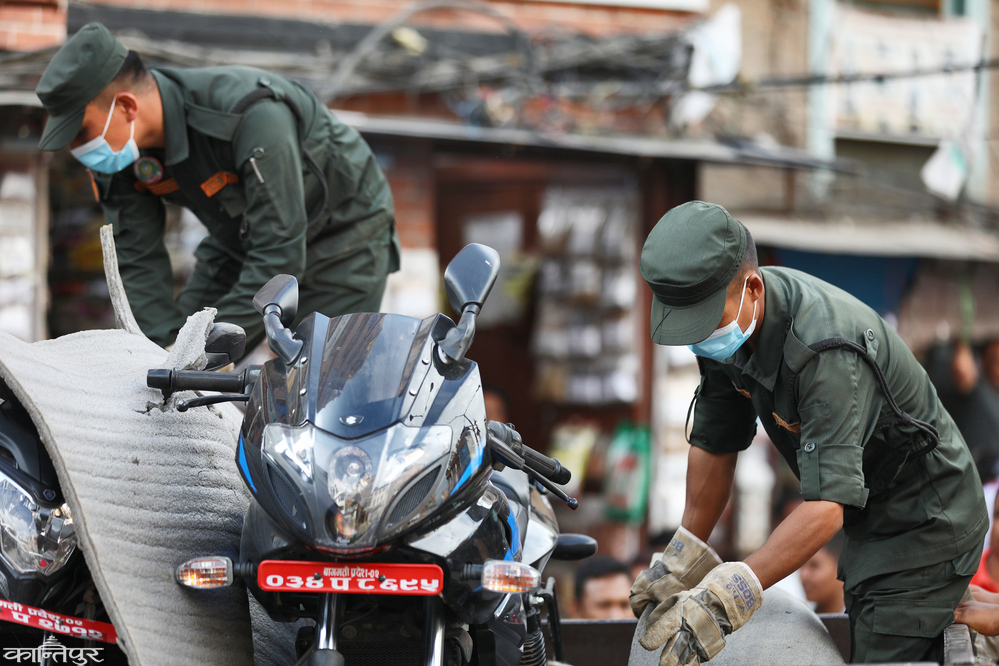
 Stating that the Metropolitan Police had to look into several issues due to the police not working, he also urged them to look into the issue of random parking after the Ganesh Nepali incident. "After I became the chief of the city police, an act was passed to organize the Metropolitan Police, and provisions were also made regarding wheel locks," he told Kantipur. "That issue even reached the court and the issue of the metropolis being allowed to install locks was upheld."
According to Kathmandu Metropolitan City spokesperson Naveen Manandhar, the Metropolitan Police have not taken to the streets immediately after Ganesh's death in connection with the wheel lock issue. Gen-G leader Raksha Bam, who also participated in the protest in favor of street vendors, alleges that the Metropolitan Police has been committing atrocities since before, but it has increased since Shah was mayor. "The same trend has been repeated elsewhere, and in this context, a law should be made immediately to clarify the jurisdiction of the Metropolitan Police," she says.