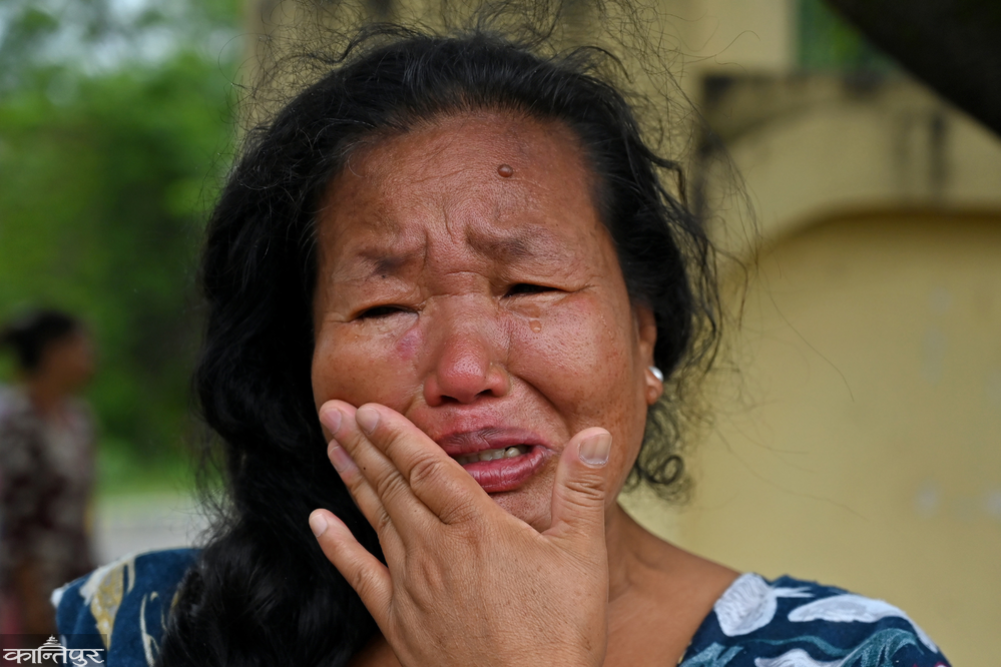
The government had given an 'ultimatum' to squatters to leave the holding center by paying 25,000 rupees, but two days before providing the money for self-resettlement, food was stopped at the holding center.
We use Google Cloud Translation Services. Google requires we provide the following disclaimer relating to use of this service:
This service may contain translations powered by Google. Google disclaims all warranties related to the translations, expressed or implied, including any warranties of accuracy, reliability, and any implied warranties of merchantability, fitness for a particular purpose, and noninfringement.
The government stopped providing food on Monday evening at the holding center in Khuripati, Bhaktapur, where displaced squatters had taken shelter. Among those affected was Kalimaya Pariyar. Met at the holding center on Wednesday, she expressed her grievances: “Not only food, they even took all the water jars inside and didn’t give us any water. People put out water on the roadside for charity, but here the government has treated us squatters with great contempt.”
After criticism mounted over the issue of squatters at the holding center being left hungry, the government resumed providing food from Tuesday evening. “But we don’t know when they’ll stop the food again,” Kalimaya said. She also shared that the 25,000 rupees the government promised for self-management has still not been deposited in her account.
On 8 Asar, the government issued a notice stating that 25,000 rupees would be deposited into the accounts of displaced squatters and gave an ultimatum to vacate the holding center and self-manage by 12 Asar. Later, another notice extended the deadline to 19 Asar. Some families, facing various constraints, are still at the holding center. The government had stopped providing food and snacks for them on Monday evening and Tuesday morning.
After Manohara’s house was demolished, Kalimaya’s family of eight was left in dire straits. Two of her grandchildren are staying at a relative’s place. Even if the money does arrive, she says, 25,000 rupees is not enough to manage the family. “There are eight of us—what can you do with 25,000? That’s just enough for rent. We have to start from scratch with belongings. We don’t even have beds or bedding. My son doesn’t have a job. He’s sitting at home with a broken arm,” she said.
Another worry for Kalimaya is that the education of her three grandchildren has been disrupted. According to her, there was still 48,000 rupees left to pay at their previous school. Now, it’s time for the first trimester exams. “But I haven’t been able to enroll my grandchildren in school. I haven’t been able to buy books either,” she said. “25,000 is like licking something sour on your tongue—gone in an instant.”
Kalimaya is upset that they were made destitute by having their house demolished during the monsoon. “If they had to demolish, they could have at least investigated first. Even insects look for shelter during the monsoon, but we’ve been left in misery,” she said with a sigh. Kalimaya herself is ill. A few days before the house was demolished, she fell and injured herself. After the demolition, she hasn’t been able to get treatment. She used to do tailoring and knitting work. When the bulldozer buried her machine, it felt as if her hands had been cut off.
The District Administration Office, Kathmandu, issued a six-point notice on 11 Baisakh instructing people to vacate their homes and shelters. At that time, it was said that arrangements were being made to provide proper housing for certified landless people within 10 to 15 days. But so far, no one has been given permanent housing.“No food, no shelter, no employment. The government has done us a great injustice,” she said, wiping her teary eyes. Sixty-five-year-old Sobita Rai’s family of seven includes her husband, son, daughter-in-law, and grandchildren. She has similar complaints: “There are so many of us. How are we supposed to manage? Just buying basic items like a gas stove will use up the 25,000. On top of that, rent is expensive.” The 25,000 rupees the government promised has not been deposited in her account either.
Sobita’s family used to live in Balkhu. After their house was demolished, they came to the holding center in Khuripati. Sobita said her daughter-in-law and grandchildren are staying with relatives. Her daughter-in-law has just given birth. Her husband is 84 years old. “Our situation is even worse. Who will listen to our suffering?” she said. When food was stopped for two days, 30-year-old Babita Tamang had no money. She was tormented by the thought of her young daughter and son going hungry. “They distributed instant noodles here. We made do with that,” she said.
When she inquired about the money not arriving in her account, Babita found out that her token number was incorrect. “The day our house was demolished in Baisakh, we went to the stadium. My husband’s citizenship card was lost. I didn’t have one. I left my name and number. Turns out the token number was registered under someone else’s name. I hear that if the money doesn’t come this month, it will never come,” she said. Babita’s family used to live in Balkhu. She used to collect and sell cartons. Her husband worked as a laborer. Since coming to the holding center, she hasn’t been able to work. Her husband also hasn’t been able to earn. “My son has a hole in his throat. His operation is scheduled for 11 Saun,” she said.
Sixty-six-year-old Kumari Rai also hasn’t received the money. Her son is ill. When she lived in Manohara settlement, Kumari used to wash dishes in a canteen. “Now I don’t know where the contractor has gone! There’s no work. I don’t know how we’ll survive,” she said.
Fifty-year-old Anju Pariyar doesn’t even have a citizenship card. On Wednesday, she was on her way to the District Administration Office, Kathmandu, to inquire about citizenship. “My husband has passed away. No one from his family will help me get one. My mother is at my maternal home. I couldn’t get one in her name either. That’s why I haven’t received the money,” she said. Anju said that on the day food was stopped, she survived the night eating only fried lentils and beaten rice.
Last Baisakh, when the government evicted squatter settlements from various places in the Kathmandu Valley, it designated seven locations as holding centers for the temporarily displaced families. Initially, there were 388 families in those holding centers.
At the Machhapokhari Lodge in Balaju, there were 294 people from 87 families; at the Radhaswami Ashram in Kirtipur, 277 people from 65 families; and at the Electricity Training Center in Khuripati, Bhaktapur, 355 people from 99 households. At the Agriculture Training Center in Bode, Bhaktapur, there were 115 people from 24 families; at the Water Supply Training Center in Nagarkot, 80 people from 21 families; at the Red Cross building in Banepa, 195 people from 45 households; and at the Ichangu Narayan Apartment, 172 people from 47 households.
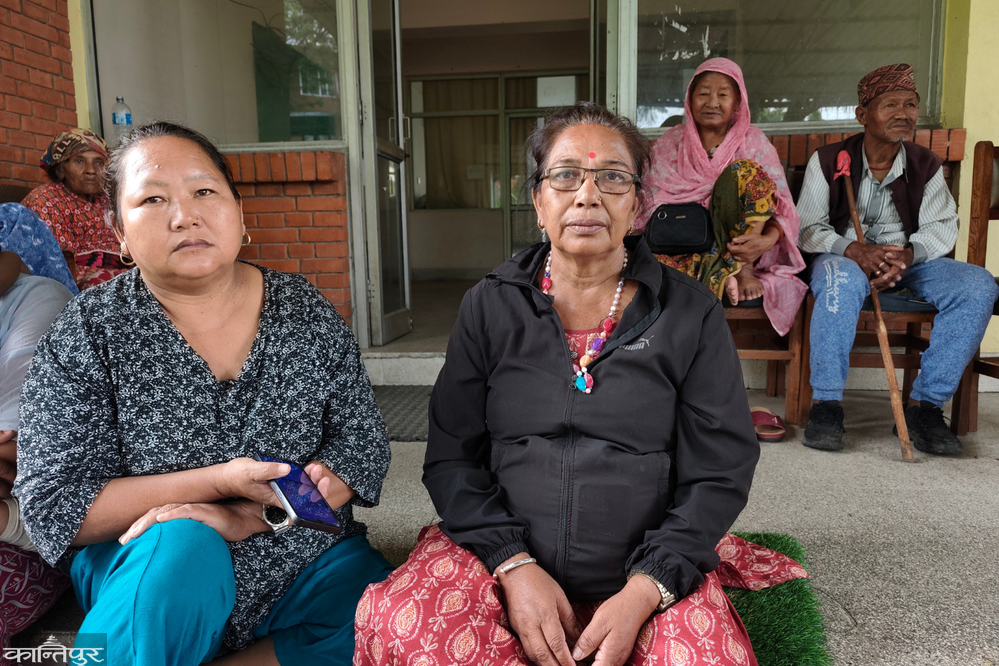 Some have managed to self-relocate and have left the holding centers. After the government’s ultimatum, some families have taken refuge with relatives. Some families, however, remain in the holding centers because they have not received the promised money. Even among those who have received the 25,000 rupees, some families are still dependent on the holding centers because they have not been able to arrange housing.
According to Machakaji Maharjan, project chief of the Bagmati Civilization Integrated Development Committee, the Water Supply Training Center in Nagarkot and the Agriculture Training Center in Bode, Bhaktapur, have been vacated since Tuesday.
Project chief Maharjan said that they stopped providing food on Monday and Tuesday to those at the holding centers who had received the money. “We had instructed not to stop food for those who hadn’t received the money. But the canteen operator misunderstood and stopped food for everyone,” he said. “Yesterday (Tuesday), we went to the holding center. We will provide food for a few more days to those who still need to be managed.”
According to the committee’s information officer, Top Bahadur Baniya, as of Tuesday, 365 families at the holding centers have received the money. “As of yesterday, 63 people were yet to receive it,” he said. “Outside the holding centers, 1,115 people have already received the money,” he added.
Project chief Maharjan said that some people’s money was withheld due to technical errors, either because they hadn’t filled out the forms or because of mistakes in the forms. “Some don’t even have citizenship cards. For those without citizenship, we arranged vehicles to take them to the CDO office. Discussions are ongoing to make citizenship cards as quickly as possible. They will also receive the money soon,” he said. When a Kantipur reporter visited the Khuripati holding center on Wednesday, a group of 11 people without citizenship cards was on their way to the District Administration Office by vehicle.
Maharjan said they are sensitive to the situation of families who, even after receiving the money, are unable to self-manage. “We had requested a list of postpartum women, people with disabilities, and the helpless. When the list didn’t come, we went ourselves and collected the details. We are working on this issue as well,” he said.
The District Administration Office, Kathmandu, issued a six-point notice on 11 Baisakh instructing people to vacate their homes and shelters. At that time, it was said that arrangements were being made to provide proper housing for certified landless people within 10 to 15 days. But so far, no one has been given permanent housing. When Kantipur asked about this, Chief District Officer Ishwar Raj Paudel said they were not in a position to comment.
On 17 Jestha, Prime Minister Balendra Shah, responding to questions from MPs in the House of Representatives, urged not to expect a solution in 35 minutes to a problem that hasn’t been solved in 35 years. He said that work is ongoing to provide land and housing arrangements for squatters, and that it would take time. “It will take as long as it takes. There’s no point rushing. Let’s not look for a solution in 35 minutes to something that hasn’t happened in 35 years. It will take some time,” he said.
On 15 Jestha, Finance Minister Swarnim Wagle, presenting the budget for fiscal year 2083/84 in Parliament, said that the management of landless Dalits, landless squatters, and unmanaged settlers would be completed within the coming fiscal year. On 3 Asar, Minister for Land Management, Cooperatives, Federal Affairs and General Administration Pratibha Rawal told the House of Representatives that land ownership certificates would be distributed to squatters starting from the third week of Asar.
 She said, while responding to MPs during the annual budget allocation for the coming fiscal year, that preparations were underway to distribute land ownership certificates to squatters.
The government, however, has not yet completed data collection. According to project chief Maharjan of the Bagmati Civilization Integrated Development Committee, data has been collected for 1,735 out of 2,608 squatter families so far. “This includes three generations of details. This work will be completed within this week. After that, the Ministry of Land Management will proceed with further work,” he said.
According to Maharjan, after completing all the processes and investigations, the distribution of land ownership certificates will begin in three months. “Until then, the government has said it will provide three months’ rent at the rate of 15,000 rupees per month. If it’s not completed by then, the government will consider other options,” he said.
However, Rajendra Prasad Gautam, information officer at the Ministry of Land Management, Cooperatives, Federal Affairs and General Administration, says it is not possible to confirm when the land ownership certificates will be distributed. “The Land Commission is working on it now. This is a gradual process. It’s not possible to say exactly how long it will take,” he said.