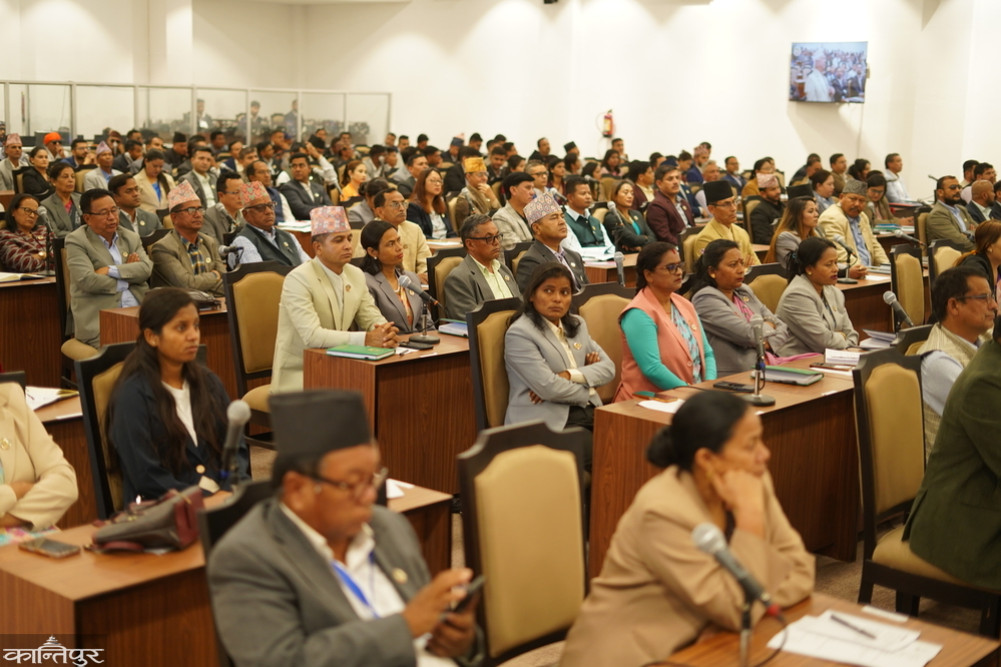
On the recommendation of the government, President Ramchandra Paudel issued eight ordinances between Baisakh 17 and 22. These ordinances were tabled in both houses of the Federal Parliament on Baisakh 28.
We use Google Cloud Translation Services. Google requires we provide the following disclaimer relating to use of this service:
This service may contain translations powered by Google. Google disclaims all warranties related to the translations, expressed or implied, including any warranties of accuracy, reliability, and any implied warranties of merchantability, fitness for a particular purpose, and noninfringement.
Of the eight ordinances issued by the government in Baisakh, four ordinances will automatically become inactive as they cannot be approved by Parliament within the 60-day time limit set by the Constitution. Of the remaining four ordinances, only two have been passed by the National Assembly's Legislation Management Committee, while the other two are still under discussion in the committee, making it challenging to complete the entire process in both the House of Representatives and the National Assembly and have them authenticated in time.
On the government's recommendation, President Ram Chandra Paudel issued eight ordinances between Baisakh 17 and 22. These ordinances were tabled in both houses of the Federal Parliament on Baisakh 28. According to Article 114 of the Constitution, a replacement bill for an ordinance must be passed by both houses within 60 days of its presentation. Otherwise, the ordinance automatically becomes inactive. The 60-day constitutional deadline for the ordinances tabled on Baisakh 28 will be completed on Asar 25.
Of the eight ordinances issued by the government, four ordinances that were embroiled in political controversy from the outset have been put on 'hold' without moving forward through the regular parliamentary process.
The process to have the Constitutional Council (Functions, Duties, Powers, and Procedures) First Amendment Ordinance, the Special Provisions on Dismissal of Public Officials Ordinance, and the Ordinance to Amend Certain Nepal Acts Related to Universities approved by the House of Representatives and the National Assembly could not move forward at all.
Only after approval by both houses of the Federal Parliament can the replacement bill for an ordinance be advanced. Although the ruling party has nearly a two-thirds majority in the House of Representatives, it has no representation in the National Assembly. In understanding with the opposition Congress and UML, the government moved forward with four ordinances and put the other four on 'hold.'
The four ordinances the government has advanced through the regular law-making process are the Cooperative (First Amendment), Public Procurement (Second Amendment), Asset Laundering (Money Laundering) Prevention (Third Amendment), and the Ordinance to Amend Certain Nepal Acts Related to Health Science Institutes. The replacement bills for these four ordinances have already been passed by the House of Representatives and have reached the National Assembly.
However, even after reaching the National Assembly, the process for these bills has not been completed. The National Assembly's Legislation Management Committee passed the replacement bills for the Asset Laundering (Money Laundering) Prevention Ordinance and the Health Science Institutes Ordinance with suggestions on Wednesday, according to Prem Dangal, leader of the UML parliamentary party in the National Assembly.
The replacement bills for the Public Procurement (Second Amendment) Ordinance and the Cooperative (First Amendment) Ordinance are still under discussion in the committee. Many amendment proposals have been registered for both these bills in the committee. To reach consensus on the discussion of the other two bills, a committee meeting has been called for Thursday morning.
Kamala Pant, leader of the Congress parliamentary party in the National Assembly, said that the bills would be passed with amendments by the Legislation Committee on Thursday morning. "Based on give-and-take, all four ordinances will be passed unanimously by the committee on Thursday morning," she said. "The government is ready to pass them with amendments; after that, the government will concede some points, and the committee will also make some concessions to pass them."
UML leader Dangal, however, said it is still uncertain whether the two bills under discussion will be passed. "It depends on how many of the committee's amendments the government accepts and how many it rejects," he said.
Since the government must complete the process of discussion, decision, and then authentication of the bills, there is time pressure to have all four replacement bills passed and sent for authentication by Thursday. However, the Federal Parliament Secretariat claims that, by counting the time from the day after the ordinances were tabled, i.e., from Baisakh 29, the deadline is until Friday. Secretary General Padma Prasad Pandey said that, according to legal and traditional practice, the count starts from the day after the ordinances are tabled, so the deadline is until Friday. "The law relating to legal interpretation, the Civil Procedure Code, and several court decisions all provide that the count starts from the day after the ordinances are tabled, so the deadline for passing the ordinances is until Friday, counting from Baisakh 29," he said.
However, sub-clause 2(1)(a) of Article 114 of the Constitution states, "Each ordinance shall be tabled in both houses of the Federal Parliament after its issuance, and if both houses do not accept it, it shall automatically become inactive." Clause (b) states, "It may be annulled by the President at any time." Clause (c) states, "If it is not made inactive or annulled as per clauses (a) and (b), it shall automatically become inactive after 60 days from the date both houses meet."
The explanation regarding when to start counting the 60 days is also provided therein. It states, "For the purposes of this sub-clause, the day both houses meet means the day the session of both houses of the Federal Parliament commences or the day the first meeting is held, and if the meetings of the houses are held at different times, it refers to the day the later meeting is held."
Both houses of the Federal Parliament met on Baisakh 28, and all eight ordinances were tabled in both houses on that day. Senior advocate Chandrakanta Gyawali said that the time count starts from the first meeting of the Federal Parliament. "Since the Federal Parliament met on Baisakh 28, the time count starts from that day; if not passed within sixty days, they become inactive. This is also the spirit, intent, and provision of the Constitution," he said.
List of Ordinances to Become Inactive
1) Constitutional Council (Functions, Duties, Powers, and Procedures) First Amendment Ordinance
2) Special Provisions on Dismissal of Public Officials Ordinance
3) Ordinance to Amend Certain Nepal Acts Related to Universities
4) Ordinance to Amend Certain Nepal Acts