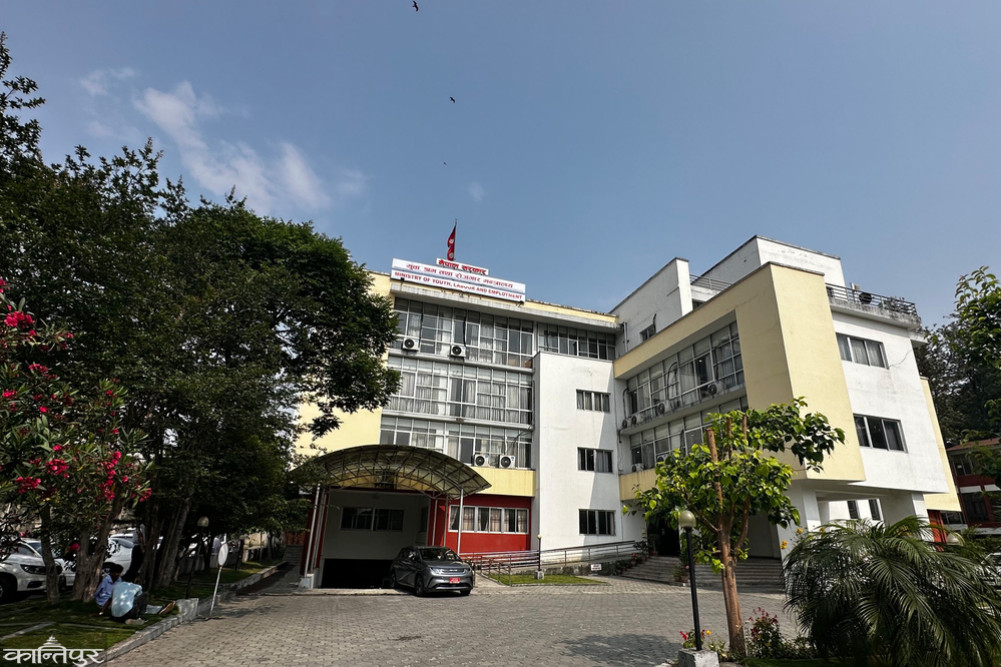
The Ministry of Labor has drafted a bill to determine the service fee to be paid by Nepali workers if the employer in the destination country does not bear the cost of foreign employment.
We use Google Cloud Translation Services. Google requires we provide the following disclaimer relating to use of this service:
This service may contain translations powered by Google. Google disclaims all warranties related to the translations, expressed or implied, including any warranties of accuracy, reliability, and any implied warranties of merchantability, fitness for a particular purpose, and noninfringement.
The Ministry of Youth, Labor and Employment has prepared a draft bill to enact a Foreign Employment Act in which the Government of Nepal will determine the service fee to be paid by the workers if the employer in the destination country does not bear the cost of the recruitment process for workers going for foreign employment.
The government has made its policy on service fees public in the draft bill prepared by the ministry to amend the Foreign Employment Act-2064. 'The cost of the recruitment process for workers going for foreign employment will have to be borne by the employer in the destination country.' The bill states that 'no service fee or any other fee will be charged when sending workers for foreign employment on a contract for a period of less than one year.'
Currently, there is a provision that licensed organizations (manpower entrepreneurs) can charge 10,000 rupees as service fees. The Ministry of Labor has started preparations to determine a new service fee, saying that this policy, which was taken in 2072, is not practical.
The Ministry of Labor has made it easier to verify the demand letters coming from employers. The mandatory provision that requires the employer to monitor each time the demand letter is verified has been removed. 'Accreditation shall be done by the Nepali diplomatic mission of the country concerned or the designated work area based on the employer organization of the destination country's compliance with the terms and conditions of the contract and the analysis of other conditions as prescribed,' the bill states. 'The validity period of the listed organization will be two years. If the demand comes from an accredited organization, the documents received in the demand letter will have to be verified and approved.'
The bill states that the manpower company will remove the prior approval from the Department of Foreign Employment to select workers after the demand letter is verified. The way has been opened for selecting workers after the demand letter is verified by the embassy. However, while selecting workers in this way, it will have to be obtained from the applicant received through the electronic system. The government has made a mandatory provision to place a mandatory advertisement on the Shram Sansar portal. The provision for language tests and skill-based training for workers has been added as per their additional needs. Similarly, the infrastructure and manpower standards of manpower companies have also been added. Currently, manpower company licenses are being issued only if there is a cash and banking deposit. In 2067 BS, the Council of Ministers had decided not to issue new licenses, saying that it was not possible to monitor manpower companies. However, businessmen are getting new manpower licenses through court orders. In 2075 BS, manpower companies were merged by providing a deposit of Rs 10 million to Rs 60 million in bank and cash. At that time, the number of manpower companies, which had decreased from 1,400 to 700, has now reached 1,600.
There is also a provision for up to Rs 300,000 per person if a worker is cheated. ‘The license may be revoked by issuing a warning for the first time, a fine of one lakh for the second time, and a fine of three lakh for the third time,’ the bill states, ‘In case of personal fraud, prosecution can be filed in the district court through the District Police Office.’
In the currently implemented act, in case of personal fraud, the person concerned must appear at the Department of Foreign Employment in Kathmandu to file an application. After the department collects the necessary evidence, a case has to be registered with the Foreign Employment Tribunal. The highest number of personal frauds are taking place in foreign employment. The department currently has files of about 44,000 complaints pending since 2057 BS. Out of which, 11,528 files have been digitized.
The bill has addressed Nepalis who have been abroad for a long time without obtaining a work permit. Rescue and welfare facilities were not provided from the Foreign Employment Welfare Fund if they went abroad without obtaining a work permit. To address this, it is mentioned that rescue and welfare will be established for Nepali citizens abroad. ‘This fund will be filled with voluntary contributions from Nepali citizens who have gone abroad for foreign employment without a work permit and for other purposes, contributions from individuals, national and international organizations, and the amount provided by the government,’ the bill states.
The bill has added a provision that Nepal and the destination country can coordinate when the destination country sets the criteria for health institutions for health screening of people going abroad for foreign employment. The destination country is coordinating with the Nepal government to select health centers according to its health protocols (SOPs) to ensure health screening of workers and increase productivity.
The new bill has added the responsibility of workers, stating that workers going abroad for employment must comply with the prevailing laws of the source country (origin) and destination countries, respect the culture, work in accordance with the contract, and demonstrate ethics.