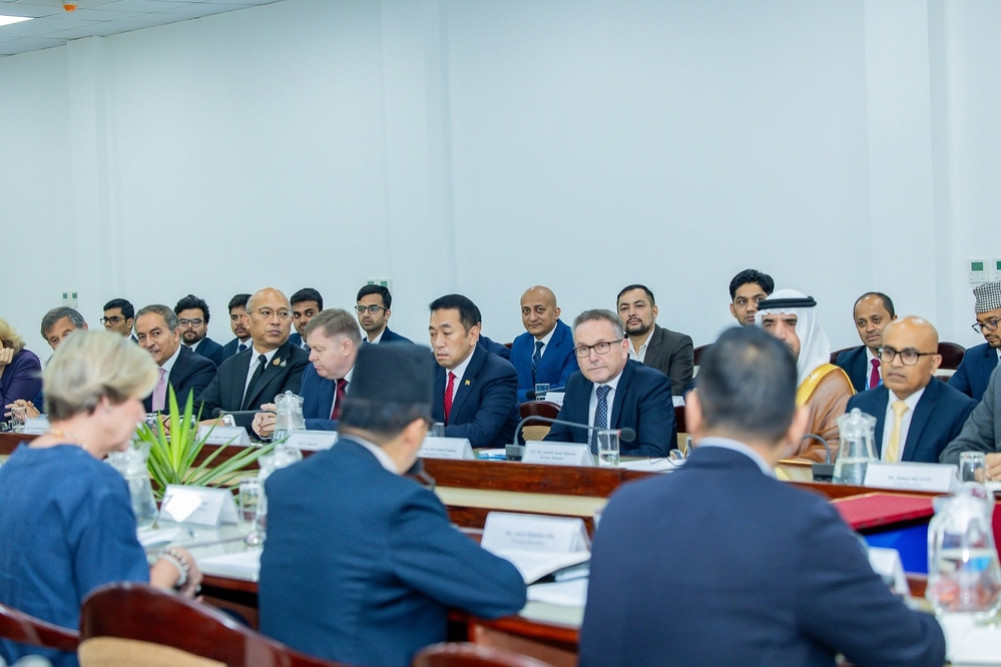
Prime Minister Balendra Shah's decision not to meet in person with foreign diplomats has not only challenged a long-standing practice but has also generated significant interest abroad.
We use Google Cloud Translation Services. Google requires we provide the following disclaimer relating to use of this service:
This service may contain translations powered by Google. Google disclaims all warranties related to the translations, expressed or implied, including any warranties of accuracy, reliability, and any implied warranties of merchantability, fitness for a particular purpose, and noninfringement.
With the formation of one of the most powerful governments in Nepal's democratic history, there was an expectation of sweeping reforms, bold policy changes, and institutional transformation. Along with this, there was also a special interest in Prime Minister Balendra Shah's foreign policy. Although the Shah-led government has started some new practices as the first 100 days of the government are completed, they appear to be partial and procedural rather than strategic.
Prime Minister Shah has disrupted some of the long-standing diplomatic practices by limiting direct meetings with ambassadors and foreign dignitaries visiting Nepal. But the core priorities of Nepal's foreign policy remain the same. Relations with India and China are still at the center of Kathmandu's diplomacy. Foreign Minister Shishir Khanal has paid special attention to sending a message that the new government respects their sensitivities by visiting both neighboring countries.
Although the government has started some new practices, they are more procedural than strategic changes. For example, unlike previous heads of government, Shah met with foreign ambassadors in Kathmandu in groups instead of meeting them individually. Similarly, he has also tried to institutionalize diplomatic ‘protocol’ without personally meeting some foreign dignitaries who have visited Nepal. According to sources in the Prime Minister’s Secretariat, he believes that Nepal’s foreign relations should be conducted through institutions rather than individuals.
‘There has not been much change in Nepal’s foreign policy,’ says Lokraj Baral, a former ambassador to India and a foreign affairs expert. ‘The fundamentals are the same. Only the style has changed.’ According to Baral, Shah’s indifference to his policies made it difficult for both India and China to understand the new government at first.
‘Initially, India seemed a bit confused, while China was not entirely confident in the new government,’ he said, ‘but gradually both have started to increase dialogue with the government.’
Within a few weeks of the formation of the new government, a series of visits by senior US officials took place. Most of the meetings during those visits were focused on the level of the Ministry of Foreign Affairs. Meanwhile, Foreign Minister Khanal also held a virtual meeting with Alison Hooker, Undersecretary of State for Political Affairs at the US Department of State. The meeting discussed economic cooperation, investment expansion, and institutional reforms. While strategic issues have been the main focus of previous bilateral meetings and talks, this time special emphasis was placed on US investment, promoting Nepal's digital economy, and creating a business-friendly environment.
Breaking the tradition of appointing ambassadors solely on the basis of political affiliation, the ministry has called for open applications for the post of ambassador. This has been done as an effort to make the ambassadorial appointment process transparent. However, the question remains whether merit will be given priority over political access and trust in the final selection. According to officials participating in the discussion, the US had prioritized the effective implementation of projects under the Millennium Challenge Corporation (MCC), investment-friendly legal reforms, artificial intelligence (AI), information technology, data centers, entrepreneurship, digital infrastructure, and technological cooperation including Starlink.
These discussions and meetings provided a good opportunity for the Shah-led government to send a message that its foreign policy priorities are economic diplomacy rather than ideological polarization. This is also the major achievement of Foreign Minister Khanal's first three months in office.
Whether addressing the parliament, meeting diplomats or giving interviews to the international media, Foreign Minister Khanal has been reiterating the view that Nepal's diplomatic success should be evaluated on the basis of economic achievements rather than just political ones.
Meanwhile, the Ministry of Foreign Affairs has prioritized attracting foreign direct investment (FDI), increasing exports, promoting tourism, expanding foreign employment opportunities, and mobilizing the non-resident Nepali community (diaspora). 'Our diplomacy should ultimately contribute to Nepal's economic transformation,' Khanal has repeatedly reiterated in public forums.
This change in diplomatic language clearly indicates that Nepal's foreign policy will no longer be limited to traditional political relations. Amidst the declining growth rate of remittances, weak foreign investment and increasing risks to the country due to climate change, Nepal's diplomacy is expected to yield economic dividends.
Meanwhile, the government has also announced plans to improve the services provided by Nepali missions abroad, strengthen the protection mechanism for Nepali workers employed abroad, establish a special mechanism to attract investment from non-resident Nepalis, and institutionalize regular dialogue with development partners. However, these priorities are not new. Previous governments have also prioritized economic diplomacy. However, according to diplomats, the real challenge lies in its effective implementation.
Some of the government's decisions are also seen as attempts to practice new practices. Instead of continuing the tradition of appointing ambassadors based solely on political affiliation, the ministry has called for open applications for the post of ambassador. More than 4,000 people have applied. Of these, about 2,700 applications have been evaluated after the initial selection. Foreign officials interpret the large number of applications as a sign of growing interest in the diplomatic service. It has been welcomed as an effort to make the ambassadorial appointment process transparent. However, the question remains whether merit will be given priority over political access and trust in the final selection.
According to government sources, discussions have begun between Prime Minister Shah, Foreign Minister Khanal and senior leaders of the ruling coalition on the appointment of ambassadors to strategically important countries including India, China and the United States.
Although the selection process is open and transparent compared to the past, the delay in appointing ambassadors has exposed the contradictions of the government. While ministers are reiterating their commitment to strengthening economic diplomacy, Nepal's diplomatic network is operating amidst serious institutional weaknesses. Currently, 17 foreign missions are without ambassadors, and several more are expected to lose their ambassadorial posts in the coming months.
Ambassadors often serve as the principal representatives and faces of states competing to attract investment, expand exports, and promote tourism. Their prolonged absence naturally limits Nepal's diplomatic outreach and engagement. Another challenge is the lack of resources.
Even diplomatic officials admit that most of Nepal's missions are still operating with limited resources. Due to this, investment promotion and diplomatic operations have not been effective. Economic diplomacy requires specialized manpower, strong professional engagement, and continuous dialogue with investors. While most Nepali missions lack these. Diplomatic experts say these weaknesses will determine whether the Shah government's foreign policy ambitions can be translated into tangible achievements.
Moreover, Nepal is now facing a more complex international environment than previous governments. With the strategic competition between India, China and the United States intensifying, there is no room for Kathmandu to make any diplomatic mistakes. That is why the government has been reiterating Nepal's long-term commitment to maintaining balanced relations with both neighboring countries and constructive cooperation with development partners. This effort is not limited to bilateral diplomacy.
Nepal has been continuously engaged with multilateral institutions, international financial organizations and regional initiatives. In addition, climate diplomacy has also become an integral part of Nepal's foreign policy in recent times. As one of the countries most vulnerable to climate change, Nepal has been demanding more support from the international community for mountain protection, disaster risk reduction and climate finance.
Similarly, these issues received less attention and discussion than relations with India and China in the first 100 days of the government. But according to officials, they are an important part of Kathmandu's long-term diplomatic agenda. While there has been widespread debate about Shah's diplomatic style, analysts say that conclusions about the government's foreign policy should not be drawn based on the first three months.
Since the external relations of a country like Nepal have traditionally been guided by structural rather than personal realities, 100 days are not enough to fundamentally transform foreign policy. Moreover, Kathmandu's strategic environment is still determined by its relations with India and China. Economic dependence on international partners also remains intact. Therefore, the need to attract investment, protect the interests of millions of Nepali foreign workers, and efficiently manage growing geopolitical competition is equally important. At the same time, every decision related to investment in infrastructure, digital technology or connectivity has started to be viewed from a geopolitical perspective in recent times.
With less than 100 days to go, the government and the Ministry of Foreign Affairs are also facing the issue of passport procurement. This issue, which has brought the Prime Minister's Office and the Ministry face to face, has raised questions about the future path of the government's diplomacy, service expansion and passport distribution. And, the challenge is also before the Ministry to make it land safely.
So far, the Shah government has been somewhat different in its style of conducting diplomacy rather than in its foreign policy. Prime Minister Shah has made a conscious effort to break away from the established tradition that has long been seen as normal practice in diplomatic circles in Kathmandu. His decision not to meet foreign diplomats in person has not only challenged the long-standing practice but has also created significant interest abroad. Apart from these limited changes in diplomatic matters, continuity of the past seems to have taken precedence.
Foreign Minister Khanal has spent most of the first 100 days of his term convincing neighboring countries, development partners, and investors that Nepal's external priorities are stable and that the balanced diplomacy of the past will continue. However, whether this balance will be maintained or not will become clearer in the coming days.
The government's economic diplomacy will be evaluated not on speeches or diplomatic visits, but on the basis of foreign investment, trade, strengthening of diplomatic institutions, and management of increasingly complex relations with India, China, and other international partners.
In the first 100 days, the Shah government has brought about some visible changes in Nepal's diplomatic style and image. However, according to analysts, the question of whether this change can achieve tangible results is still important and decisive.