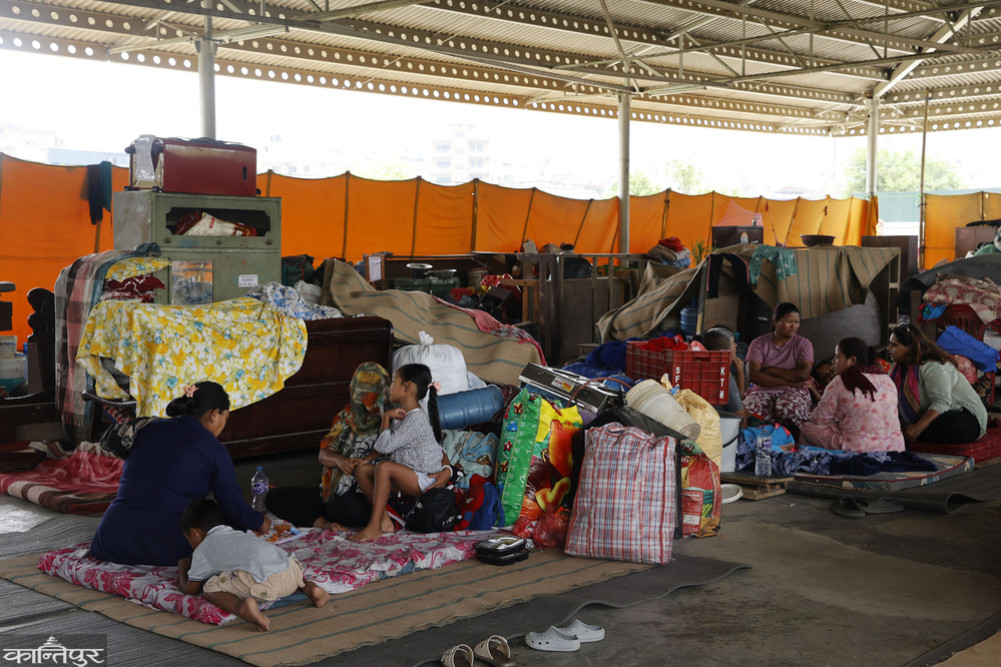
The system of subsidized treatment for burn victims has not yet become effective, the Blue Bus service has yet to be operational, and the plan to install CCTV cameras in public transport is also incomplete.
We use Google Cloud Translation Services. Google requires we provide the following disclaimer relating to use of this service:
This service may contain translations powered by Google. Google disclaims all warranties related to the translations, expressed or implied, including any warranties of accuracy, reliability, and any implied warranties of merchantability, fitness for a particular purpose, and noninfringement.
Most of the commitments made public by the government, including subsidized treatment and blue bus service, with the goal of fulfilling them within 100 days by prioritizing women's safety, burn treatment, and safe public transportation, remain incomplete.
Among the commitments made public by the government, the arrangement for subsidized treatment for burn victims has not yet become effective, while the blue bus service, which was supposed to be operated exclusively for women, has yet to be operational. Similarly, the plan to install CCTV in public vehicles has also yet to be fully implemented.
The government had announced that it would start the process of establishing burn wards in most provincial-level hospitals within 30 days, provide treatment to burn victims at subsidized rates, and expand access to treatment services. The government had put forward the plan saying that the problem of death, disability, and long-term rehabilitation due to burns was increasing due to the lack of well-equipped hospitals at the provincial level. However, even after 100 days, burn wards have not been established in most hospitals as announced.
According to Sameer Kumar Adhikari, spokesperson for the Ministry of Health and Population, there are currently burn units in 14 hospitals across the country and burn beds in 4 more hospitals. He said that training has been intensified to produce human resources for burn treatment. But victims say that the government system is not sufficient.
According to acid and burn victim Bindbasini Kansakar, burn victims still have to bear a huge financial burden for treatment. 'Burn victims have to endure not only physical but also mental pain for years. Long-term treatment and rehabilitation cost a lot, so the treatment of the victim should be considered as the responsibility of the state,' said Kansakar. She said that a separate legal system and permanent fund are needed to ensure the treatment, rehabilitation, compensation and long-term livelihood of burn victims.
Blue bus did not start operating in 100 days, preparations to operate from Shrawan
The government had announced to operate a free 'Blue Bus' service in all seven provinces to ensure the safe movement of women. In the first phase, the target was to bring at least 25 buses into operation within 100 days. Similarly, Finance Minister Swarnim Wagle had also announced in the budget statement for the fiscal year 2083/84 that a blue bus service with a CC camera would be operated for women. The government had given the responsibility to the Department of Transport Management and Sajha Yatayat for the operation of the blue bus.
According to Bhupendra Aryal, Executive Director of Sajha Yatayat, the working procedure for operating the service has been prepared and preparations are underway to move the process forward from the month of Shrawan. Although the government announced to bring 25 buses into operation in 100 days, he said that it took time for technical and practical studies. ‘The government had a new plan to operate buses only for women, it took time to prepare the working procedure modalities for that, now it has reached the final stage, it will be operational from Shrawan,’ he said, ‘The working procedure has been prepared. The route is also fixed.
The budget has also been arranged, now we are preparing to launch the service after receiving final approval from the Ministry of Finance.' According to Aryal, there is a plan to operate 8 blue buses in the Kathmandu Valley in the first phase from Shrawan. Initially, 2 buses will be operated on the Nagdhunga-Tribhuvan International Airport route, and additional buses will be operated on the Lagankhel-Budhanilakantha and Ring Road routes, and the management of the remaining buses has also been completed, he said.
According to Aryal, Executive Director of Sajha Yatayat, some practical issues are still being discussed during the implementation of the government's policy of providing free services to women. He said, 'If an elderly woman is traveling with her son or grandson, we are making a clear policy on whether or not to allow them to board.' Saroj Sitaula, President of the National Federation of Transport Entrepreneurs, said that the blue bus plan put forward by the government cannot be implemented due to practical difficulties. He said that there are practical difficulties in implementing this scheme as the government has brought this scheme for popularity. He said, ‘Even if the government immediately brings it into operation for testing, it will not be sustainable.’
The target of installing CCTV in public vehicles is also incomplete
Although the government has made public a plan to make CCTV, dashcam and SOS button in ride-sharing apps mandatory in vehicles within 30 days to prevent gender-based violence in public transport, the work has not been done as per the target despite announcing the installation of CCTV in public transport. According to Naresh Raj Subedi, Superintendent of Police of Kathmandu Valley Traffic Police Office, CCTV has been installed in only 3,303 public vehicles so far. He also informed that there is no exact data on how many vehicles are yet to be installed with CCTV as the total number of public vehicles is not available with the traffic police.
Superintendent Subedi also said that since the CCTV installation has helped in the investigation, it will be further intensified. He said, "The installation of CCTV has significantly helped in investigating disputes, sexual violence, pickpocketing and accidents on public transport, and there are plans to expand it."