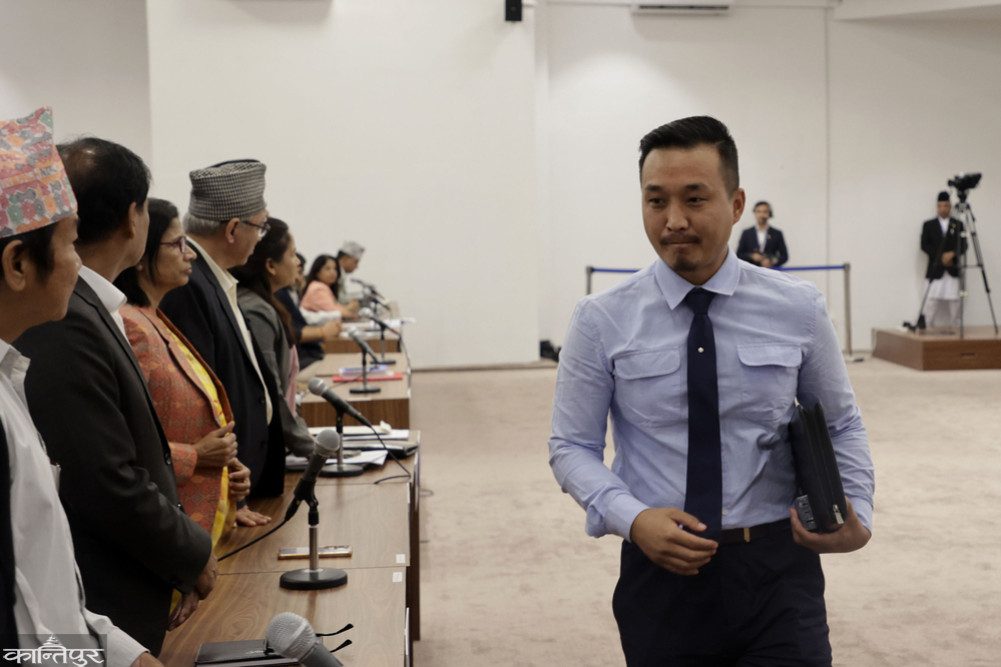
An AIG of the Nepal Police says, ”Looking at the work done so far, Home Minister Gurung seems to be eager to do something, but hasty decisions on some issues are creating problems.”
We use Google Cloud Translation Services. Google requires we provide the following disclaimer relating to use of this service:
This service may contain translations powered by Google. Google disclaims all warranties related to the translations, expressed or implied, including any warranties of accuracy, reliability, and any implied warranties of merchantability, fitness for a particular purpose, and noninfringement.
After returning to the leadership of the Ministry of Home Affairs after the investigation into the share investment dispute, Home Minister Sudhan Gurung took a famous decision - to proceed with the investigation into the palace massacre. Some people on social media praised his decision, while others commented that Gurung may have decided to proceed with the 25-year-old file just for the sake of discussion.
Even three weeks after this decision, which became a topic of national debate for a few days, the Ministry of Home Affairs is still confused about how to proceed with the investigation. The process has not progressed due to the lack of clarity on whether to proceed with the investigation through the Nepal Police or form a separate committee to investigate.
Deviram Sharma, who was the head of the National Investigation Department when the palace massacre took place on 19 Jestha 2058, says that although the decision to proceed with the investigation again is positive, there may be some technical complications for that. ‘Some complications are natural when the incident has been going on for a long time, but they are not impossible,’ he told Kantipur. ‘However, it would have been better to have had sufficient discussions with the relevant experts before deciding to proceed with such an investigation.’
Home Minister Gurung said that he had only discussed it with the police officials after taking the decision. During that, the police officials presented a list of difficulties, saying that the investigation committee formed under the leadership of the Chief Justice had already done its work in the past, and that the incident site report, post-mortem report, ballistic examination, etc. had not been done in the past. Some officials even suggested that a decision be taken by the Council of Ministers to proceed with further investigation.
This decision taken immediately after returning to the leadership of the ministry explains Gurung’s working style to a great extent. An analysis by an AIG of Nepal Police shows that Home Minister Gurung’s work so far shows that he is eager to do something, but hasty decisions on some issues are creating problems. According to police officers, Home Minister Gurung seems so determined to show work that he sometimes pressures the police by saying that he will go and arrest the accused himself. The context is the pressure exerted on the police to implement the report of the inquiry commission led by Gauri Bahadur Karki after he became the Home Minister on 13 Chaitra.
Amid high-profile arrests and announcements of police reforms, Home Minister Sudhan Gurung tried to establish himself as an 'action-oriented' leader, but the court raised questions due to some actions taken beyond the due process. The first cabinet meeting held after the formation of the government led by Balendra Shah decided to implement the commission's report. In the evening, he called Nepal Police Chief IGP Dan Bahadur Karki, the then Chief of the Armed Police Force Raju Aryal and others and directed them to immediately arrest UML Chairman and former Prime Minister KP Sharma Oli, Congress leader and former Home Minister Ramesh Lekhak and others.
By the time the police officers received the instructions, they had not even formally received the report, and documents were still being prepared to proceed with the study and further process. That is why they asked Home Minister Gurung for time to study. Police officials said that since UML workers could come out on the streets when they proceed to arrest them, they should also analyze the possible reaction and start preparing.
But Gurung said that it would not take time to study and instead said that documents could be given to AI for that, and if they did not want to arrest them, he would go to the field himself.
After Home Minister Gurung insisted on regular coordination with Prime Minister Balendra Shah and making immediate arrests, the police officers asked for written instructions. A letter from the Home Ministry to arrest Oli, the writer and others for the implementation of the report reached the police headquarters at midnight. Then Oli and the writer were arrested in the wee hours of the morning. Later, they were released on the order of the Supreme Court, and no case has been registered in the court yet. SSP Dilip Ghimire of the District Police Range, Kathmandu says, ‘The investigation is still ongoing in the matter, we will file a case as soon as it is completed.’
Gurung tried to build an image of himself as an ‘action-oriented’ Home Minister in his first term. Questions were raised against him for counting the number of arrests on social media after ‘high-profile’ accused were arrested, and sometimes for making the arrest warrant public. 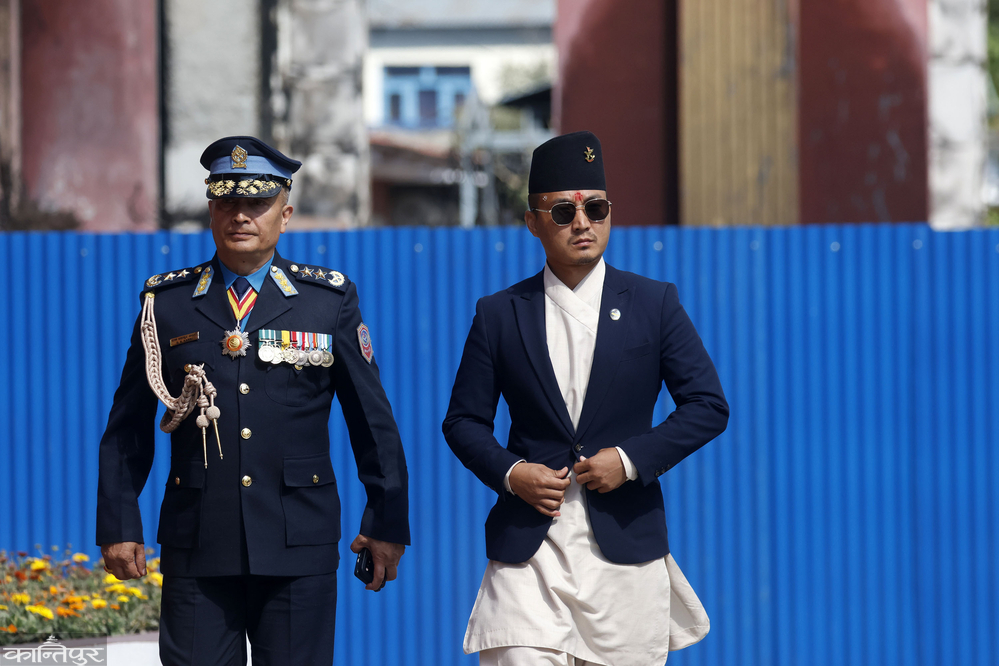
The Home Administration has been accused of arresting a person on suspicion and then finding fault with him later. From the interrogation of Secretary Krishnahari Pushkar on charges of sending a message to the Prime Minister by breaking the ‘chain of command’ to the incident where contractors Ramesh Sharma and Pitambar Badu were mobilised by the police and taken to the Ministry of Physical Infrastructure on charges of non-performance, some examples of this are. During this period, the police were seen to be used for matters beyond the law and procedure, says former DIG Hemant Malla Thakuri, who is also the former head of the Central Investigation Bureau (CIB).
When the police took action without sufficient evidence, a series of arrests and court releases followed. The CIB, a specialized criminal investigation agency, had arrested both Jyoti Prakash Pandey, CEO of Nepal Investment Mega Bank, and businessman Shekhar Golchha. But after the court ordered them to be kept outside custody and investigated, both were released.
When Congress leader Deepak Khadka, who is also a former minister, was arrested on 15 Chaitra, Home Minister Gurung made the arrest warrant public on social media. Khadka himself was also released on the court's order. His house was set on fire amid the situation that arose on 24 Bhadra after the Gen-G movement. At that time, videos of Nepali and foreign notes burning were made public on social media. The Supreme Court had ordered his release on April 3 after he was arrested on the same matter. UML's Lumbini Province MP Rekha Sharma was also released by the court.
Home Minister Gurung expressed his frustration on April 3 after the series of arrests by the police and release by the court. 'I thought that I was the greatest minister, everything could be improved from here,' he had said, 'But it's not true, these days I think the greatest is the judge.' He had said that he had even formed a separate team to study legal issues after the courts started releasing him continuously.
Advocate Mohana Ansari, who is also a former member of the Human Rights Commission, says that those in power have not understood since the past that the subject of investigation is purely the police's. "If the police make a mistake, we will take action, but we should leave the investigation impartial," she says, "but the police have never been allowed to work impartially."
After becoming the Home Minister, Gurung pledged to free the transfer and promotion system from political influence and resolve the internal problems of the police organization in discussions with the police leadership. He also warned against putting pressure on the police to transfer. He spoke openly about the low ration allowance of the police, the condition of lower-level employees, and improving work performance, which sent a positive message within the police organization.
When IGP Dan Bahadur Karki got emotional at an event saying that he preferred the police uniform to be black rather than blue and that the employees could not be sustained, he stood up and applauded, trying to convey the message that he was with the entire police force. He also announced that he would open a factory in the country to improve the quality of police uniforms. But a detailed study has not been done on this yet. An official in the minister's secretariat says that some work has not been possible due to the resignation. 'Now, past commitments are gradually being fulfilled,' he said.
Gurung tried to show himself close to the common people. Sometimes he went to Maitighar to meet the protesters who had taken to the streets with various demands, and sometimes he ate with the common people in the canteen of Singha Durbar. He tried to show his activism by publishing a photo of himself sleeping on the ministry's sofa.
Gen-G leader Sarishma Thapa says that the Home Minister should not work alone, but should mobilize the Home Administration and other mechanisms to show reforms. Some interpret Home Minister Gurung's activities as a series of political interference in the police, saying that the police should be allowed to do their job. Gen-G leader Majid Ansari said that the Gen-G movement was triggered by the wanton misuse of state machinery in the past, and said, “Such trends are still recurring.” According to him, the police should act according to the Criminal Procedure Code and the Police Act, not according to the mood of the Prime Minister or Home Minister. He said that the Home Administration should create an environment for that.
Home Ministry officials say that they have not worked with an active minister like Gurung in the past. However, they say that difficulties arise when it comes to legal procedures. However, there are some expectations in the police circle because he has spoken openly about the condition of the lower-level police within the security organization, the manipulation of transfers and promotions, and organizational reforms. But it is yet to be tested how much those commitments will be transformed into practice.