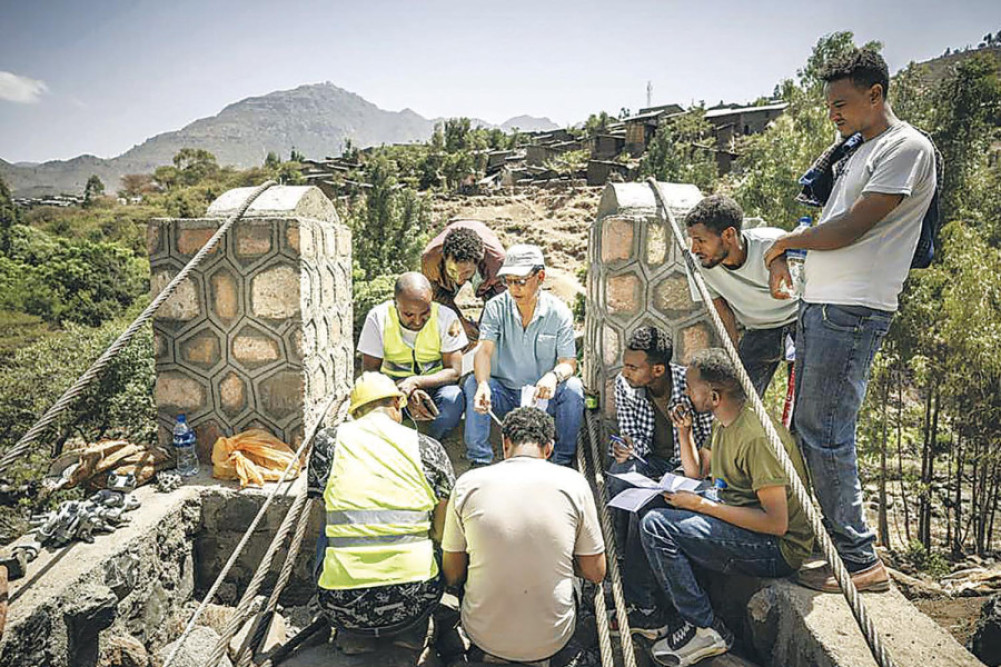
“Nepal is often seen as an aid recipient,” says Tsehay Tsegaye, national coordinator of Helvetas Ethiopia, “but in the context of the suspension bridge program, Nepal has emerged as a provider of expertise, not an aid recipient.”
We use Google Cloud Translation Services. Google requires we provide the following disclaimer relating to use of this service:
This service may contain translations powered by Google. Google disclaims all warranties related to the translations, expressed or implied, including any warranties of accuracy, reliability, and any implied warranties of merchantability, fitness for a particular purpose, and noninfringement.
Growing up in a small village in Sindhupalchowk, Padam Gurung had to struggle to reach school every day when he was 13. Once, a severe flood during the rainy season washed away the wooden bridge, preventing him and his friends from going to school for 7 months.
Then, the villagers made a rope by pulling a wire and hanging a wooden box on it. Gurung had to cross the river by hanging on the rope. According to Gurung, he had to pay a fee every time he used the rope. The journey was very risky. Parents worried every day about whether their children would return home safely. About a year later, a suspension bridge was built at the same place. The risky rope journey ended and travel became easier.
Four decades later, Gurung's life has taken a strange turn. Having struggled to cross rivers to go to school as a child, he now contributes to bridge construction in various countries around the world. That is, he is active in providing safe transportation facilities to other communities.
Gurung has contributed to the construction of hundreds of suspension bridges across Nepal since joining the suspension bridge program run by the Swiss development organization Helvetas in 1996. He has since traveled to Burundi, Cameroon, and Ethiopia to train engineers, provide technical advice to the government, and help remote communities solve the problems he faced as a child.
Gurung's journey is a representative story of a remarkable change Nepal has achieved in the international development arena. At one time, foreign engineers used to come to Nepal to build bridges. Now, Nepali engineers are traveling to countries like Ethiopia, Tanzania, and Guatemala to teach communities facing similar challenges.
With the aim of institutionalizing this experience gained by Nepal, Helvetas (South-South Cooperation Unit) established in 2008, which is now known as Track-4-Change. Its aim is not only to build bridges, but also to enable the countries concerned to build bridges.
This project aims to enable various countries to operate suspension bridge programs by transferring the technical knowledge, engineering standards and training systems developed by Nepal through decades of practice.
Through Track-4-Change, Nepali engineers have been assisting the governments of 11 countries, including Bhutan, Ethiopia, Tanzania, Indonesia, Guatemala and Afghanistan, to develop suspension bridge programs based on Nepali technology, Nepali standards and Nepali experience.
‘Our aim is not just to build bridges and return,’ said Ansu Tumbahangphe, director of Track-4-Change. ‘We want to empower the human resources and institutions of the countries concerned.’
But Nepal did not achieve the status of sharing its expertise with the world overnight. The foundation for this began to be laid nearly six decades ago. In the 1960s, the Swiss Agency for Technical Assistance (SATA), in collaboration with Nepal through Helvetas, began an effort to find solutions to connect rural areas. At that time, the rivers flowing in the hilly and mountainous terrain made it difficult for villagers to reach schools, health facilities and markets. During the rainy season, the risk of crossing rivers was even greater. When the river flow increased, some settlements would be cut off from the outside world for days or weeks.
Swiss and Nepali engineers came up with the solution. They studied the chain bridges that have been built for generations in Baglung and other districts using local materials and traditional skills. Based on that, they developed the modern suspension bridge technology. “Swiss and Nepali engineers refined and made the traditional technology used by the local community safer,” says Tumbahangphe.
Compared to traditional bridges, suspension bridges are simpler and more economical to build. They do not require heavy equipment. Construction materials can be carried by people to remote areas. A large part of the construction work is completed with the participation of the local community.
‘Its engineering quality is strong, but the design is relatively simple,’ said Tumbahangphe, ‘We estimate that the cost of building such a bridge is at least 10 times cheaper than that of a conventionally designed bridge.’
Nepali engineers also changed the practice of creating a new design for each bridge separately. Instead, a modular design based on standards that could be adapted to the needs of different locations was developed. This significantly reduced both the time taken to prepare the design and the construction cost.
Over time, the program was not limited to bridge construction. 16 technical manuals were prepared covering topics such as surveying, design, construction, maintenance, quality control, etc. In addition, suspension bridge engineering was also included in the curricula of universities and technical education in Nepal. ‘We are not just exporting bridges,’ says Tumbahangfe, ‘we are exporting a whole system.’
By the time Helvetas stopped its direct support in 2023, more than 11,000 suspension bridges had been built across Nepal. More than one million people use these bridges every day. Studies have shown that after such bridges were built, school attendance rates increased by 16 percent and women’s access to healthcare during pregnancy increased by 31 percent.
But Padam Gurung said that statistics cannot measure the impact of bridges. He recalls a village in Burundi where locals had to pay boatmen to cross a river. When the suspension bridge became operational, people from all over the village gathered to celebrate.
‘They were singing songs. I asked the interpreter what they were singing, Gurung recalled, “They are singing. Take away the boats, the bridge has set us free.” I felt so proud to hear that. The scene reminded Gurung of his childhood in Sindhupalchowk, where parents had to worry every day whether their children would cross the river and return home safely. Through Track-4-Change, Nepali suspension bridge experts and engineers like Gurung spend four to five months at a time in the respective country, working directly with local governments, consultants, construction companies and technicians. The training program combines classroom study, on-site observation and practical on-the-job guidance. Some training courses last longer than a month.
According to Ethiopian officials, this pragmatic and capacity-building approach has made Nepal's assistance different and more effective than traditional development projects.
Before Nepal adopted the suspension bridge model, rural settlements in Ethiopia were facing the same difficulties that Nepal had faced decades ago. During the rainy season, when the river water rose, villages had difficulty accessing schools, health centers, and markets. Without safe bridges, locals had to cross the river at their own risk or walk for hours to reach a safe crossing point.
This problem ultimately brought Ethiopian officials to Nepal in search of a solution. "At that time, Ethiopia did not have the technical knowledge and skills to design and build suspension bridges," said Tsehay Tsegaye, national coordinator of Helvetas Ethiopia.
Instead of adopting expensive foreign technology, Ethiopia chose to learn from Nepal’s experience, which had similar difficult geographical and economic conditions. ‘Nepal’s model was simple, standard-based and affordable,’ says Tsegaye. ‘The design could be modified according to local needs, and the construction process was also easy.’
Ethiopia’s mountainous geography is divided into rivers and deep valleys. To a large extent, it is similar to Nepal’s. ‘Given Ethiopia’s limited financial resources, the suspension bridge program became the most suitable option to solve the problems of rural areas,’ says Tsegaye.
Today, 272 suspension bridges have been built across Ethiopia with Nepali assistance. But the biggest achievement of this program is not just the number of bridges. It is also capacity building. Now, Ethiopian engineers do not have to depend on Nepali experts for every project.
‘This program has enabled Ethiopian engineers to independently carry out the work of site selection, design and construction for bridge construction,’ said Tsegaye.
Today, Ethiopian engineers are able to design and build steel truss and suspension bridges spanning up to 120 meters without external assistance. ‘This self-reliance is the greatest achievement of this program,’ she says.
Now the program has entered a new phase. With financial support from the World Bank, Ethiopia plans to build an additional 600 suspension bridges using this system within the next three years.
‘This is our success,’ says Tumbahangfe. ‘It took Nepal about 40 years to institutionalize this system. Ethiopia is completing the same task in 20 years.’
The fact that local engineers are starting to operate and manage most of the projects themselves is a sign of success for Nepal. At one time, there were four Nepali suspension bridge experts working in Ethiopia, but now that number is limited to two. ‘This is what we want,’ says Tumbahangfe, ‘and our goal is to create a situation where our assistance will not be needed in the near future.’
But expanding Nepal’s suspension bridge model to other countries has not always been easy. The model has also had to be modified according to local geographical conditions, soil nature, and construction methods.
In Indonesia, engineers had to redesign the bridge foundation when they found that the soil there was very different from Nepal’s. Similarly, the construction model based on local labor that was successful in Nepal was not as effective in Ethiopia. The construction work was then carried out through contractors. ‘The model must be adapted to the local conditions and needs of each country,’ says Tumbahangfe.
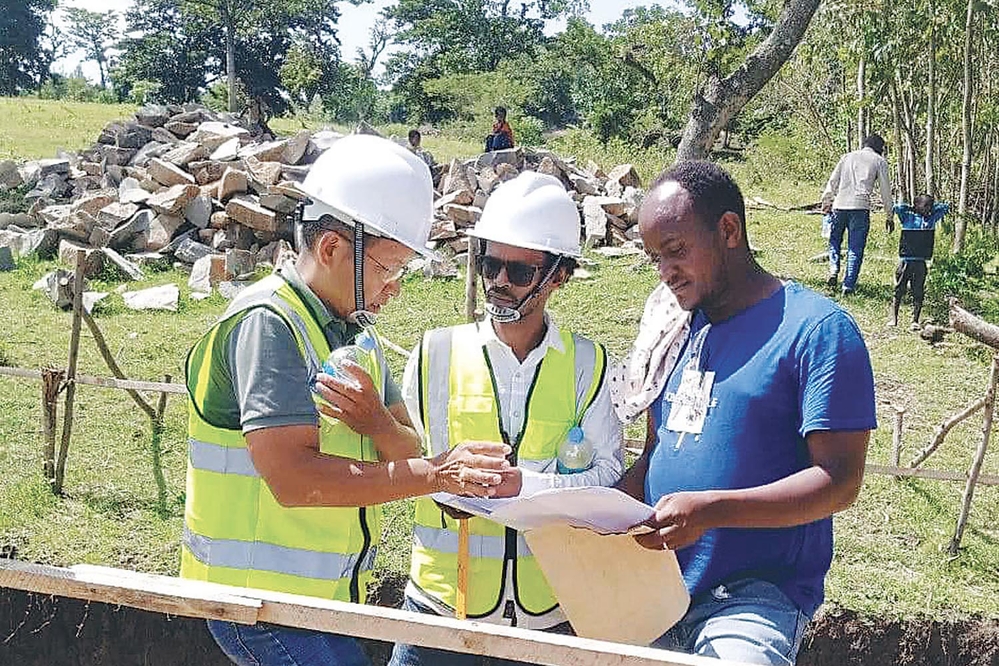 Earlier this year, a team of Tanzanian government officials visited Nepal to study the suspension bridge program closely. They traveled from Kathmandu to Pokhara and observed suspension bridges at various locations.
Many of them saw for the first time a national-level suspension bridge network built using a system based on a single standard at low cost. At the end of the visit, some of the participating officials expressed their commitment to take the initiative to advance the suspension bridge construction program in Tanzania through their ministries.
Many still see Nepal only as a country that receives development assistance, not as a country that can transfer its experience and technical knowledge to others. But in Ethiopia, this perception is gradually changing.
‘Nepal is often seen as an aid recipient,’ says Tsehay Tsegaye, national coordinator of Helvetas Ethiopia, ‘but in the context of the suspension bridge program, Nepal has emerged as an expert provider, not an aid recipient.’
According to Tsegaye, Ethiopian government officials and engineers are now looking at Nepal as an equal partner and a country that can provide practical solutions. This has further strengthened the mutual respect and cooperation between the two countries.
Large-scale projects easily attract the attention of news and donor agencies. Suspension bridges, on the other hand, are relatively small in cost. A suspension bridge of about 60 meters in length costs between US$80,000 and US$100,000 to build. This is much less than large infrastructure projects.
However, its impact can be enormous. ट्रयाक–फोर–चेन्जका अनुसार अहिले पनि विश्वभर करिब एक अर्ब मानिस नदी, खाोच र दुर्गम भूगोलका कारण सडक तथा आधारभूत सेवाको पहुँचबाट टाढा छन् । यस्ता धेरै समुदायका लागि एउटा साधारण झोलुङ्गे पुलले नै जीवन परिवर्तन गरिदिन सक्छ ।
यही सोचका साथ कार्यक्रमले अहिले बंगलादेशमा बिस्तारको सम्भावना अध्ययन गरिरहेको छ । साथै भियतनाम र लाओसमा नयाँ अवसर खोजिरहेको छ । त्यस्तै तान्जानिया, इथिपोपिया र अफगानिस्तानमा काम जारी छ ।
पदम गुरुङलाई आफ्नो बाल्यकालीन अनुभवले नै यसको महत्व बुझाएको छ । त्यसबेला नदीको एक किनारमा उभिएर उनले अर्को किनारमा अवसरहरू छुटिरहेको अनुभव गर्थे । आज उनी त्यही अवरोध अरू कसैले भोग्न नपरोस् भनेर संसारका विभिन्न समुदायलाई सुरक्षित पुलमार्फत् जोड्ने काममा लागेका छन् ।
नेपालले आज आफनै अनुभव र सीप विश्वसँग बााडिरहेको छ । नेपालका पहाडमा पहिलोपटक परीक्षण गरिएको अवधारणाकै कारण सिन्धुपाल्चोकबाट हजारौँ किलोमिटर टाढाका बालबालिकाले आज सुरक्षित रूपमा नदी पार गर्न पाएका छन् ।