Four decades after its declaration as a protected area, the Annapurna region has become a destination for 400,000 tourists annually, but the Dhaulagiri region, which has an equally grand and adventurous potential, has been deserted for years due to lack of infrastructure, policy neglect, and institutional vacuum.
We use Google Cloud Translation Services. Google requires we provide the following disclaimer relating to use of this service:
This service may contain translations powered by Google. Google disclaims all warranties related to the translations, expressed or implied, including any warranties of accuracy, reliability, and any implied warranties of merchantability, fitness for a particular purpose, and noninfringement.
The old homestay signboard still hangs on the wall of the house. Looking at the fading signboard, Ganesh Gharti remembers the sound of foreign tourists' boots in the village and the smell of food coming from the kitchen late at night. But that day is now only a memory.
Gharti, who ran a community homestay in Mudi, Dhaulagiri Rural Municipality-4, Myagdi, now runs a goat farm. 'We had to close the homestay and open a goat farm due to the lack of tourist arrivals,' he says. 'I wonder if the government, businessmen, and local level have not noticed the decrease in tourists reaching Dhaulagiri base camp via Dharapani, Takam, and Mudi.'
The lap of Dhaulagiri Mountain lies a few kilometers north of Mudi village. The seventh highest mountain in the world, a majestic height of 8,167 meters and a trekking route that experienced trekkers call ‘the most exciting journey of life’. But the village of Mudi, located in the lap of this mountain, is deserted today. Homestays are closed. Porters are unemployed. The village’s produce has not been sold.
Tourists visit Ghandruk, Ghorepani, and Ghalegaun in the Annapurna region all year round. Foreign tourists flock to trekking routes including the Annapurna Circuit, Annapurna Base Camp, Mardi Himal. More than 400,000 foreign tourists entered the Annapurna Conservation Area in the current fiscal year. Two mountains. Two different destinies. This story of contradictions highlights the gap between the tourism potential of the Dhaulagiri region and the neglect of the state.
Two turns in history
In 1950, French climbers Maurice Herzog and Louis Lachenal successfully climbed Annapurna I, a mountain over 8,000 meters high, for the first time in human history. Herzog's book 'Annapurna' became a 'best seller' worldwide. Interest in Nepal and Annapurna increased in Europe and America. Exactly a decade later, on May 13, 1960, a Swiss-Austrian joint team led by Max Iselin made the first successful ascent of Mount Dhaulagiri. The seven-member team, including Nepali climbers Nima Dorji Sherpa and Ngwang Dorji Sherpa, created history. Seven days before the Dhaulagiri climb, on May 5, the 'Pilatus PC-6', a supply plane of the Dhaulagiri expedition named 'Yeti', crashed in the Dhampus Pass. This Swiss plane transported food and provisions to climbers from Pokhara to Dhaulagiri. Both pilots survived. This was the first air accident to occur at the world's highest peak.
The climbing history of these two mountains is almost parallel. But the subsequent journey was marked by a land-sky difference. Pokhara, the gateway to Annapurna, attracted a wave of tourists along with hippie culture in the 1960s and 70s. In 1986, the Annapurna Conservation Area Project (ACAP) was established under the King Mahendra Nature Conservation Trust. That decision changed the fate of Annapurna.
The fate changed by ACAP
According to ACAP chief Rabin Kadariya, today there are 57 conservation area management committees, more than 45 tourism management committees and more than 300 mother groups active within the ACAP area. More than 1,500 hotels are in operation. The annual revenue collected from the tourist entry fee alone is more than Rs 450 million. During the establishment of ACAP, about 33-36 thousand foreign tourists used to visit this area annually. In 2012, it crossed one lakh for the first time and reached 1 lakh 2 thousand 570. In 2025, this number has crossed three lakh.
4 lakh 444 thousand tourists have reached Annapurna till Jestha of the current fiscal year. This figure includes the recent increase in the number of Indian tourists visiting Muktinath. Till Jestha, 1 lakh 21 thousand tourists have entered the Annapurna area from third countries. More than 6 lakh domestic tourists arrive annually. The local community earns more than Rs 200 million annually from Yarsagumba collection alone. ACAP built shelters, arranged water, and developed campsites. These campsites were later converted into hotels and tea houses. The triangle of local employment, local income, and local ownership is the formula for Annapurna's success.
Dhaulagiri Rural Municipality 4 Chairman Yam Bahadur Gharti has 22 years of experience working in Manang. 'ECAP has done so well there,' he says, '10 years ago, there was no place to camp in Mudi village due to the influx of tourists. Now, no tourists have come.' Dhaulagiri climbers reach the base camp by helicopter. According to the Nepal Mountaineering Association, 733 people have climbed Dhaulagiri so far. But the locals have not been able to get much economic benefit.
Difficult geography, lack of infrastructure
Experienced trekking guide and former president of Nepal Mountaineering Association Gandaki Province Shesh Kant Sharma took a Japanese team to the base camp of Dhaulagiri-4 as a porter in 1994-95. In 1996, he trekked the Dhaulagiri Circuit with a Russian team via the Myagdi River. ‘A little higher up from the Italian base camp, there was a kuineto and a small river to cross,’ he recalls. ‘When we reached there again in 1996, the route had completely changed and was from the south.’ The biggest challenge of the Dhaulagiri trekking route is that the route changes every year due to glaciers.
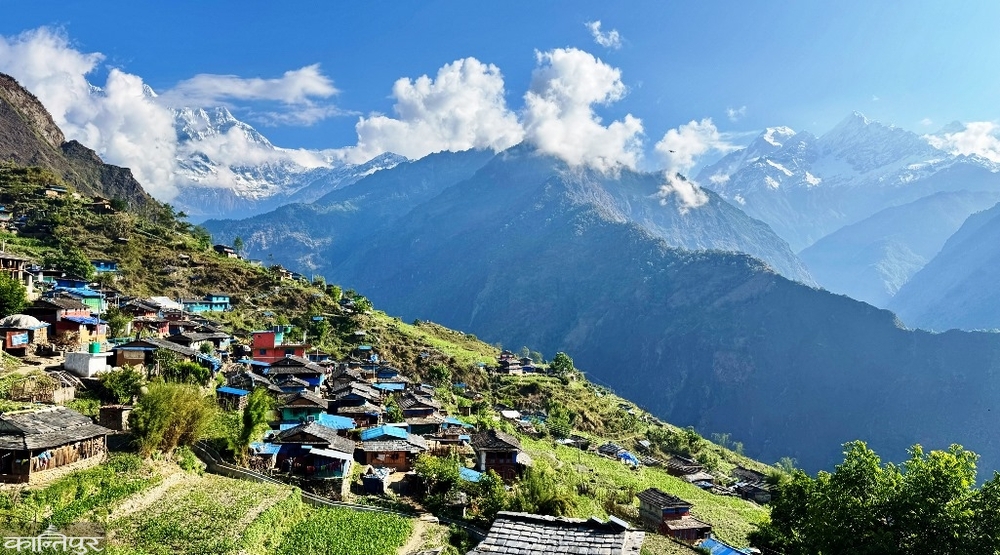
The journey of the Dhaulagiri Circuit Trek starts from Pokhara. The Dhaulagiri base camp is reached via Beni, Darbang, Dharapani, Takam, Muna, Mudi, Bagar, Dobhan, Italian Base Camp, Japanese Camp. The view of the mountains is unmatched from the base camp, which is at an altitude of 4,700 meters. From the base camp, the journey is completed by crossing the French Pass (5,300 meters) and Hidden Valley, passing through Dhampus Pass, Yak Kharka in Mustang, Marfa and Jomsom.
This entire trek usually takes 16 to 18 days. ‘From the French Pass, you can see Dhaulagiri, Tukuche, Nilgiri and Annapurna ranges simultaneously,’ says Sharma. ‘Hidden Valley is a wide deserted valley between the mountains, where you feel like a Himalayan desert when you reach it.’ But accessing this beauty is equally difficult. Due to the inaccurate weather forecast, the glacier changing its course every year and the lack of accommodation, this route has not caught the eye of tourists.
Although it used to be possible to walk from Darbang earlier, now the hydroelectric project has provided a dirt road to Dobhan. Bagar village is the last human settlement on the Dhaulagiri Circuit trek. There are two roads to reach Bagar. One goes through Takam, Muna, Mudi, and the other goes through a dirt road through Khiwang. There are 8 homestays in Bagar. Previously, it took 5 hours to reach Dobhan from Bagar, but now it can be reached in 2 hours by jeep. There are three hotels in Dobhan. Then there is a restaurant in Talitre, 2 hotels in Sallaghari, and one hotel in Italy Base Camp. There are no hotels at the Japanese Base Camp, which can be reached in a day from the Italian Base Camp, and the Dhaulagiri Base Camp, which can be reached the next day, and you have to stay in tents.
The homestays and hotels are also deserted due to the lack of tourists. Hari Tilija, a tourism activist and businessman in the Dhaulagiri region, has been running the Tilija Hotel at the Italian Base Camp on the trekking route for three decades. ‘Earlier, when 18-20 foreigners came in a group, 150 Nepali helpers would come,’ he recalls. ‘After 064/065, the number of tourists started to decline.’
Earlier, there was no practice of keeping records of how many tourists reached the Dhaulagiri circuit. Since a decade ago, at the request of the administration, his hotel has been keeping records. At that time, only about 500 foreign tourists visited annually, but now it is difficult to reach even 300 foreign and Nepali tourists. Tourists do not have to pay any entry fee in the Dhaulagiri region, but since they have to exit via Mustang, ECAP charges an entry fee. The municipality has not received royalties from the Dhaulagiri mountaineering expedition. A building was built at the Italian base camp to keep records of tourists, provide information and first aid services, but it is unused.
Despite the tourism potential, Tilija, who is also a public representative, says that the tourist arrival has been continuously declining due to the lack of proper investment from the state. ‘The tourists who came earlier suffered,’ he says, ‘The suspension bridges over the rivers and creeks along the trek have not been heard from anywhere.’ He suggests that a detailed project report (DPR) of the Dhaulagiri trekking route should be prepared and investment should be made in infrastructure and that loans should be provided to the locals at subsidized interest rates for operating hotel businesses.
There are more than 1,500 well-managed hotels in the Annapurna Circuit, there are communication facilities, and a rescue mechanism. There are signboards along the trek. There is no hotel, no mobile network, no emergency shelter above the Italian base camp on the Dhaulagiri trekking route. Due to the increase in temperature, the snow from the Italian camp to the base camp has melted, so the problem of falling rocks has increased. Sometimes snow falls and blocks the path.
Prem Prasad Pun, chairman of Dhaulagiri Rural Municipality, accepts this reality. ‘When the trekking route built in winter is destroyed by the floods and landslides of the monsoon, it causes a big problem for the trekkers,’ he says, ‘It is built today, tomorrow an avalanche will take it away.’ But he is optimistic about the prospects of his rural municipality. He says that the development of a new route from Dhorpatan to Gurja, a vast geography connecting Baglung, Mustang, Dolpa and eastern Rukum, will require the partnership of the federal, provincial and local levels.
Master plan abandoned, budget misused
Earlier, when Thamsara Pun was the chairman of the rural municipality, the tourism master plan for Dhaulagiri (078/79–082/83) was prepared. The master plan, which was prepared after two years, estimated that Dhaulagiri rural municipality would spend 78 million rupees on tourism in 5 years. The work was not done according to the master plan prepared after spending millions of rupees.
Earlier, when Prithvisubba Gurung was the Chief Minister of Gandaki, 50 million rupees were allocated for the infrastructure development of the Dhaulagiri circuit. But there was a dispute among the locals about whether the trekking route should be taken from the Khiwang side to Bagar village or from the Mudi side. As a result, the amount could not be properly utilized. A trekking route was made by laying stones at various places to exit Bagar from Khiwang, but the trekking route is not currently used. Out of that amount, Rs 5.5 million was spent on installing iron railings in Mudi village on the other side.
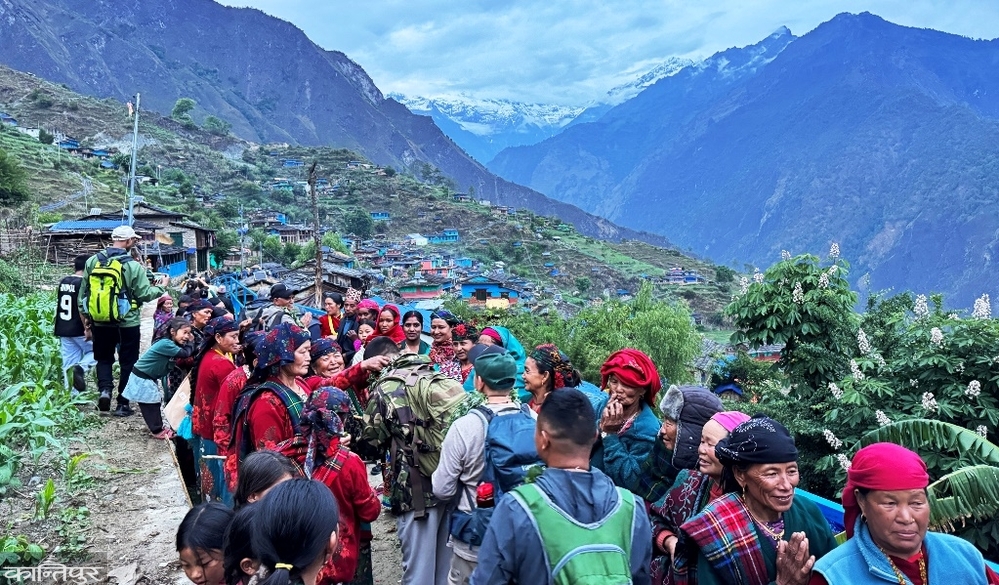
Rs 30 million was allocated from the province to work on the Dhaulagiri circuit through the rural municipality in the current fiscal year. That amount could not be utilized properly either. Resham Pun Magar, the vice-chairman of the rural municipality, claims that the work could not be done due to delays in the tender process when the funds were exhausted in Jestha. ‘The rural municipality had seen the need to construct suspension bridges at 12 different places and small sewers at three places after conducting an on-site study,’ he said. ‘Our budget alone is not enough. The union and the province should invest.’ The municipality had spent Rs 50 million in the last fiscal year and Rs 2.5 million in the current fiscal year. No amount has been allocated for the Dhaulagiri trekking route for the upcoming fiscal year 083/084.
Demand for ‘DCAP’
Trekking Agencies Association of Nepal (TAAN) Gandaki President Krishna Acharya has a question, ‘If 4 lakh tourists visit Annapurna annually, why can’t Dhaulagiri be reached? There is no question that it won’t be possible here.’ The answer is also with him. The work done by ACAP in Annapurna has not been able to be done in Dhaulagiri. ‘We have been repeatedly raising our voice that this area should be taken to the model of Dhaulagiri Conservation Area Project (DCAP),’ he says.
ACAP chief Kadariya supports the concept of DCAP and compares it. Dhaulagiri Base Camp (4,600 m) and French Pass (5,300 m) are at the same altitude as Thorong Pass (5,416 m) and ABC (4,130 m), the highest points of the Annapurna Circuit. In terms of geographical and cultural diversity, both regions are equivalent. ‘Within the next 10 to 15 years, the Dhaulagiri region can easily attract more than 15,000 foreign tourists and a large number of domestic tourists annually,’ he says.
But the demand for DCAP also carries complications. Resham Jugjali, a member of the Gandaki Provincial Assembly elected from Myagdi and former Tourism Minister, recalls that Annapurna Rural Municipality of Myagdi and Madi Rural Municipality of Kaski had to protest against the ECAP because the regulations of the ECAP were not local-friendly. ‘It is appropriate for the central and provincial governments to amend the law to ensure the rights of the local level and community over natural resources and then move towards the DCAP framework,’ he believes.
Need for policy decisions
In point 19 of Schedule 6 of the Constitution, the rights related to ‘national forests, water use and environmental management within the province’ clearly fall within the province’s territory. The list of common rights in Schedule 7 includes forests, wildlife, and biodiversity.
Currently, the Annapurna Conservation Area Project (ACAP) and the Manaslu Conservation Area Project (MCAP) within Gandaki Province operate under the National Parks and Wildlife Conservation Act, which is under the federal government. The Gandaki Province Forest Act 2080 has made provision for the declaration of ‘Special Forest Areas’. Section 6 of the Act also provides for the declaration of areas of ecological importance as Special Forest Areas. The Act envisages the formation of a Special Forest Area Management Council for that purpose.
Mohanraj Kafle, Secretary of the Gandaki Province Ministry of Forests and Environment, says that the Dhaulagiri region can be taken to the ‘Special Forest Area’ model, where the provincial government itself manages it, unlike the ACAP model. ‘There is a debate going on that the province should also get the management of ACAP and MCAP.’ He adds that a special forest area can be declared in Dhaulagiri after holding discussions with the locals.
The Dhaulagiri region is not covered by the Dhorpatan Hunting Reserve, nor by Dolpo, nor by the entire Annapurna Conservation Area. The ECAP covers only up to Marfa in Mustang. The middle part of the Dhaulagiri Himal is in an institutional vacuum. The second five-year plan of Gandaki Province mentions the upgrading of trekking routes and the development of alternative trekking routes in the Annapurna, Dhaulagiri and Manaslu regions. Dr. Krishna Chandra Devkota, Vice Chairman of the Provincial Policy and Planning Commission, says that the tourism development of Dhaulagiri is a priority of the provincial government. But he indicates that it would be hasty to declare a new conservation area immediately.
The issue of taking the Dhaulagiri region as a conservation area like ECAP or MCAP is a matter that completely depends on the scope and decision of the federal government. The provincial government cannot make a single decision on this. Devkota says that it would be a bit hasty to imagine declaring a new conservation area in Dhaulagiri immediately when the ACAP and MCAP cannot be brought under the control of the provincial government. ‘Integrated cooperation between the federal government, local levels and the private sector is indispensable for the development of the Dhaulagiri region,’ he says. He suggests that the private sector should be encouraged to establish hotels and restaurants by developing systematic trekking routes in remote places.
Mobile network and construction of emergency shelters are the minimum requirements. At a time when the Annapurna Circuit is shortened to 5-6 days due to the road, if Dhaulagiri is passed and connected to Lete, Marfa and Alubari in Mustang, this route can become an excellent world-class trekking trail of 21 days, says Krishna Acharya, President of TAAN Gandaki. He says, ‘A DPR should be prepared for that.’
Provincial MP Resham Jugjali sees the need to identify a technically suitable location on the trekking route to the Japanese Camp in the Dhaulagiri region and build a suspension bridge and safe infrastructure. He, who is also the former Tourism Minister of Gandaki Province, shared his experience, ‘After the Gandaki Province government built a suspension bridge on the route to the Annapurna Base Camp towards Myagdi, the tourist arrival there increased significantly.’
Maniraj Lamichhane, Head of the Gandaki Province Office of the Nepal Tourism Board, says that tourism entrepreneurs from Pokhara should be encouraged to take tourists to the Dhaulagiri region. TAAN Gandaki celebrated the 66th anniversary of the Dhaulagiri mountain ascent on 30 Baisakh in Mudi, Myagdi. Rabin Kadariya, Head of ACAP, who arrived at the festival, said that he is ready for technical cooperation and coordination. Tanaka Acharya called this day the ‘beginning of the campaign’. But the same colorful signboard still hangs on the wall of Ganesh Gharti’s house in Mudi village. When he returns from the goat farm, he sees the white peak of Dhaulagiri in the evening light. Still majestic, still stable. He is hopeful that the mountain will one day welcome him back to his home.

