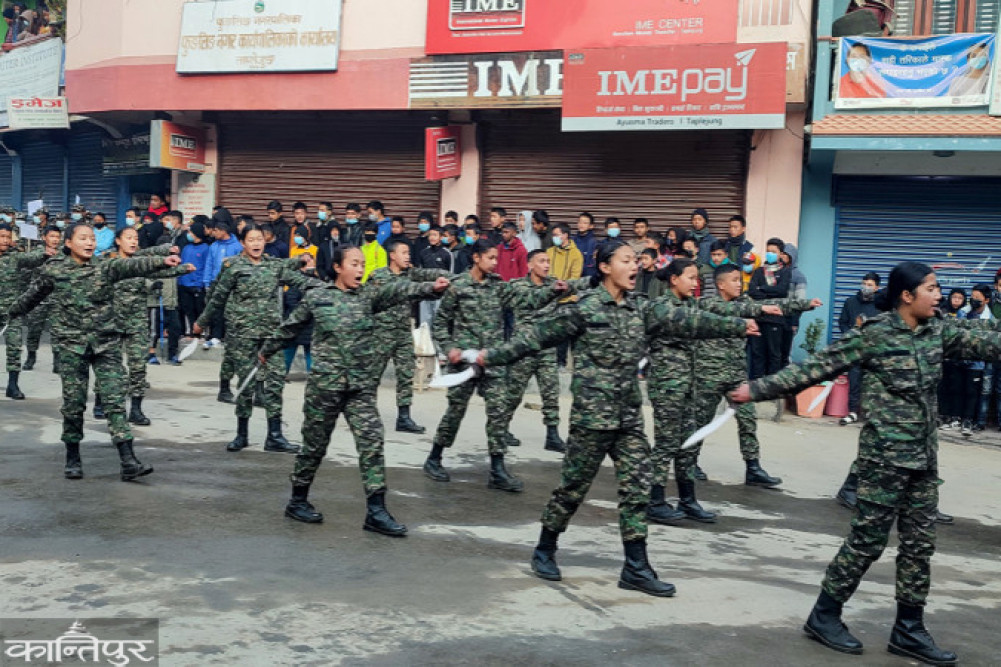
A bill on the National Service Corps, which provides for training Nepali citizens based on national needs and for deploying trained individuals as volunteers in national service, has been registered in Parliament.
We use Google Cloud Translation Services. Google requires we provide the following disclaimer relating to use of this service:
This service may contain translations powered by Google. Google disclaims all warranties related to the translations, expressed or implied, including any warranties of accuracy, reliability, and any implied warranties of merchantability, fitness for a particular purpose, and noninfringement.
The government has brought a bill to prepare human resources that can be mobilized under the Nepali Army in special circumstances. The National Service Corps Bill, which provides for training any Nepali citizen studying in school or based on national needs and for the trained person to be deployed in national service as a volunteer, has been registered in the Parliament.
The bill prepared by the Ministry of Defense has been introduced in the House of Representatives. The bill, registered by Prime Minister Balendra Shah, who is also holding the responsibility of the Ministry of Defense, provides for training of any Nepali citizen in the Service Corps during special circumstances and war or internal conflict. The bill aims to prepare human resources with high morale and national spirit for various services of the Nepali Army, other security agencies, and the Government of Nepal.
The bill states that the purpose of the Service Corps is to make students disciplined, honest, and self-respecting, to awaken patriotism, service to the people, and national unity, and to develop leadership skills. The Service Party will be responsible for preparing manpower that can be mobilized as volunteers in special situations as prescribed.
The purpose and reason for the bill states, 'To instill a sense of patriotism, public service, and national unity in students studying in schools, making them moral and disciplined, and to train any Nepali citizen based on national needs and to deploy trained persons in national service as volunteers, the present bill has been submitted to the Federal Parliament.'
The constitutional reason for bringing the bill has also been shown. Article 51, Clause A (6) of the Constitution states that 'to make citizens ready and capable of serving the nation in accordance with national needs'. The bill states that a new act has to be formulated to address the same provision of the constitution.
The government has brought the bill to replace (repeal) the National Service Party Act made in 2027. The prevailing act does not have a provision for the creation of manpower that can be mobilized under the army or for training any Nepali citizen based on national needs and for deploying trained individuals in national service as volunteers. The act aims to make the youth disciplined and accountable to the state. After the National Service Corps Act was promulgated, training was started for university and school-level youth.
The proposed act states that training will be provided to students studying in basic or secondary education. An official from the Ministry of Law said that the subjects of training for students are a continuation of the existing act. However, he mentioned that the subject of mobilizing trained students or any Nepali citizen under special circumstances under the Nepali Army is new.
The official said that the Ministry of Defense may have felt the need for a law to implement them since some subjects are mentioned in the constitution. ‘The bill was drafted by the Ministry of Defense,’ he said, ‘We will only look at its legal aspects.’ We have even suggested that some issues are not in order . Some have also been corrected .’ When asked whether it would be possible to train any citizen and mobilize them under the army, he refused to give a formal response, saying that further debate on this would be held in Parliament .
During the drafting of the constitution, the then Maoists had proposed to include a provision in the constitution that every youth who has reached the age of 18 should undergo compulsory military training . Other parties did not agree to it . However, after several rounds of discussions, it was written in the constitution that compulsory service should be mandatory for citizens whenever the state wants . It was also written in the state policy to make citizens ready and capable of serving the nation according to national needs .
The bill mentions that the training of the National Service Corps will be provided by army officers . It has been proposed that the government will appoint the Director General of the Service Corps from among retired superiors on the recommendation of the Chief of Army Staff . The bill also states that the Nepal Army will deploy the trainers required for the training of the Service Corps from serving soldiers . It also mentions that the Prime Minister will be the chief patron of the Service Dal and the Minister of Defense will be the patron.
Section 18 of the bill states that even if the training is provided by the Service Dal, the arrangements for deploying the trained people to the national service as volunteers will be as determined by the Government of Nepal and the Council of Ministers. The Council of Ministers will also determine the 'national need'. It is said that the Service Dal will have the authority to formulate the necessary procedures and standards for conducting training.
The bill states that the cadets of the National Service Dal can be mobilized in public service, infrastructure development, disaster management, epidemic control, nature and environmental conservation, cultural heritage conservation and promotion, security, service, sports and other various fields deemed necessary at the time.