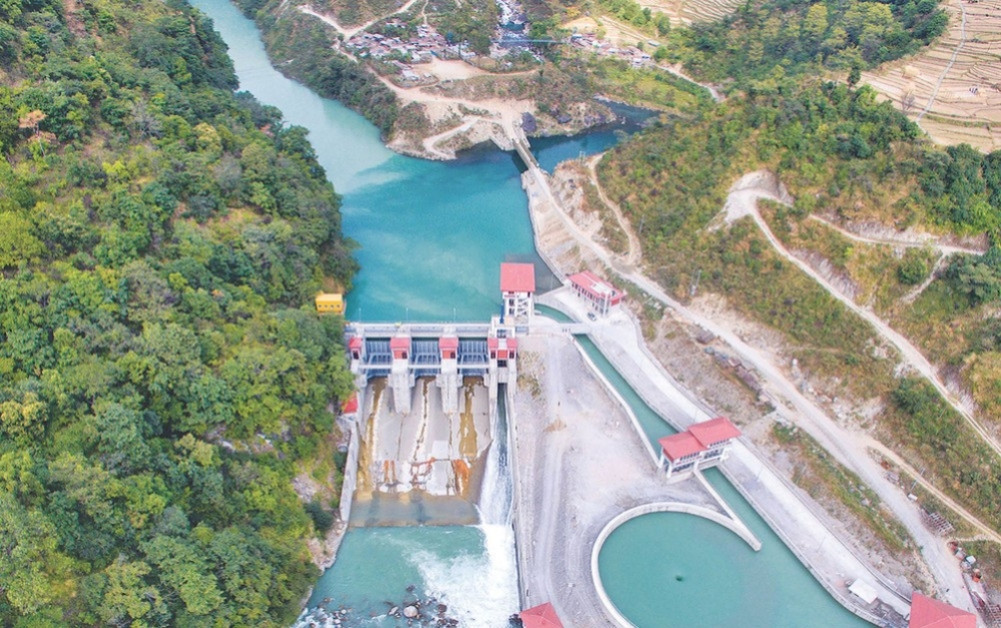
The Electricity Authority does not have to pay money when projects that are in 'contingency' are forced to reduce production, but the Authority must pay money when projects that are not in 'contingency' are forced to reduce production.
We use Google Cloud Translation Services. Google requires we provide the following disclaimer relating to use of this service:
This service may contain translations powered by Google. Google disclaims all warranties related to the translations, expressed or implied, including any warranties of accuracy, reliability, and any implied warranties of merchantability, fitness for a particular purpose, and noninfringement.
The Nepal Electricity Authority (NEA) has started instructing hydropower projects to reduce production, citing the need to maintain the stability of the system (grid) due to the fact that the transmission line is not ready, the capacity of the substation is not sufficient, there are problems in the grid, and electricity production is more than the demand. The NEA has started instructing hydropower projects that are in ‘contingency’ to reduce production as needed.
The NEA has been placing projects that cannot be operated at full capacity due to lack of transmission lines or substations in ‘contingency’. Since electricity consumption is low and production is high and the capacity of the transmission lines and substations is not sufficient, the NEA has been instructing projects that are in ‘contingency’ to reduce production every year during the rainy season.
According to Mohan Dangi, president of the Independent Power Producers Association of Nepal (IPPAN), more than 30 projects are currently in ‘contingency’. The NEA has been instructing projects in various places to reduce production by looking at the transmission capacity and substation capacity. Due to the lack of transmission lines in the Marsyangdi Corridor, projects including Dordi-1, Upper Dordi 'A', Chepe Khola, Dordi Khola, Super Dordi, Nyadi Khola and others have been in 'contingency' for a long time.
In an interview with Kantipur, some projects in 'contingency' have not been instructed. However, even projects not in 'contingency' have been instructed to reduce production. IPPAN Chairman Dangi's 7.5 MW Upper Khorunga Khola small hydropower project has been operating in 'contingency' for seven years.
'My project has been in contingency for seven years, there are many such projects, the number of such projects keeps increasing and decreasing,' he said, 'Until a month and a half ago, there were 30/32, now the number of projects may have increased or decreased.'
According to him, currently Nepal's maximum 'peak load' is about 2200 MW. The NEA has received approval to export about 1,200 megawatts to India and Bangladesh. ‘The total export and consumption will reach 3,400 megawatts, and the installed capacity in the national grid has reached about 4,300 megawatts, so about 900 megawatts of electricity are wasted,’ he said. ‘As soon as production increases and consumption decreases, the first thing to do is to reduce the production of projects in contingency.’
The NEA says that electricity is not wasted, but is produced in excess of demand. NEA’s Acting Executive Director, Dirghayu Kumar Shrestha, admits that there is an electricity ‘surplus’ (production of electricity in excess of immediate requirement) during the ‘off-peak’ period (a period when electricity demand is lower than other times of the day) during the rainy season. According to him, even though the installed capacity has reached 4,300 megawatts, the production is only about 4,100 megawatts.
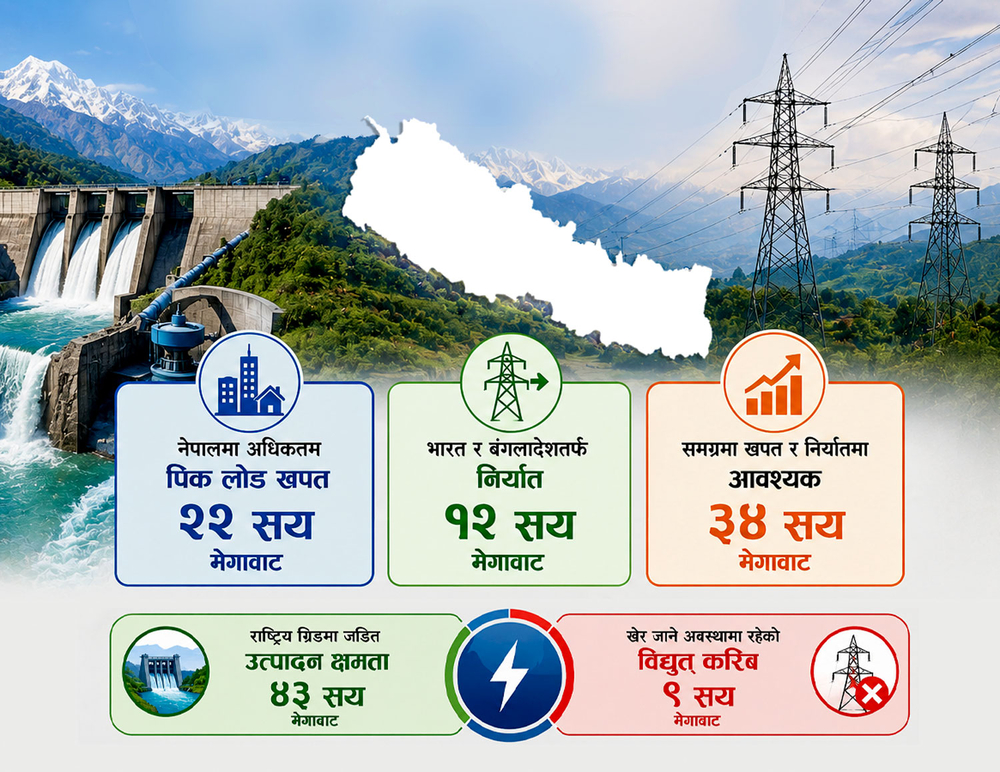
‘3,200 megawatts is required, including internal consumption and exports. After the monsoon, 3 to 400 MW projects are shut down due to various problems including water, floods and landslides, he said. The remaining 500 MW are in reserve. Production has increased now. There is a surplus during off-peak times. But he does not like to say that 'electricity will be wasted'.
In last Jestha, the same Shrestha had claimed that if the Hetauda-Dhalkebar transmission line section is not operational within the current fiscal year, there is a risk that about 800 MW of electricity generated during the rainy season will not be able to flow and will be wasted. He said that although approval has been received to export 1,200 MW, 900 to 1,000 MW is being exported.
Sujan Poudel, manager of 12 MW Dordi-1, said that instructions have been given to reduce production since mid-Jestha. “Sometimes the authority has asked to operate for four to five hours, sometimes for eight hours, sometimes to operate the project completely,” he said. “To reduce production, the authority prioritizes the project that is in contingency.”
When making a power purchase agreement (PPA), if the project cannot be built on time, the promoter has to pay 5 percent compensation to the authority, and if the transmission line cannot be built, the authority has to pay 5 percent compensation to the promoter. Dangi says that changes can also be made in the bilateral agreement between the promoter and the authority. “The transmission line is not built after the project is built, the bank interest has to be paid, we cannot pay the bank interest with the 5 percent compensation given by the authority,” Dangi said. “Then, as the authority says, the promoters are forced to go to ‘take and pay’ and go to ‘contingency’ as per the authority’s instructions. After going into contingency, energy has to be produced as per the authority’s instructions. We cannot operate at full capacity and electricity is wasted.”
The authority has also instructed to reduce production in Madhya Modi as per the requirement. ‘They are asking to reduce the load from time to time, when there is no demand, when the grid is damaged,’ says project chief Pratap Kharel, ‘this time the water flow has finally started increasing.’ Promoter Guruprasad Neupane says that calls have started coming in at the 25-megawatt Kabeli B-1 as well, pointing out the lack of capacity of the transmission line. ‘The project is not in contingency, but the NEA is instructing to reduce production, citing lack of capacity of the transmission line,’ he says, ‘It was the same last year, and it is the same now.’
When such instructions are given to projects that are not in ‘contingency,’ the NEA has to pay money to the promoter. That is why NEA officials prefer to call it ‘kept in reserve’ rather than ‘power outage.’
The NEA has been instructing the 54-megawatt Super Dordi to operate with reduced capacity since Jestha, says project director Arjun Prasad Gautam. ‘The authority has been reducing since Jestha, our project is also in contingency,’ he said, ‘The Markichowk-Bharatpur bottleneck of the Marsyangdi Corridor was, they say it will be charged on Asad 23. The authority has already committed to removing it from contingency as soon as the line is built.’
He said that since it is in ‘contingency’, electricity is being wasted if the authority’s instructions are followed, but now it will end soon. ‘Those in contingency had to reduce production as soon as the authority said, and after reducing production, it was wasted,’ he said, ‘Now after being removed from contingency, the authority has to pay whether or not it buys electricity.’
According to the authority, electricity will be tested and operated by flowing electricity through the Markichowk-Bharatpur 220 kV transmission line under the Marsyangdi Corridor from next Tuesday. The promoters expect that most of the projects in the corridor will come out of ‘contingency’ once this line comes into operation. This will facilitate the flow of electricity that is wasted due to lack of transmission infrastructure to the national grid.
The construction of the 28-kilometer section of the 220 kV Markichowk-Bharatpur transmission line under the Marsyangdi corridor has been completed within one and a half years with the active participation of the private sector. After the construction could not be completed for seven years, the NEA had given the responsibility of construction to the private sector in 2081 Mangsir. After that, seven private hydropower projects had taken up the construction through joint investment.
With the commissioning of the line, the projects that have been in ‘contingency’ for a long time will now be removed, said Uttam Vlon Lama, Senior Vice President of IPPAN. ‘It does not mean that the contingency will be removed but that electricity will not be wasted,’ he said, ‘Electricity in the corridors including Dordi, Kaligandaki was being wasted due to the lack of transmission lines. This situation is no longer the case, but it does not mean that all projects will generate electricity according to their capacity. There will be situations where electricity is wasted due to consumption or various other reasons.'
Promoters say that the private sector should be allowed to trade to prevent electricity from being wasted. Even when the 'Nepal Power Exchange' (NEPEX) was registered through IPPAN in 2018 and requested permission, the government has not yet given it. Companies such as NEPEX, Nepal Infrastructure Bank (NIFRA) Trading and Energy Exchange, Himalayan Trading Electricity are waiting for the license. But the government has not given it yet. 'Uttar Pradesh in India has opened a tender for 4,000 MW. If we had a license, we would have put in a tender, but we do not have a license,' he said.
He said that even if the private sector does business, money will come to the country. Informing that 53/5400 MW may be connected to the national transmission line in the coming fiscal year, Dangi said, 'If the authority does not increase its selling capacity, electricity from the private sector will be wasted.' He said that domestic consumption should increase or exports should increase to prevent electricity from being wasted. He said that the biggest problem in the energy sector is 'contingency'.
Stakeholders say that emphasis should be placed on the construction of the Hetauda-Dhalkebar-Inruwa 400 kV transmission line to export electricity from the Kaligandaki and Marsyangdi corridor hydropower projects to India. Out of the total 288-kilometer-long project, the eastern section, 154 kilometers long, Dhalkebar-Inruwa, has already come into operation, while the 134-kilometer Hetauda-Dhalkebar section was delayed due to a compensation dispute. The foundation (Jag) construction of the transmission line tower has been completed and the work on the remaining structures has reached the final stage, says Project Chief Shyam Yadav.
‘Only two towers are left to be built now, the work is progressing at a rapid pace, if this transmission line is built, it will be easier to export electricity from the Kaligandaki and Marsyangdi corridor hydropower projects to India, and it will be easier to import and export during the dry season,’ he said. Shrestha said that if the Hetauda-Dhalkebar transmission line is built, electricity from eastern projects can also be exported, adding that it can be sold and reliability will also increase.