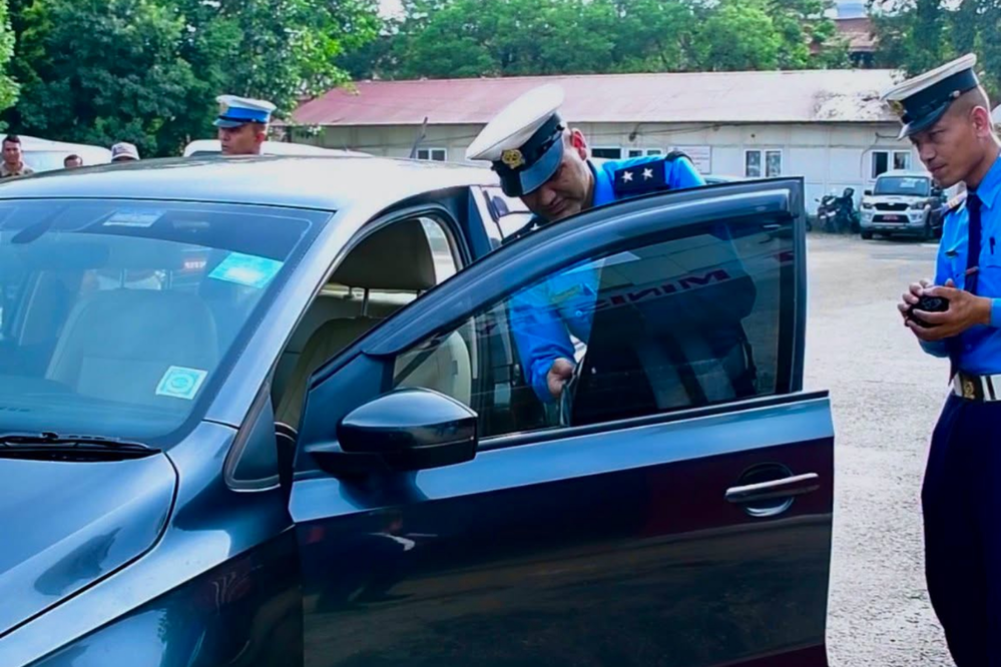
According to Central Police Spokesperson Abhinarayan Kafle, the Police Headquarters issued a circular to Highway Safety and Traffic Management Offices across the country on Tuesday.
We use Google Cloud Translation Services. Google requires we provide the following disclaimer relating to use of this service:
This service may contain translations powered by Google. Google disclaims all warranties related to the translations, expressed or implied, including any warranties of accuracy, reliability, and any implied warranties of merchantability, fitness for a particular purpose, and noninfringement.
You must have been seeing the traffic police removing or getting black stickers removed from vehicles on the roads for the past few days. Why are they doing this?
In fact, this has been done in preparation for the new vehicle and transport law that will come into effect from July 1, which provides for a maximum fine of Rs 15,000 for vehicles violating traffic rules.
On the initiative of Home Minister Sudhan Gurung, strict action has been taken against vehicles with black stickers in the past few days. Home Minister Gurung and Home Secretary Rajkumar Shrestha himself called the traffic police on July 15 and asked them to remove the black stickers from vehicles. The traffic police are also calling on citizens to spontaneously remove the black stickers from their vehicles.
In the past few days, the traffic police have not only been keeping a close watch on vehicles with black stickers on the roads, but have also started issuing cheats and sending them to the transport office. The Police Headquarters has stated that it has issued a circular to police offices across the country to remove the black stickers on public and private vehicles.
According to Central Police Spokesperson Abhinarayan Kafle, the Police Headquarters issued a circular to Highway Security and Traffic Management Offices across the country on Tuesday.
The police said that the crackdown on such vehicles has been intensified after concluding that they are being used for drug trafficking, hundi, illegal weapons, gold smuggling and the movement of criminals.
'People inside can misbehave, loot, or escapees involved in various criminal incidents can also move around, but it is not visible from the outside,' Kafle said, 'We have installed technology for security surveillance. But with black glass, nothing is visible inside. That means police personnel cannot monitor manually and it is also difficult to monitor using technical equipment.'
The traffic police is also discussing with vehicle sales companies about changing the glass of vehicles with black glass installed from the company.
The police are currently taking action based on the provision of 'no modification without approval' mentioned in Section 39 of the Vehicle and Transport Management Act, 2049 BS. According to the said section, no modification can be made to the color, number of seats, shape, engine or chassis of a vehicle without approval. Similarly, Rule 12 of the Vehicle and Transport Management Regulations, 2054 BS mentions the provision that approval must be obtained if vehicle equipment needs to be changed.
Section 136 of the Provincial Vehicle and Transport Management Act, 2075 BS, provides for the prohibition of the use of tinted glass. Sub-section (1) makes it illegal to install tinted glass in any vehicle so that it is not visible from the outside or to use any other substance on the glass to make it tinted.
However, in the case of vehicles deemed suitable from a security perspective, there is a provision that up to 20 percent tint can be used with permission.
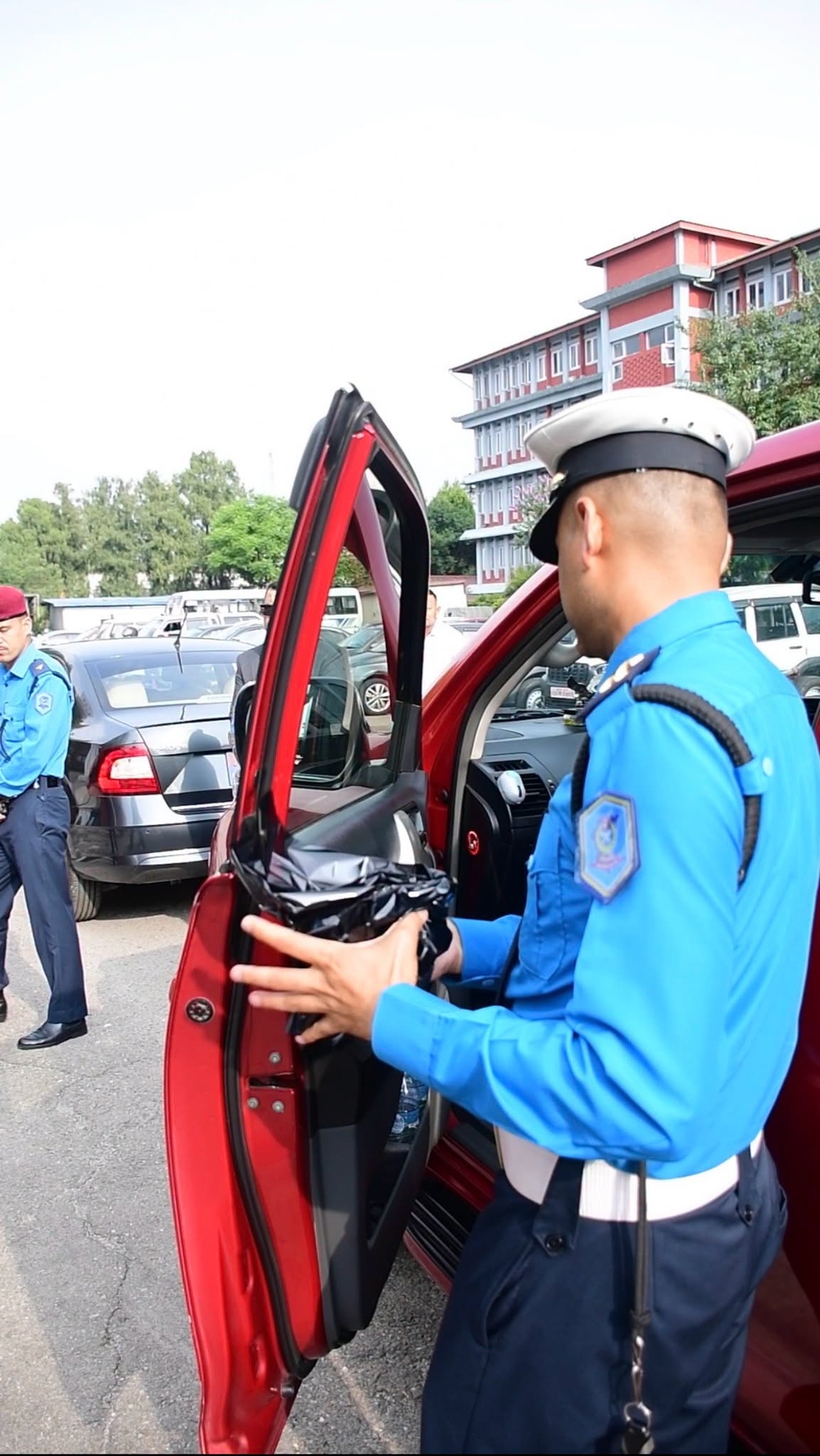 Former police officers also argue that the policy of not using tinted glass is positive from the perspective of crime control and security sensitivity. The police have identified it as a security challenge as it reduces the driver's visibility, increases the chances of accidents and makes it difficult to monitor criminal activities inside the vehicle.
'Kidnapping, extortion, extortion, and sexual violence. Vehicles with black stickers have been widely used in all four of these crimes,' says Keshav Adhikari, former DIG of Nepal Police, 'because you can hide your identity. In a vehicle with plain glass, we can see who is inside. Now this has come as a new campaign. But there was no need to bring it as a new campaign. Because the traffic police have been doing this for a long time and the Supreme Court has also ordered this.'
On Magh 26, 2067, the Supreme Court had ordered the government and the concerned bodies to implement a system to remove black glass installed illegally, keeping in mind public safety, crime control and road safety. The order states that black glass can be used in vehicles used by the President and Prime Minister.
According to SP Nareshraj Subedi of the Valley Traffic Police Office, since Asad 13, strict action has been taken against vehicles with black stickers, and 218 vehicles have been taken into action as of Wednesday.
What is the practice in other countries?
Although Nepal has been strict against unauthorized or non-standard black stickers, most countries in the world have allowed the use of tinted glass based on scientific standards.
In many countries, including India, China, and the US, there is a provision that at least 70 percent light should enter through the front windshield and driver-co-driver's seat glass, while up to 35 percent tint is allowed in the rear glass.
European countries have also made transparency mandatory in the front glass. In most countries, including the UK, Germany, and France, tinting that affects the driver's forward view is not allowed. However, dark tinted glass can be used in the rear glass after meeting certain standards.