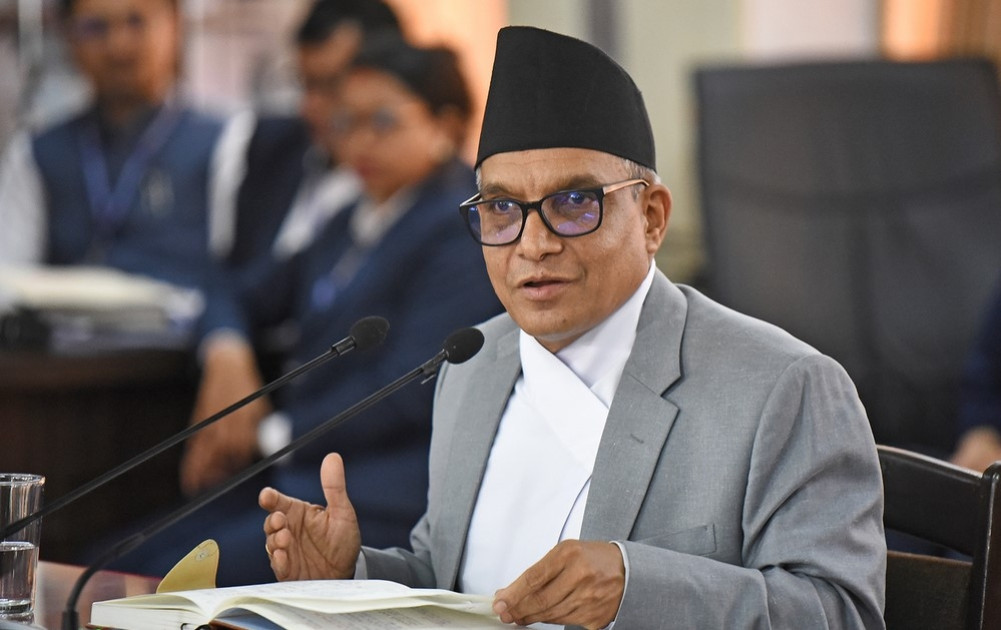
As of mid-June, there are 27,000 cases pending in the Supreme Court, 1,442 cases that have been pending for more than five years, and the Nepal Bar Association has suggested appointing judges immediately to resolve the cases in a timely manner.
We use Google Cloud Translation Services. Google requires we provide the following disclaimer relating to use of this service:
This service may contain translations powered by Google. Google disclaims all warranties related to the translations, expressed or implied, including any warranties of accuracy, reliability, and any implied warranties of merchantability, fitness for a particular purpose, and noninfringement.
The Supreme Court had scheduled 463 cases for hearing on Tuesday. But only 131 cases were decided and ordered, while the rest were postponed for various reasons. The number of cases that were listed as 'unwatchable' was only 193.
This is not the first time that such a large number of cases have been postponed in the Supreme Court, it happens every day. There are various reasons for the postponement of most of the cases, one of which is the lack of judges. The Supreme Court, which has a staff of 21 people, including the Chief Justice, currently has only 18 judges. Out of them, Justice Til Prasad Shrestha has been on leave for three months due to ill health.
Chief Justice Manoj Kumar Sharma is aware of the delay in hearing cases due to the lack of judges. Therefore, during the parliamentary hearing held on 5th Jestha after being recommended for the post of Chief Justice, he had promised to establish a system for appointing judges before the post becomes vacant in the court. It has been over a month since he was appointed as the Chief Justice after being approved by the parliamentary hearing on the same day. But the process of appointing judges has not started.
Sub-section (1) of Section 4 of the Judicial Council Act, 2073 states that ‘the Judicial Council shall determine the post of a Supreme Court judge who is retiring due to age limit and recommend for appointment at least one month before such post becomes vacant.’ Sub-section (2) states that ‘if the post of a Supreme Court judge falls vacant due to reasons other than retirement due to age limit, the Judicial Council shall recommend for appointment within one month from the date of such vacancy.’
Sub-section (3) provides that the Chief Justice and the judge of the High Court must be recommended for appointment within three months of the vacancy. The Judicial Council, which recommends the appointment of judges, is constitutionally headed by the Chief Justice. The Judicial Council consists of the senior-most Judge Sapana Pradhan Malla, Law Minister Sobita Gautam, as well as Mahesh Kumar Nepal (appointed on the recommendation of the Prime Minister) and Damodar Khadka (appointed on the recommendation of the Nepal Bar Association). It is the practice for the Chief Justice to call the meeting of the Judicial Council. The Council has not met since Sharma became the Chief Justice.
The Judicial Council had earlier recommended Meghraj Pokharel to the Supreme Court on 27 Jestha 2082. One post was also vacant after his appointment. Since then, Prakash Man Singh Raut and Kumar Chundal have retired. Chundal retired on 9 Kartik 2082 and Raut on 18 Chaitra 2082. There are five posts vacant in the High Court, including Chief Justice and Judge. The last recommendation for the post of Chief Justice of the High Court was on 27 Jestha 2082. At that time, the Judicial Council had recommended Shrikant Poudel (Janakpur) and Shant Singh Thapa (Dipayal).
According to Ram Prasad Bhandari, the acting secretary of the Judicial Council, no time has been fixed for the immediate meeting of the Judicial Council. However, a member of the council said that Chief Justice Sharma has not been able to call the council meeting. ‘The main reason for the failure to hold the meeting is the problem between the Chief Justice and the senior-most judge,’ he told Kantipur.
Immediately after the Constitutional Council recommended Sharma, who was ranked fourth, as the Chief Justice, senior Supreme Court judges expressed their dissatisfaction in the full court. They said that the tradition of the court had been violated and there was interference by the executive. ‘In the meantime, there is also dissatisfaction that work has been done to the extent of not registering a writ that would be inconvenient for Sharma. This may also be the reason why the council meeting was not convened,’ the member said.
After Sharma’s appointment as the Chief Justice, the senior-most Justice Malla was on leave for 20 days. After that, she sat on the bench for a few days and then went on leave again. ‘The senior-most judge has been sitting on the bench since Monday. Now, there will be a discussion about convening the council in a few days, right?’ the member said.
As of mid-Jeshma, there are 27,739 cases pending in the Supreme Court. Of these, 10,234 are more than two years old and 1,442 are more than five years old. Nepal Bar Association President Vijay Prasad Mishra says that judges should be appointed immediately to resolve these cases on time. “The judiciary has been facing a long-standing problem of not appointing judges on time. This trend has continued even after Sharma took over,” he said.
The Supreme Court has not been able to appoint judges as per the vacancies for three and a half years. The hearing of cases has been affected due to the lack of judges as per the vacancies. In addition, the appointment of the Chief Justice has not been done on time as per the constitution. Article 284 (3) of the constitution provides that the Constitutional Council should recommend the appointment of the Chief Justice one month before the post of Chief Justice falls vacant. However, Chief Justice Sharma himself was appointed only one and a half months after the post fell vacant.
The Supreme Court has also issued a decree at various times stating that the Judicial Council, which is chaired by the Chief Justice, has not followed the constitution and the law. The last time, on 18 Jestha, the Supreme Court issued a decree in the name of the Judicial Council to follow the constitution and legal provisions regarding the appointment of judges. A joint bench of Justices Hari Prasad Phuyal and Binod Sharma had issued such a mandate in the name of the council, of which Chief Justice Sharma is the chairman and senior-most Justice Malla is a member. It has been almost a month since this order was issued.
The joint bench issued this order in a writ petition filed by advocate Deepak Bikram Mishra, stating that Section 4 of the Judicial Council Act, which requires appointments to be made one month in advance in the case of the Supreme Court and within three months in the case of the Chief Justice and judges of the High Court, was not followed. ‘Since the important fact that the case load has increased in the Supreme Court and the administration of justice has been delayed, in the case of the Chief Justice of the Supreme Court, judges and judges of subordinate courts who are vacant due to retirement or other reasons, it is held that a mandate order will be issued in the name of the Judicial Council Secretariat and other parties to complete the process prescribed by law and make appointments within the time limit,’ the order said.
The Supreme Court has reminded the court of Section 4 of the Judicial Council Act. “Sub-section (1) of Section 4 of the Act seems to have specified a time frame of one month in the Supreme Court and sub-section (3) in the case of the High Court within three months,” the order states. “In order to fulfill the responsibility of appointing judges on time, the Judicial Council Act has given the Council the responsibility to prepare a record of persons eligible to be judges, to collect details in coordination with the concerned bodies, to publish notices to inform those interested in the appointment, and to maintain details of the persons who have been appointed. In such a situation, it seems to be the binding obligation of the officials of the Council to implement that provision objectively and transparently.”