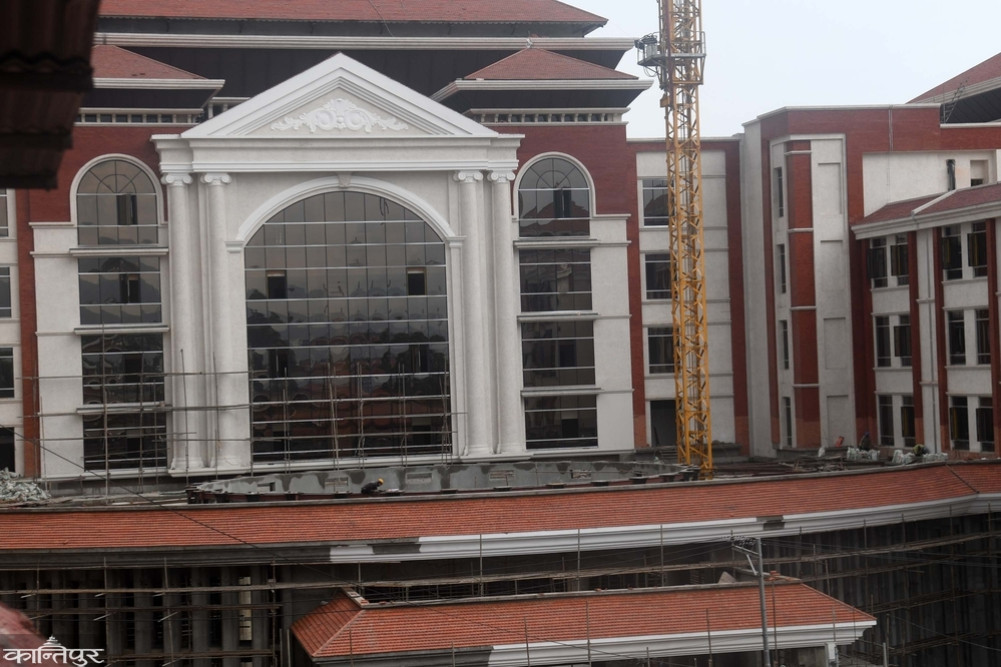
The failure to resolve the case for years has jeopardized citizens' property, businesses, and family lives, and there have been delays in implementing recommendations for reform.
We use Google Cloud Translation Services. Google requires we provide the following disclaimer relating to use of this service:
This service may contain translations powered by Google. Google disclaims all warranties related to the translations, expressed or implied, including any warranties of accuracy, reliability, and any implied warranties of merchantability, fitness for a particular purpose, and noninfringement.
There is a very famous saying in the judicial sector – justice delayed is justice denied. But now the situation that confirms this saying the most is seen in the Supreme Court of the country. In this court, where citizens hope to get final justice, the backlog of cases has become so great that even years-old cases are being left behind, waiting for their turn.
Some parties have passed away while waiting for justice. Some are spending their property, business and family lives in uncertainty. In such a situation, the question arises – why are there so many cases piling up in the Supreme Court? What can be the solution to this? A question and answer prepared based on the Supreme Court's statistics, various study reports, the suggestions of the Nepal Bar Association and discussions with stakeholders in the judicial sector:
What is the current real situation in the Supreme Court?
The number of cases pending in the Supreme Court is continuously increasing. According to the latest statistics of the court, 27,739 cases are pending as of mid-Jeshta. Of these, 10,234 cases are more than two years old, while 1,442 cases that are more than five years old are still pending. Some cases that have been pending for more than seven years are yet to reach a final conclusion.
The situation in daily hearings is also not very encouraging. For example, out of the 463 cases scheduled for hearing on Tuesday, only 131 were ordered or decided. The remaining cases were put on the waiting list or postponed to another date.
These figures show how serious the workload of the court has become.
The most famous example of this is the Lauda aircraft rental case. The case related to the alleged irregularities in the leasing of Lauda Air aircraft by Nepal Airlines Corporation in 2057 BS has not reached a final conclusion even after more than 20 years. Similarly, hundreds of general cases have been waiting for their turn in the Supreme Court for years.
What is the reason for the backlog of cases? Is it just the lack of judges?
There is not only one reason for the increase in cases in the Supreme Court. The lack of judges, legal structure, procedural weaknesses and administrative problems seem to have created the current situation.
The Constitution has provided for a maximum of 21 judges, including the Chief Justice. But the Supreme Court has not been able to function in full strength for a long time. Even now, some posts are vacant. In practice, the court is still operating with insufficient manpower.
The Judicial Council Act, 2073 BS has provided for the recommendation of a new judge 1 month in advance if a post falls vacant due to age limit and 1 month in case of vacancy for other reasons. But in practice, the appointment process is often delayed.
However, according to many legal experts, the lack of judges is not the only problem. Many cases that could have been resolved by the district and high courts have finally reached the Supreme Court through appeals, retrials, writ petitions and other legal processes. They argue that this has made the Supreme Court more like a larger appellate court than a constitutional court.
In addition, case management, repeated postponements of hearings, failure to prepare files on time, parties or legal practitioners asking for time, and administrative delays have also slowed down the pace of case disposal.
What suggestions have the study reports and stakeholders given to solve the problem?
The common conclusion of many study reports is the same - the jurisdiction of the Supreme Court should be redefined. The Nepal Bar Association has suggested that the Supreme Court should focus mainly on constitutional disputes, fundamental rights, interpretation of federal laws and serious cases of national importance. If this is done, the bar believes that the thousands of cases currently coming to the Supreme Court will automatically decrease.
Another important suggestion is to make the Constitutional Bench permanent and regular. Currently, when a Constitutional Bench is sitting, 5 judges should be focused on it, so the hearings held in the general bench are affected. It has been argued that if a permanent Constitutional Bench is set up, other benches can dispose of a large number of cases of the general public.
Along with this, the issue of expanding the powers of the High Court is also linked. There is also a debate on making the decisions of the High Court final in some types of cases and transferring some powers to it.
Similarly, suggestions have been made to improve the retrial and appeal systems, digitize case management, reduce unnecessary adjournments, and make reconciliation, mediation, arbitration, and local-level judicial committees effective.
In addition, the reports have suggested that there should be sufficient administrative manpower within the court, such as investigation officers, legal assistants, information technology experts, and record management.
What is the practice in other countries? What can Nepal learn?
In many democratic countries like the US, UK, Canada and Australia, the Supreme Court does not hear most appeals or petitions automatically. Only serious cases related to public importance, constitutional questions or legal principles are heard in full with special permission. Because of this, the Supreme Courts of those countries mainly focus on the interpretation of the Constitution, the development of legal precedents and questions of national importance.
In Nepal, the situation is different. Along with the responsibility of giving the final interpretation of the Constitution and protecting fundamental rights, many civil and criminal cases of a general nature also reach the Supreme Court. As a result, cases of constitutional importance and general disputes have to wait for a long time in the same court.
This is why the debate to redefine the jurisdiction of the Supreme Court has become stronger in recent years.
What is the way forward?
This debate is not new. In 2078, a study committee led by Justice Harikrishna Karki concluded that the jurisdiction of the Supreme Court should be reviewed. In the same year, a task force formed by the Ministry of Law also suggested that about 2 dozen laws should be amended.
But many of these suggestions have not been implemented. The main reason for this is said to be the need to amend the constitution and various laws. Now that the debate on amending the constitution has resumed, there is a demand to make judicial reforms an important issue.
The current surge in cases seen in the Supreme Court is not a problem created solely by the weakness of a single person or the absence of a few judges.
Many experts accept that this is the result of the legal structure, court jurisdiction, procedural delays, administrative weaknesses, and the failure to implement long-standing reform suggestions. There is a need for simultaneous reform in the court structure, jurisdiction, appeal system, digital management, and alternative dispute resolution system.
According to the suggestions of experts, Nepal Bar Association and various study committees, it seems that improvements should be made in many areas at once to reduce the workload of the Supreme Court.
First, the appointment of judges should be made within the time prescribed by law.
Second, the jurisdiction of the Supreme Court should be redefined and focused on cases of constitutional and national importance.
Third, the High Court can be given more powers and a final decision can be made there in certain types of cases.
Fourth, the number of cases that unnecessarily reach the Supreme Court should be reduced by reviewing the retrial and appeal systems.
Fifth, case management should be completely digitalized, unnecessary adjournments should be reduced, file management should be improved and time management should be modernized.
Sixth, if mediation, mediation, arbitration and local level judicial committees can be made effective, many common disputes can be reduced from having to reach the courts.