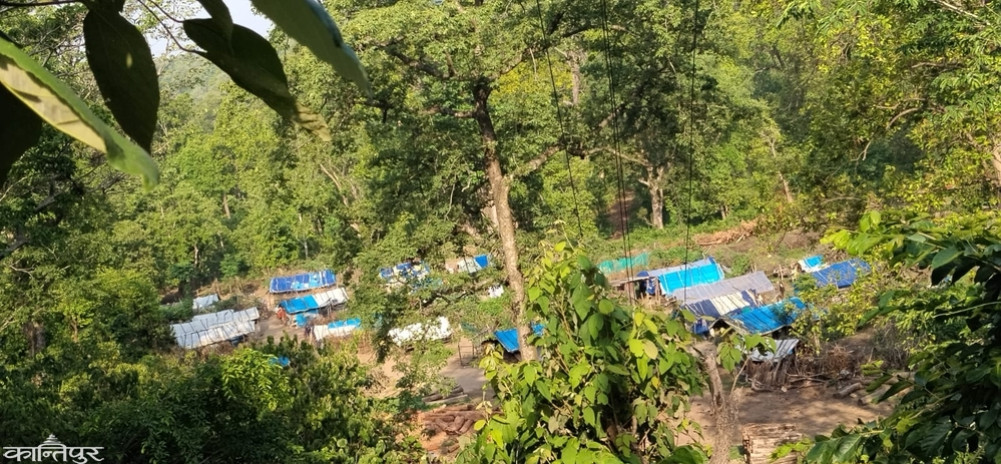
116 families from Chure Rural Municipality 4, 5, and 6 of Kailali, who were displaced by landslides in 2077 BS, are still living a precarious life in temporary huts.
We use Google Cloud Translation Services. Google requires we provide the following disclaimer relating to use of this service:
This service may contain translations powered by Google. Google disclaims all warranties related to the translations, expressed or implied, including any warranties of accuracy, reliability, and any implied warranties of merchantability, fitness for a particular purpose, and noninfringement.
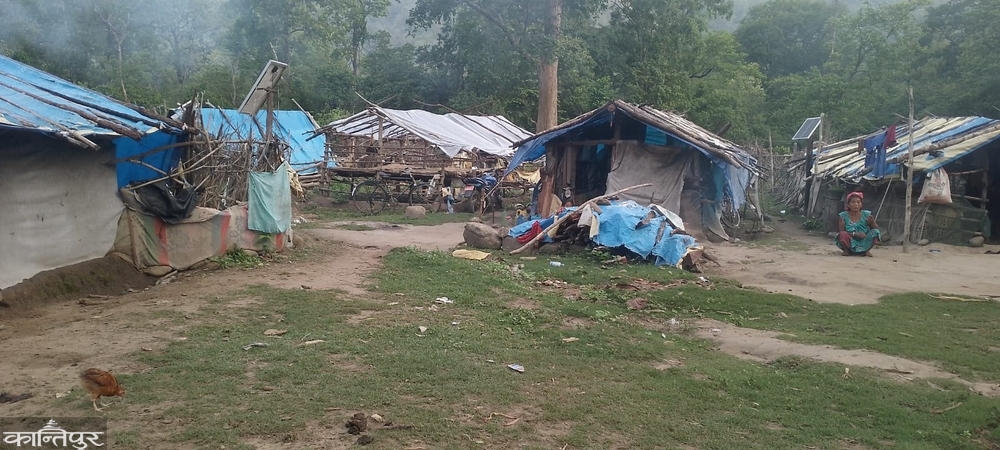
There are many huts made of flimsy tarpaulins and bamboo poles on the banks of the Baluwagada River in Chure Rural Municipality-4. The weaker these huts look from the outside, the more painful the story inside is. There is a forest around, a river flowing nearby, and the fear of wild animals and snakes is also equal.
30-year-old Meena Thapa has been living a struggling life in this settlement for the past 6 years. She and her family of four live in a precarious hut that does not even provide basic security. The Thapa family survives by pounding gravel.
6 years ago, their situation was not like this. In 2077 BS, a landslide in Chure's Masurkhet not only swept away their house, but also made Meena's family homeless. Since then, they have been living sometimes near the forest and sometimes in the riverbank. The sky is visible from the spot where Meena is sleeping in the hut where she is now. ‘The tents are all torn and old, and there is no place to take shelter when it rains,’ says Meena. ‘It is a problem to protect your belongings or yourself in the rain.’
Not only Meena, but also 30 other families are in the same situation in this settlement located just above the river and next to the forest. Another settlement in Chure-4 that was displaced by the 2077 landslide lives in Paneru Gana. The condition of this settlement is no less than that of Baluvagada. These settlements are deprived of even the minimum facilities.
According to the data of Chure Rural Municipality, 116 households living in wards 4, 5 and 6 have been displaced by the disaster. According to Kali Bhatta, the information officer of the rural municipality, although the municipality has tried to manage these settlements, it has not been able to manage them due to land acquisition and lack of resources.
According to him, these settlements were located in a safe place near the forest for three years. But in 2081, the Sub-Division Forest Office Khairala drove a bulldozer into the settlement, saying that it was encroachment. Since then, the settlements have been living in risky areas. These settlements in Chure are just examples. The condition of the Bandargaudi settlement in Kailari-4, Kailali, which was displaced by the floods of 2078 BS, is also critical. The settlement, which was located in the local Pavera community forest for some time after the displacement, has not been managed even after four years.
Why could not the rehabilitation take place?
Due to the lack of budget under the heading of rehabilitation of disaster-affected people, many settlements in Kailali and Kanchanpur, such as Baluwagada, have not received grant money. According to the Ministry of Internal Affairs and Law of the Far Western Province, more than 50 million rupees have been spent on rehabilitation in the current fiscal year alone.
Of which, Rs 30 million was allocated by the province for rehabilitation, while Rs 20 million was spent from the disaster management fund. All this money has been spent on disaster-affected people in hilly districts. According to Janak Dhami, the ministry's disaster contact person, the first, second and third installments have been distributed to those affected since 2077. 'This year, Rs 50 million has been spent on rehabilitation in seven hilly districts except Kailali and Kanchanpur,' he said.
According to the Disaster-Affected Private Housing Reinforcement, Reconstruction and Rehabilitation Grant Procedure, 2081, arrangements have been made to provide a grant of Rs 500,000 in hilly districts, Rs 400,000 in hilly districts and Rs 300,000 in Terai districts to beneficiaries whose houses have been damaged due to disasters and need to be reconstructed. There is a provision for an additional Rs 300,000 for land purchase for affected families who do not own land for house construction or who have to relocate due to the risk of their previous location. If both land purchase and house construction are required, there is a provision for a total grant of Rs 800,000 in the Himalayan region, Rs 700,000 in the hills, and Rs 600,000 in the Terai.
Accordingly, it appears that the affected families of Chure will receive a grant of Rs 600,000 since they need both a house and land. According to the rehabilitation procedure, the federal government will bear 50 percent of the cost for house construction, the province 30 percent, and the local level 20 percent. However, in Kailali and Kanchanpur, the local level has not been able to secure land, according to Krishna Shahi, Senior Deputy Secretary of the Ministry. 'The province will do its share in relocation or rehabilitation. We will spend 30 percent of our budget on settlements where the demand has been received and the process has been completed.' The rest will be done by the union and local levels,' he said. However, the province is spending money for the construction of houses in the settlements where the process has been completed by the union and local levels.
According to the working procedure, it seems that permanent housing and land should be arranged for 116 displaced families in Chure at the rate of Rs 600,000 per family. For which a total of Rs 69.6 million is enough. This amount is less than half of the Rs 164.2 million frozen by the provincial government in the last 6 years.
According to the cost-sharing procedure of the three levels of government, the federal government will have to bear only Rs 34.8 million, the provincial government Rs 28.8 million and the local level Rs 13.9 million for the displaced settlements in Chure. Thus, if a total budget of Rs 69.6 million is ensured, the housing problem of 116 families who have been living a difficult life under tents in Bagar for the past 6 years will be solved. But Chure Rural Municipality Chairman Chakra Bahadur Bogati said that there is a problem in securing land for the relocation of the settlements.
He said, ‘There is no safe place in Chure to relocate them. We have tried to manage them many times. The land where we have taken them is within the forest. The forest uses dozers saying it is encroachment.’ He informed that coordination is being done with the district administration to resolve this problem. He said that if the land is secured, the municipality has planned to build houses even after mobilizing resources.
Pradeep Kumar Koirala, Executive Chief of the National Disaster Risk Reduction and Management Authority, says that the local government should secure the land. He said that only after the municipality completes the process and identifies the beneficiaries and secures the land, the affected people will receive grants as per the procedure.
According to the authority’s data, 4,116 disasters have occurred in the Far West in the last 10 years. 429 people have lost their lives due to this. The economic loss due to disasters is also increasing. Although the province allocates a large amount of money for disaster management every year, its implementation has been very weak.
Data from the Ministry of Internal Affairs and Law shows that the regular disaster management budget is being frozen and money is piling up in the disaster management fund. Analysis of disaster expenditure for the last 6 years provided by the ministry shows that the financial management of the provincial government is weak.
According to the data, a total of 537.541 million rupees was allocated for the operation of various disaster programs from the fiscal year 2077/78 to date. During this period, the ministry has been able to spend only 373.3 million. In this way, a large part of the allocated budget, i.e. 164.23 million rupees, has been frozen.
Not only the budget for regular programs, but also the amount of the province's 'disaster management fund' has been spent less than half every year. Only 253.751 million rupees have been spent from the fund in the last seven fiscal years.
In the current fiscal year's budget, Rs 5 million has been allocated for the air rescue program for disasters, Rs 700,000 for the operation of humanitarian aid sites and provincial warehouses, Rs 10 million for the disaster insurance program, Rs 1.8 million for the disaster preparedness awareness program for disaster-affected communities, and Rs 550,000 for cash relief to individuals and organizations for losses caused by disappearances and other incidents.
Similarly, Rs 4 million has been allocated for the transportation of disaster search, rescue, and relief materials, Rs 850,000 for the purchase of disaster search and rescue drones, Rs 4 million for the purchase and installation of flood early warning equipment, Rs 500,000 for the purchase of disaster search and rescue materials, and Rs 30 million for the 30 percent grant to be provided by the provincial government as per the 'Disaster-affected Private Housing Reconstruction Cash and Rehabilitation Grant Procedure' for monsoon-induced disasters and fires. A large amount of this budget is spent on preparedness and public awareness programs. If these activities are not carried out or are reduced, the budget will be frozen, said Janak Dhami, the ministry's disaster contact person.