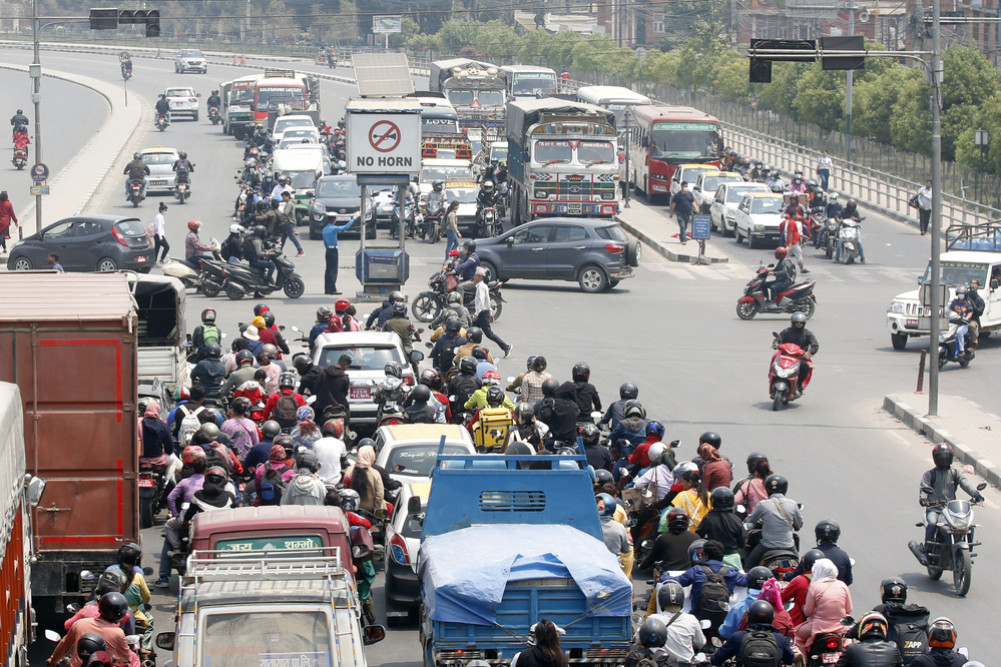
The government has proposed a new law that would impose fines of between Rs 500 and Rs 100,000 on drivers and pedestrians for poor road infrastructure.
We use Google Cloud Translation Services. Google requires we provide the following disclaimer relating to use of this service:
This service may contain translations powered by Google. Google disclaims all warranties related to the translations, expressed or implied, including any warranties of accuracy, reliability, and any implied warranties of merchantability, fitness for a particular purpose, and noninfringement.
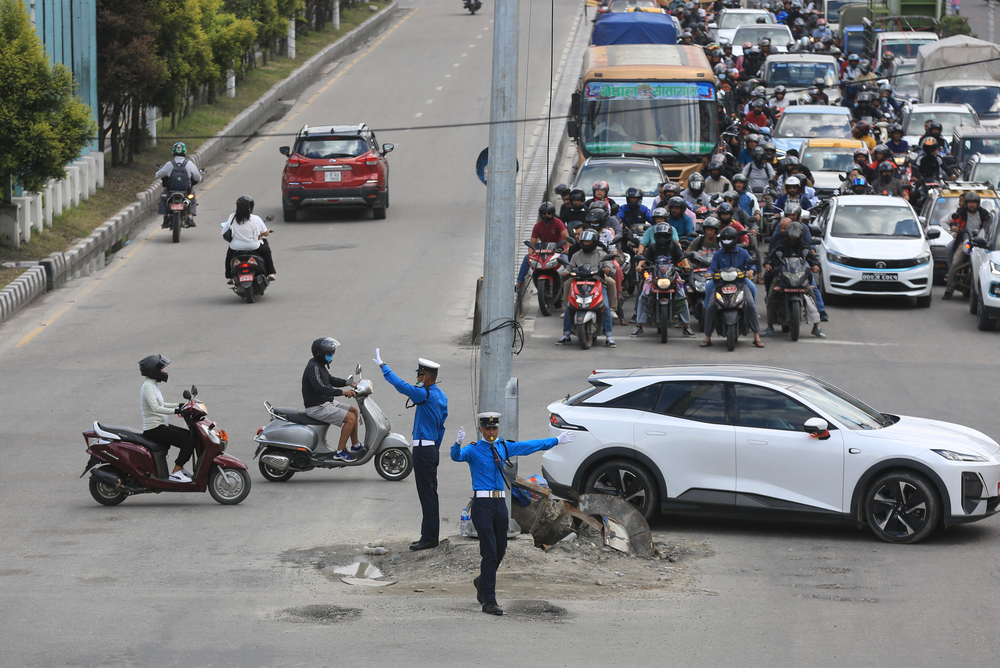
The government is preparing to adopt a policy of stricter traffic rules without preparing a strong infrastructure. The government is going to adopt a policy of binding pedestrians and drivers to strict rules and imposing heavy fines.
A law is being introduced to impose fines ranging from 500 to 100,000 rupees on pedestrians and drivers. The Ministry of Infrastructure Development has prepared a draft bill to amend and unify the laws related to vehicles and transport and sent it to the Ministry of Law, Justice and Parliamentary Affairs, seeking its consent.
The concerned bodies claim that it is wrong to impose arbitrary fines without considering the condition of the road infrastructure. They argue that the rules and regulations should be made considering the income level of the law-abiding people.
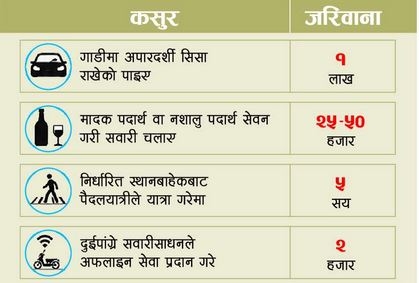
The draft of the proposed bill stipulates a fine of 500 rupees for pedestrians walking on the road from places other than the designated places on public roads. A provision has been made for a fine of 100,000 rupees for those who are found to have opaque glass in vehicles or any other object on the glass to make it invisible inside.
A draft of a completely new act has been sent to the Ministry of Law, said Krishnaraj Pantha, head of the Infrastructure Construction and Transport Division of the Ministry of Infrastructure Development. “Once the agreement is received from the Ministry of Law, we will send it to the Office of the Prime Minister and the Council of Ministers, where it will be approved by the Council of Ministers and then go to the parliamentary committee via the House of Representatives,” he said, “but it does not mean that all the rules that are currently in place will be implemented.”
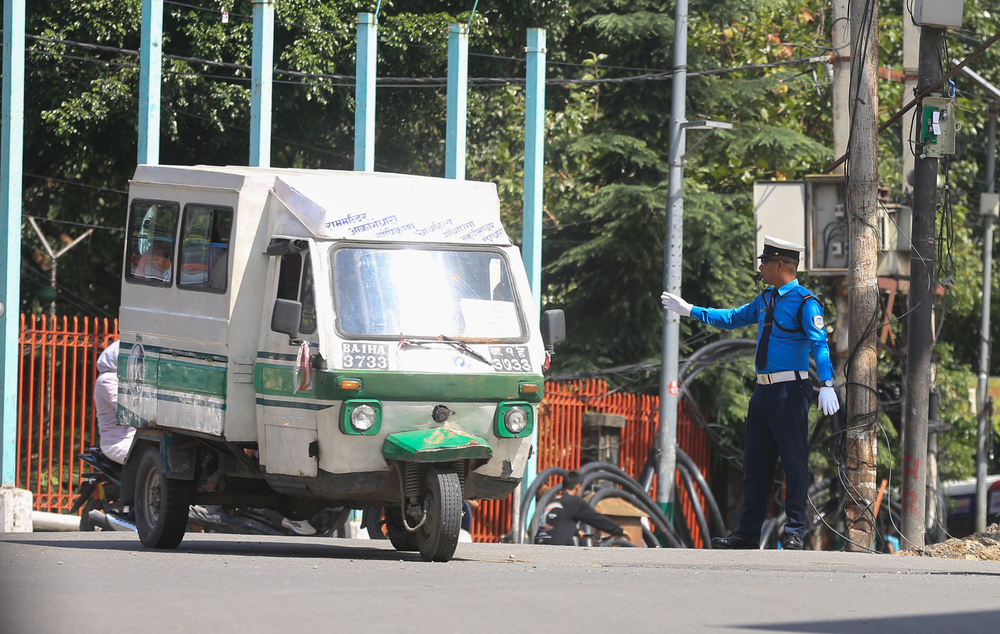
The proposed draft stipulates that drivers who drive vehicles under the influence of alcohol or drugs will be fined Rs 25,000 for two- and three-wheelers, Rs 35,000 for small vehicles, and Rs 50,000 for medium and large vehicles. The law is being brought so that officers up to the rank of police assistant inspector can impose fines if they violate the rules.
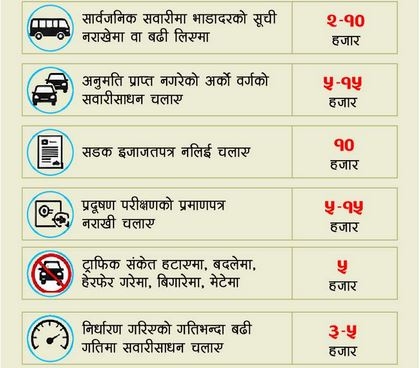
According to the draft of the proposed bill, drivers of two- and three-wheelers who drive vehicles faster than the speed limit will have to pay a fine of Rs 25,000 and those of small vehicles will have to pay a fine of Rs 35,000. Medium and large vehicles will have to pay a fine of Rs 50,000.
‘However, no fine will be imposed if the speed limit is exceeded by five percent,’ the draft of the proposed bill states, ‘If the speed limit is exceeded by up to 20 percent, 20 to 40 percent, 40 to 60 percent, 60 and 100 percent will be imposed if it is exceeded.’
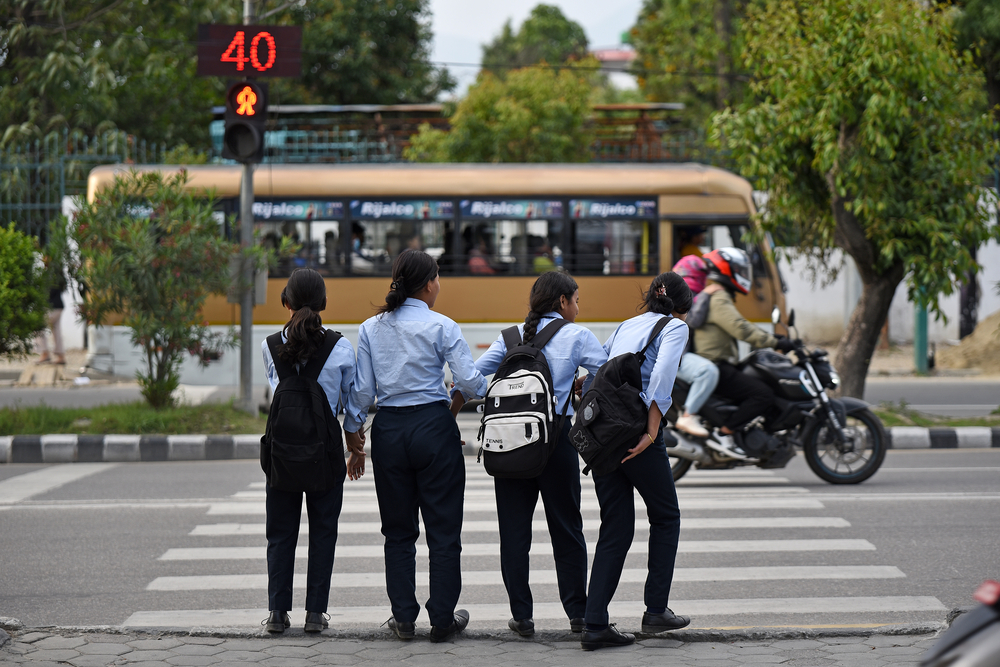
Even if a vehicle is driven at a speed lower than the safe speed limit prescribed for vehicles, a fine of Rs 3,000 to 5,000 will be imposed. However, former Secretary Devendra Karki has commented that the fine mentioned in the law being introduced by the government is not relevant.
‘Before imposing fines, road infrastructure should be of good quality,’ he said, ‘Most of the provisions in the law being introduced are not satisfactory, but the fines prescribed for drunk and freight vehicles are relevant.’
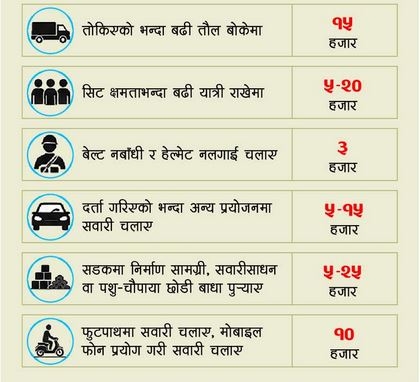
The proposed bill stipulates that if a public passenger vehicle operating on long, medium and short-distance routes is found carrying more passengers than the prescribed seating capacity, it will be fined 20,000 rupees for long-distance routes, 10,000 rupees for medium-distance routes and 5,000 rupees for short-distance routes. A fine of 3,000 rupees will be imposed for driving without wearing a seat belt and helmet. Road safety expert Bhagwati Sedhai said that the risk of accidents is increasing due to poor road infrastructure and non-compliance with safety rules.
‘According to World Health Organization statistics, 28 people die in Nepal per 100,000 population in a year,’ she said. ‘This is the highest rate in the world. If action is taken carelessly without good infrastructure and regulatory technology, it is unforgivable.’ She says that this is like a crime against citizens. ‘It seems that a little ruthlessness should also be done to make road users follow the rules,’ she said.
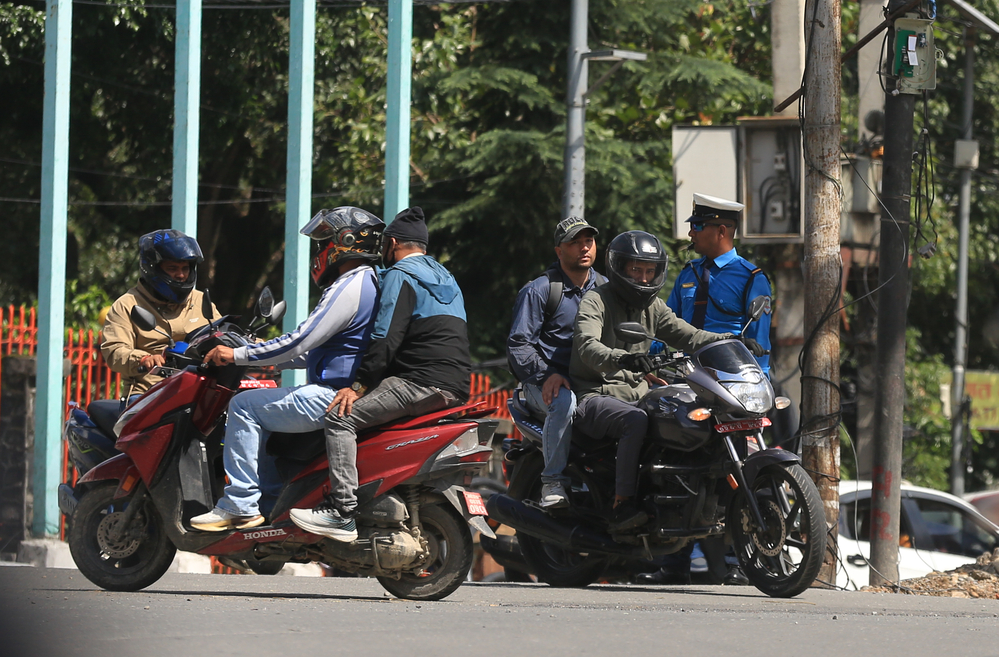
She says that strict action must be taken to reduce accidents. "The government that enforces the rules should build road infrastructure accordingly," she said. "By making the rules stricter, vehicles should be operated only on bad, difficult and difficult roads by meeting the standards." She said that while making laws to impose such high fines, it is necessary to inform as many road users as possible about road safety.
The law is making a provision to refund the excess fare to the passengers who charge more than the prescribed fare without keeping a fare list on public transport and impose a fine of Rs 2,000 for three-wheelers, Rs 5,000 for small vehicles, and Rs 10,000 for medium and large vehicles.
Former DIG Keshav Adhikari said that while laws are being brought to punish citizens, the state should also be held equally responsible. "Those who break the system should be fined," he said. "But where the system itself has not been developed, the road infrastructure is not good, traffic signs are not understood and visible. The level of awareness among drivers is very low, and if road users do not even know the meaning of traffic signs, how can they impose such high fines?’
The official said that although the fines are five times higher than here, there is a system in place there. ‘It is fair that people pay taxes there. But what is wrong here?’ He said, ‘We should also look at the income level of Nepalis.’ He claims that this will not control accidents but will increase them.
‘I also worked in the traffic police for a long time. With a fine of 500/1,000, the risk of many accidents increases when drivers take a U-turn when they see a traffic policeman a hundred meters away,’ he said, ‘Now there is talk of imposing a fine of 50,000. This is something that current road users cannot even think about. The state must be serious about this.’
He argues that the proposed fine for installing black glass is appropriate. ‘Common people do not drive vehicles with black glass and stickers, only high-ranking people do,’ the official said.
Former directors general who have worked in the transport sector for a long time have also argued that it is not appropriate to impose high fines. Former director general of the Department of Transport Management, Chandraman Shrestha, has said that in any country, any type of fine is imposed based on the income level of the citizen.
‘In Nepal, there is no need to impose such high fines for violating traffic rules. If it were 5,000 for drunk driving and 2,000 for lane violation, everything would be fine, everyone would get in line,’ he said, ‘But with the current inflation, the burden of such high fines is not bearable.’
Therefore, Shrestha says that the laws and fines to be made now should be bearable by the people. ‘If we impose high fines and collect more revenue, it will have a negative impact,’ he said, ‘It does not seem like the proposed fines will come exactly as they are now. The parliamentarians elected by the people will also look at it and make an appropriate decision.’
MP Gyan Bahadur Shahi also emphasizes that the government should create the infrastructure accordingly before introducing new provisions related to traffic rules. ‘Not protesting, rules should be followed, action should be taken, people should be prepared,’ he had said in the House of Representatives meeting on Sunday, ‘Today, citizens can pay a fine of up to Rs 100,000 for violating traffic rules, if they can, they should pay it. While citizens are paying a fine of Rs 100,000, if a pothole is found on the road, will the state pay Rs 100,000 or not? Will they pay Rs 100,000 or not if they do not install traffic lights? Will they pay Rs 50,000 or not if the traffic police misbehave? Will they pay Rs 50,000 or not if they do not get a license within a week of passing the trial?’
He also appealed to Law, Justice and Parliamentary Affairs Minister Sobita Gautam to bring a law to prosecute the relevant bodies and contractor companies in the industry that kills people if the road conditions deteriorate and an accident occurs. ‘Law is for the state and the people, not to punish the people,’ he said, ‘Law should be brought, but the relevant bodies should also be held responsible.’