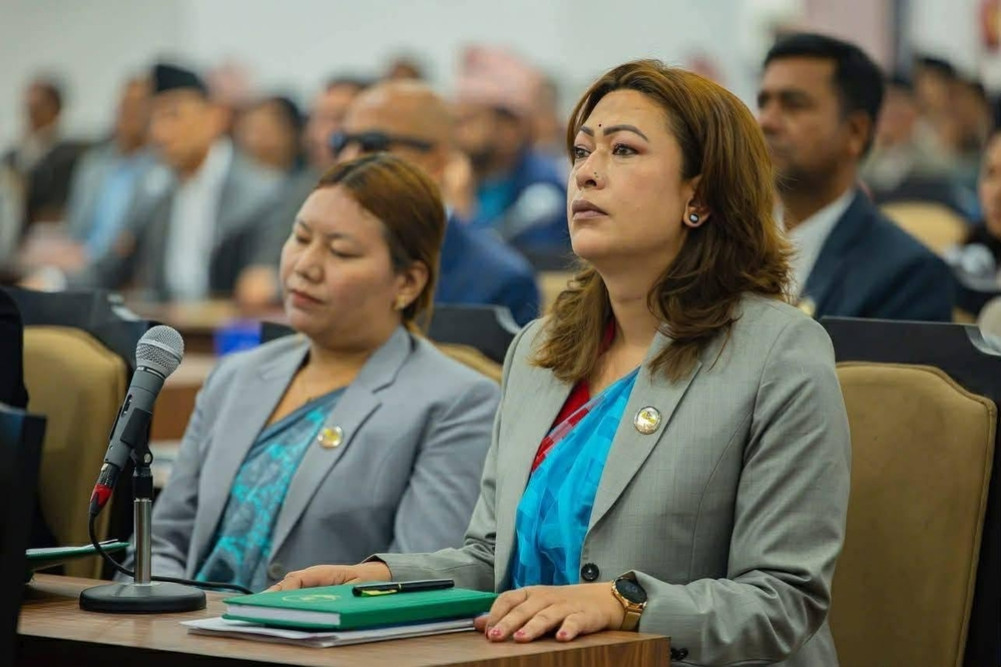
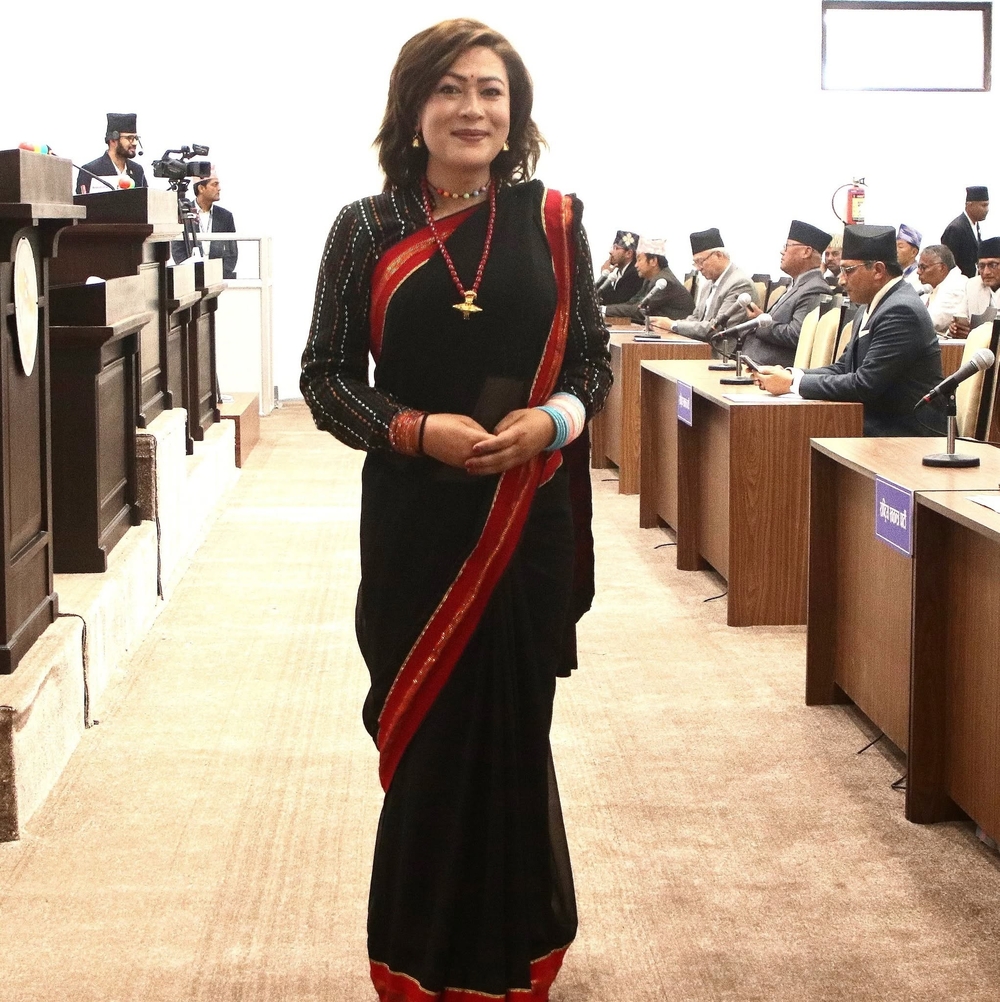
Bhumika Shrestha, who has been fighting for the rights of sexual and gender minorities from the streets for two decades, is a transgender MP in the House of Representatives. She has played a strong role in lawmaking in areas ranging from the LGBTQIA+ community to children.
We use Google Cloud Translation Services. Google requires we provide the following disclaimer relating to use of this service:
This service may contain translations powered by Google. Google disclaims all warranties related to the translations, expressed or implied, including any warranties of accuracy, reliability, and any implied warranties of merchantability, fitness for a particular purpose, and noninfringement.
Anwesha Wagle (Kathmandu)
Bhumika Shrestha's last 3 months have been historic. Bhumika, who started her struggle for the rights of sexual and gender minorities from the streets for two decades, ended up fighting in the House of Representatives as a transgender MP. She is also a member of the Law, Justice and Human Rights Committee of the House of Representatives and has taken many initiatives for the rights of sexual and gender minorities.
On her initiative, the name of the 'Ministry of Women, Children and Senior Citizens' was changed to the 'Ministry of Women, Children, Sexual and Gender Minorities and Social Security'. 'I did not expect the name of the ministry to change like this,' says Bhumika, 'I was also surprised.'
However, she has a unique experience of the pain, frustration and contradictions of being an MP in Nepal's democratic practice. In Bhumika's view, there are 'progressive' court decisions on one hand, and a slow-moving government mechanism on the other, and a 'symbolic' identity on the other, and a lack of power on the other.
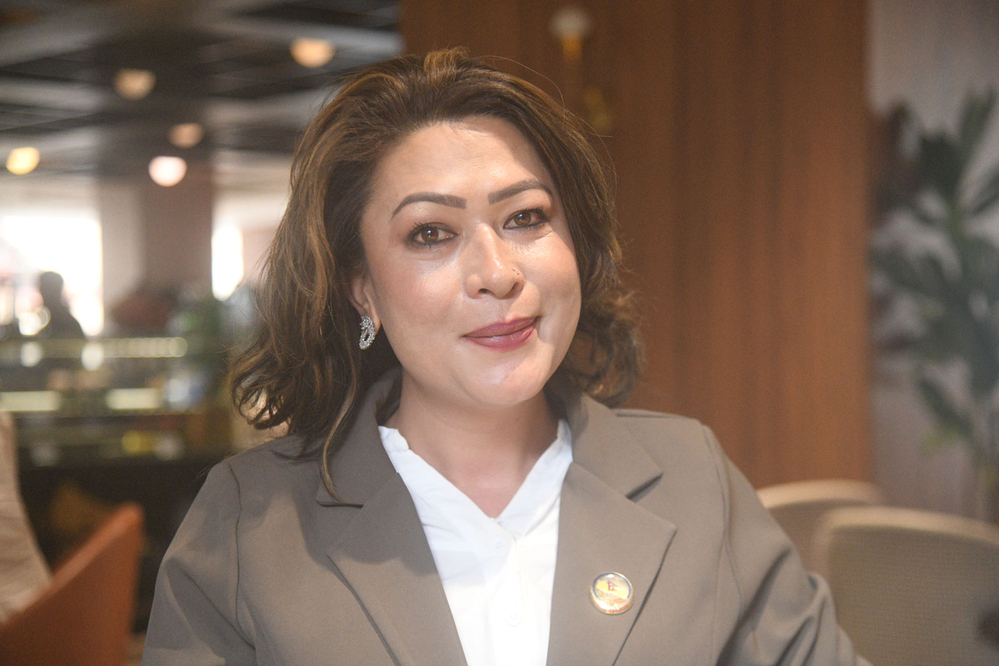
Bhumika did not experience this when she entered parliament. For her, the classroom became a place where the gap between who she was and how society perceived her became clear. When teachers taught her about gender, other students would turn and look at her. 'I felt like I was the only person in the world with a different biological body and mental identity,' she says. 'I even tried to commit suicide.'
She was teased and insulted by her own classmates. By the time she reached grade 8, she stopped using the school toilet. She stopped drinking water during school hours. 'That's why I have kidney stones now,' she says. At that time, there was no one to explain the changes and feelings going on inside her. She had not even found a word to give a name to her identity, ‘Who am I?’.
Someone introduced her to her identity for the first time while she was waiting for a bus at Ratna Park. It was in 2060. Pinki Gurung, who was working as an activist at the Blue Diamond Society, saw a teenager near the gate of Ratna Park, wearing black pants, a white shirt, a red woolen half sweater, long red hair darker than the sweater, and a ratai tika on her forehead.
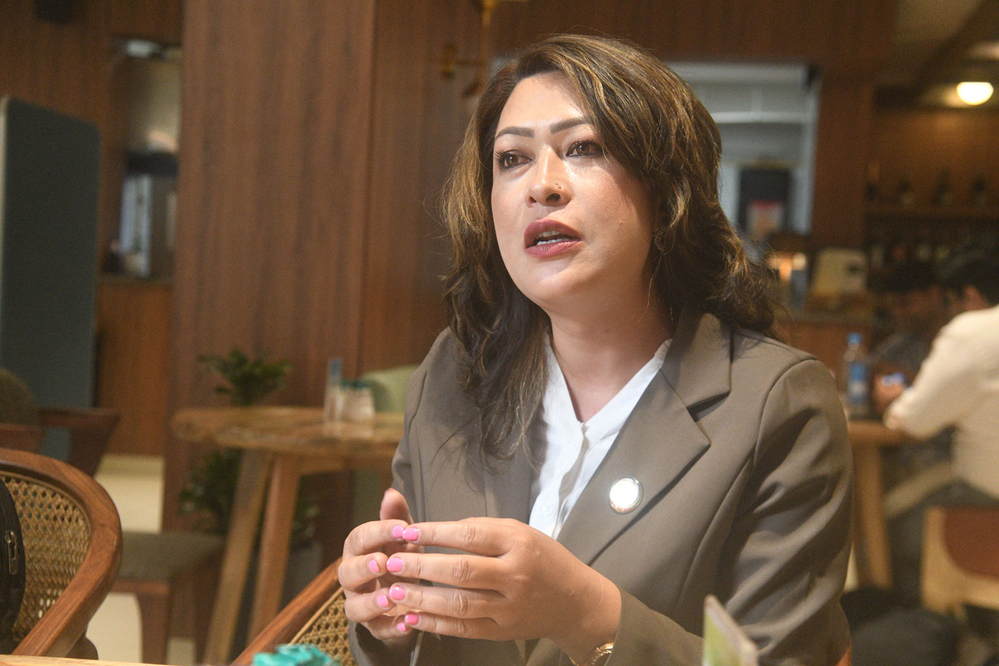
‘I knew she was trans as soon as I saw her,’ Gurung recalls. But she seemed scared. She knew nothing about the community. She was still a child, unaware of the LGBTQIA+ community, who had never seen anyone else like her. That same day, Gurung spoke to Bhumika and brought her to the office. She was 15 years old at the time.
Bhumika understood from that organization that she should work for her community. From a volunteer to a trainer, she rose to the organization's central responsibility. She identified potential leaders within the trans community, enrolled them in leadership development training, documented and monitored incidents of violence against sexual and gender minorities. She also conducted legal awareness and counseling sessions for community members struggling with a system that lacked legal recognition.
She repeatedly organized press conferences to inform them about the difficulties faced by the community. Not only that, she constantly put pressure on government agencies such as the District Administration Office, the then District Development Committee, and the municipality, as well as political parties, demanding that citizenship be issued that reflected transgender identity.
The decisive turning point in this campaign came in 2064, when the Supreme Court delivered a historic verdict that gender identity should be determined based on a person's self-identification, not a medical test. It also ordered the state to give legal recognition to transgender people. After that verdict, her advocacy focused on one thing: to implement the court order in practice, not just on paper. That constant struggle, held in meetings and behind the scenes, established her as a public figure. She had become a familiar face even before the election took her to Singha Durbar.
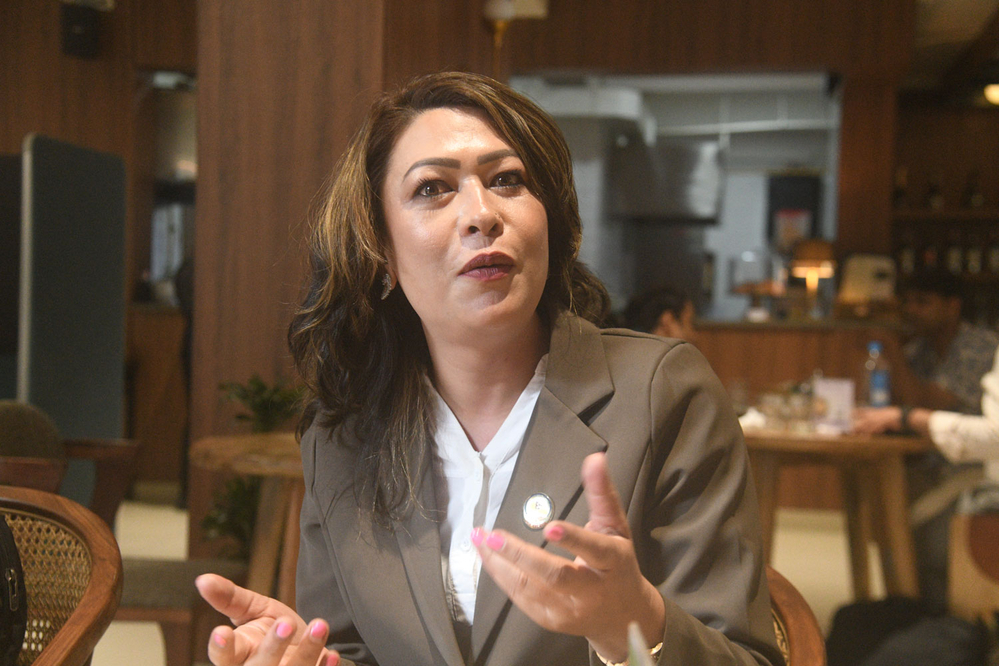
‘She was one of the few trans people who was not afraid to come out from a young age, she never hid her identity and this openness became the foundation of her advocacy,’ says Pinky, who has been closely following her for two decades. ‘The platform and opportunities she got after joining the Blue Diamond Society further helped her develop her skills.’
However, the journey to parliament for Bhumika was not easy in itself. She entered parliament through the tribal women’s quota as there was no separate quota for gender and sexual minorities under the proportional representation system in Nepal. This fact highlights both the progress Nepal has made in inclusivity and the structural contradictions that still remain.
Her daily life as an MP is busy. Sometimes the parliament session runs from 11 am to 7 pm, the session is shortened only on days when the parliament is disrupted. On other days, she is busy with parliamentary committee meetings, subcommittee programs and ministry runs. She has very little time outside parliament. “Nowadays, family and friends joke that you even forgot our birthdays, you don’t care about us,” she says, “but you have love. But since this is the initial stage, I am still learning how to manage my time.”
Meanwhile, at a meeting organized for proportional representation lawmakers, she raised the issue of years of administrative confusion with Prime Minister Balendra Shah, which became her most tangible achievement so far. According to the Nepal government’s division of labor regulations, no ministry was formally assigned the responsibility of looking into sexual and gender minority issues. For years, activists had to go from one ministry to another, and ministries would dismiss the issue as not falling within their purview.
Shrestha had only demanded an expansion of the ministry’s scope. But the government directly changed the name of the ministry. Such structural victories, which are rarely possible through street protests and only occasionally through the legislative process, also show how much further the rest of the agenda still needs to be advanced.
For more than two decades, the role has focused on a single community. But Parliament has broadened its scope. “I can’t just speak up for my community, I have to look at many other issues, from children’s issues to children’s issues,” she says. That’s why she wanted to sit on the Law, Justice and Human Rights Committee, where she is currently active on the subcommittee looking into the issue of children in orphanages. On the committee, she is pushing for amendments to the Children’s Act to include ‘intersex’ children.
‘Intersex’ refers to a person born with biological characteristics whose reproductive organs, chromosomes or hormones do not fully match the criteria for traditionally defined male or female. It is a biological condition that is innate, not a matter of identity or personal choice. The concerns she is raising now are particularly linked to medical practice.
When an ‘intersex’ baby is born, doctors and families sometimes perform surgery to permanently assign a sex before the child is old enough to understand or consent to their own body and identity. The aim of such surgery is often to shape their bodies to conform to social norms of male or female. It is not yet a crime under the law.
Bhumika has proposed replacing the gender-discriminatory legal provision on adoption with the gender-neutral term ‘adopted children’. ‘If children are safe, they will not have to face problems when they grow up,’ she says. These are still efforts in progress, not achievements. No laws have been passed yet. She understands that the work of law-making will be limited beyond the headlines, mainly to committee meetings, ministerial rooms and consultations.
She has also experienced how processes can be stalled for reasons outside of parliament. ‘When different LGBTQIA+ organizations bring conflicting suggestions to the ministry, the process stalls,’ she says. ‘A lot of our energy is now being spent on getting everyone to agree on a common document.’ Some issues are not just slow, they are completely stalled. The Home Ministry has put on hold the process of applications for legal recognition of gender identity, a process that Bhumika herself completed in 2080. “I am now preparing to speak on this issue next time it is my turn,” she said.
The problems and obstacles are not just administrative. She is also grappling with differences within her own movement. After entering parliament through the tribal women’s quota, she faced criticism from within the LGBTQIA+ community for ‘occupying a women’s seat.’ In response, she says, “There is no separate cluster for gender minorities in the current electoral system. My inclusion in the category of women is a practical obligation of the current legal structure, although I am fighting to expand those categories. No matter how I got to parliament, I went there to raise the voice of my community. But when some friends from my own community object, I feel sad.”
The second controversy is more serious, which focuses on the issue of what gender symbol transgender people should receive in citizenship. Sunilbabu Pant’s 2007 case set a precedent for the state to grant gender identity based on self-perception rather than medical examination for the first time. According to Shrestha, Pant is now pressuring the Home Ministry to limit transgender people to the citizenship designation of ‘other’ so that having a separate category shows the power of the population. MP Bhumika and many other organizations oppose this.
The ‘other’ designation on citizenship now limits access to civil service positions, meaning that the choice of gender designation affects not only identity but also employment opportunities. Bhumika says, ‘The right of any person to be identified according to their choice and perception should not depend on the opinion of anyone else.’ Article 12 of the 2072 Constitution clearly guarantees the right to citizenship with a gender identity according to their self-perception. The 2007 case, which Pant himself won, established the principle of ‘self-perception’, where gender identity is determined by the person concerned, not by an employee or activist. Pant himself claims that his identity is listed as ‘male’ on his passport. When Kantipur spoke to him on this issue, Pant saw no contradiction in this. ‘Advocacy for human rights is not limited to one’s own category. One does not have to be a woman to advocate for women’s rights.’ Pant’s support for the ‘other’ category is not to force everyone into it, but to give legal recognition to those who fall outside the traditional definition of male and female. He argues that it is necessary to pay attention to the international human rights framework as well as the multi-gender norms in Nepal’s own indigenous traditions.
Even where the law has been amended, it is not being implemented in practice. Shrestha says, ‘While it is important to get citizenship and gender identification, the work of the movement is not over yet. Marriage equality is the main agenda now and it is a crucial issue for the community.’ She is equally clear about her situation, saying that despite making such a big leap as an MP, she still does not have the right to legally marry.
२०८० असार (सन् २०२३) मा सर्वोच्च अदालतको अन्तरिम आदेशपछि समलिंगी जोडीहरूले आफ्नो विवाह दर्ता गर्न त पाएका छन् । तर, मुख्य विवाह दर्ता किताबमा नभई छुट्टै अस्थायी नागरिक दर्ता किताबमा मात्र । ती प्रमाणपत्रहरू स्पष्ट रूपमा ‘अस्थायी’ हुन् । २०८१ मा अस्थायी मान्यता पाएयता नेपालमा मात्र ३५ समलिंगी जोडीले मात्र विवाह दर्ता गरेका छन् । तर ती जोडीले सम्पत्तिमा अंश पाउन, एकअर्काका लागि स्वास्थ्यसम्बन्धी निर्णय लिन वा धर्मसन्तान राख्न पाउँदैनन् ।
तर भूमिकालाई लाग्छ, उनको यात्रा त भर्खर सुरु हुँदै छ । उनीसँग एउटा यस्तो दृष्टिकोण छ, जसले संसद्को प्रतिनिधित्वलाई प्रभावमा र दृश्यलाई स्थायी परिवर्तनमा बदल्न खोज्दै छ । उनको पाँचवर्षे योजनामा अंशबन्डासम्बन्धी कानुनमा ‘छोरा’ वा ‘छोरी’ को सट्टा ‘सन्तान’ जस्ता लैंगिक तटस्थ शब्दहरू राख्ने, शिक्षक तालिमका निर्देशिकाहरू परिमार्जन गरी कक्षाकोठामा एलजीबीटीक्यूआई प्लस पहिचानबारे सही ढंगले पढाउने र नयाँ शौचालय बनाउनुको सट्टा भइरहेका शौचालयहरूलाई नै ‘लैंगिक तटस्थ’ घोषणा गर्नेजस्ता व्यावहारिक बुँदाहरू समेटिएका छन् । ‘अब हामी प्रतीकात्मक बजेट र तालिमभन्दा माथि उठेर वास्तविक कार्यमुखी कार्यक्रमहरूमा जानु आवश्यक छ,’ उनी भन्छिन्, ‘मेरो भिजन अझै ठूलो छ र मभित्र धेरै सम्भावना बाँकी छन् ।’