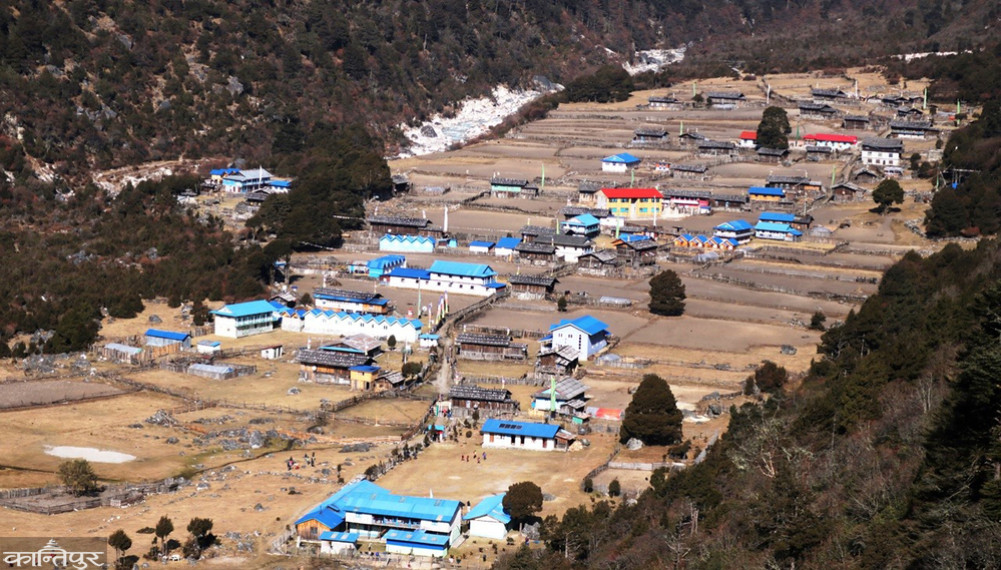
Settlements that are usually covered in snow after Mangsir are at risk of landslides and floods during the rainy season. Residents of the Himalayan region are forced to complete development work in a short time after Baisakh.
We use Google Cloud Translation Services. Google requires we provide the following disclaimer relating to use of this service:
This service may contain translations powered by Google. Google disclaims all warranties related to the translations, expressed or implied, including any warranties of accuracy, reliability, and any implied warranties of merchantability, fitness for a particular purpose, and noninfringement.
Nupu Sherpa of Olangchunggola, Faktanglung-7, Taplejung, got a chance to chat with his friends after two months on Saturday. He has been working all day, feeding his yaks, making arrangements for his house, and building the village's sewer and road.
The ward office had allocated 900,000 rupees this year for the construction of sewer and road in his village. 'The planning work in the village is now being completed, the committee members go to the municipality and submit the bill and come back with the payment. After distributing the money for the work, I finally have full freedom,' said Nupu. Usually, if you work here all day, you get a wage of 1,000 rupees. But Nupu says that since he has to implement the budget of his own ward and work according to the estimate, he does not get the amount according to that.
Ward chairperson of Faktanglung-7, Cheten Sherpa Lama, and ward members have already reached the municipality center, Tapethok. They have reached the municipality to ensure the amount their ward will receive in the budget for the upcoming fiscal year. The ward has also discussed in the village how the amount will be used in the upcoming year.
The work of placing the idol in the Sodo Pond of Tokpegola, Papung, Mikwakhola Rural Municipality-5, located at an altitude of 3,100 meters, has just been completed. The ward office has constructed a place to place the idol here with the help of the rural municipality and Nepalis living in the US. According to ward member Topla Sherpa, this is the biggest project of the upper settlement. All 13 family members living in Tokpegola and residents of the settlement of Papung, which is a day's walk away, participated in it.
There is a lot of activity in the mountainous settlements above 3,000 meters at this time. Human activity in the mountainous settlements that are empty throughout the winter occurs only after Baisakh. Development work in these settlements also occurs only during this time. There are mountainous settlements in the district, Olangchungola, Ghunsa, Phale, Tokpegola, at an altitude of 3,100 meters. Yangma and Khambachen are at an altitude of 42 meters. There are no settlements higher than here.
Most of these settlements are deserted in winter. Many people descend to the Aul to escape the cold. They only start climbing after Falgun. They live in the villages from Baisakh to Bhadau. Schools and government offices here also open regularly only during the rainy season. ‘No matter how much rain falls, we have to work now,’ said Nupu, ‘In winter, the snow completely covers the work area, and even in monsoon, at least the work area is clear.’
When implementing development projects, villagers work in groups. If they have to work far from the settlement, they take tents, cooking utensils, rice, and vegetables. ‘We have to go and stay where the work is and work from dawn to dusk,’ added Ward Chairman Chheten, ‘The villagers work 13/14 hours a day, if not, it will not be possible to work here.’
When working like this, the decision is made in advance who will do tea, cook food, carry goods, and other tasks. Everyone says that they will do their own work accordingly. Outgoing ward chairperson Cheten Sherpa Bhote informed that since it has to be completed in a short time, the work of looking after children and livestock from every house is entrusted to a few people.
In Himalayan settlements, there are usually plans for constructing paths, bridges, etc. ‘The geography is vast, what is done in one place this year will have to be done in another place next year. The budget is also small, and the work is done in the same way,’ said Sherpa, a ward member of Mikwakhola-5, ‘The life of the people of the Himalayan region is different. If you live in the village, you have to sit in silence from Mangsir to Falgun.’
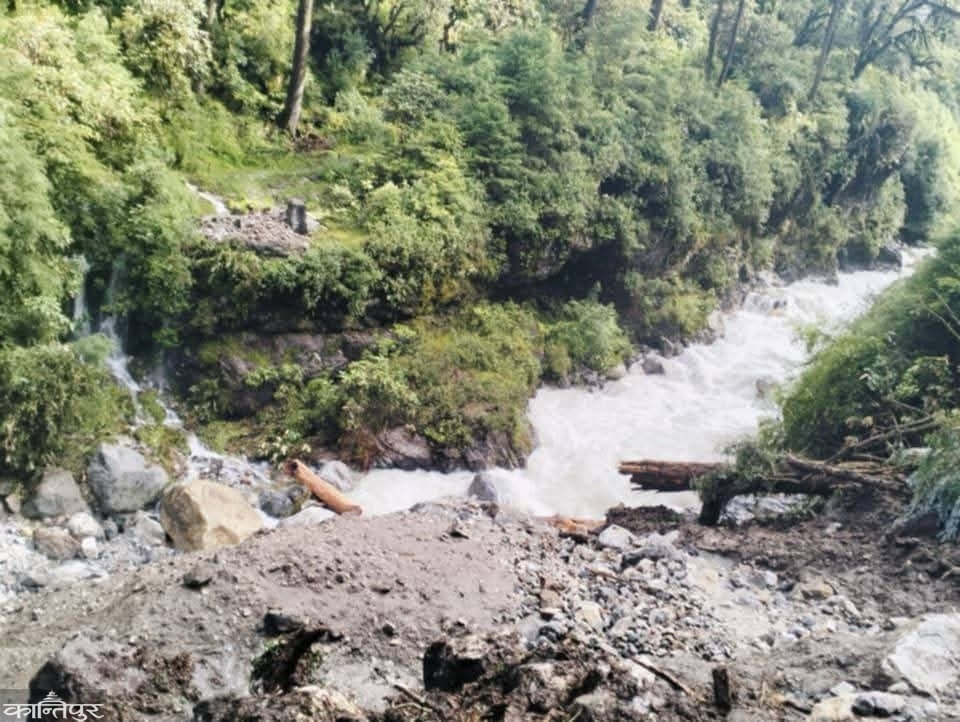
Since it snows from Mangsir, there is almost no work including farming. He said that some years, the village has to be left from Kartik. In recent years, there has been increased concern among the locals as it has snowed in Baisakh and Jestha. To cope with the snow, food and clothes for people, grass, straw, and hay for livestock should be arranged . Alternative arrangements should be made outside the settlement ‘Even during the monsoon, villagers have to stay stuck at times,’ said Ward Chairman Chheten, ‘The river floods wash away the bridge. The footpath is often not suitable. Even if it is built, it is not possible until the water stops. Therefore, we must be prepared to be stuck whenever and for as long as possible during the monsoon.’
He says that due to the lack of a footpath and bridge from Olangchungola to the district headquarters, Phungling, he has been unable to reach the district headquarters, Phungling, by going around Ghunsa and Papung many times. He said that even if there was a road and bridge, he had to travel for five days in an emergency for a day’s journey. Locals say that they have to stock up on food for at least two to three months, be it winter or monsoon. There are 62 families living in Olangchungola, 11 in Yangma, 33 in Phale, 44 in Ghunsa, and 13 in Tokpegola.
It is difficult to reach one settlement from another due to snow in winter or rain in monsoon. To get from one settlement to another, one has to cross dozens of ravines. In every ravine, snow in winter and rain in monsoon have caused landslides. It is not possible to climb uphill during snowfall, and there is a high risk of landslides and rockfalls. When it rains during monsoon, there is a risk of landslides and rockfalls. Since the nearest commercial center to these settlements is Riu in Tibet, some of them bring goods from there and some from the district headquarters Phungling for the monsoon. If someone runs out of food in the middle, they have to use a pancho and bring it back when the road opens.
Dawaand Lama, a businessman from Olangchungola, said, ‘There is a trade in goods like biscuits, noodles, soap in every settlement. But rice, flour, lentils, are not kept for sale. Each house brings them from outside and makes arrangements for a long time.’
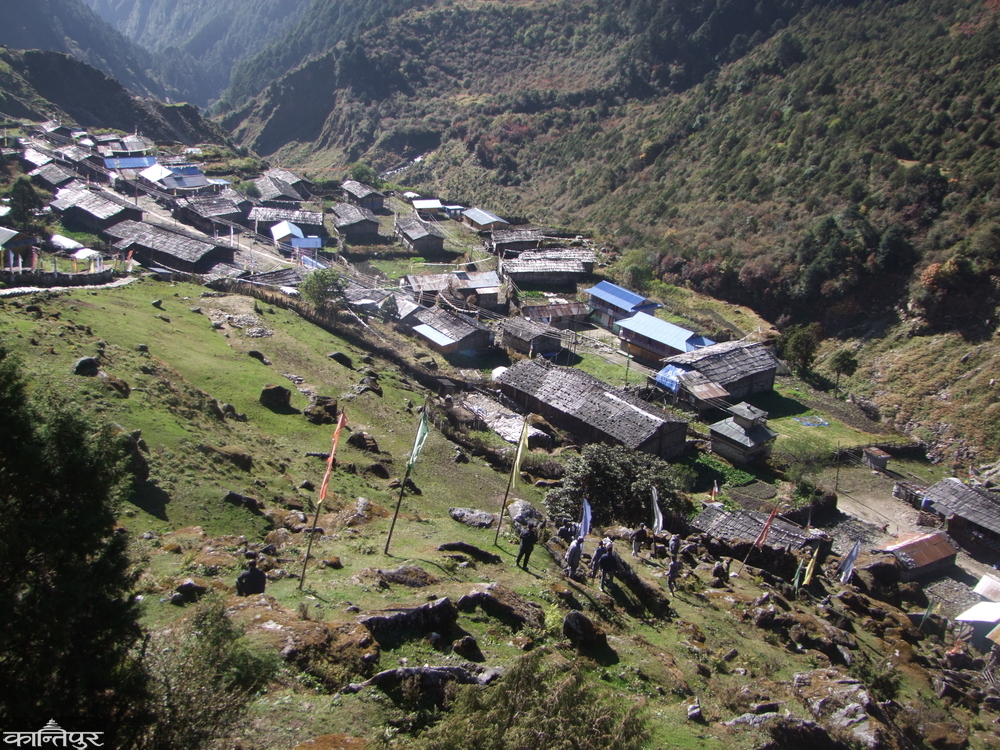
All human settlements are surrounded by mountains and are located in the middle of the plains. In such places, a lot of snow accumulates in winter and it takes a long time to melt. During the rainy season, torrential rains flow. Thasshi Lama from Olangchungola said, ‘In winter, the sun only shines for a short while in the afternoon. You have to sit inside the house by heating the fire. Firewood is used a lot because the rain continues to disturb the house even during the monsoon. The houses are built to keep hay and milk for livestock and calves on the ground floor. People live on the second floor. Houses made of thatch and wood do not have a third floor. After burning firewood in the stove, which is usually built in the middle of the second floor, family members sit in a circle around it.
During snowfall, water taps also freeze here. Locals have to reach large rivers/streams like Tamor and Ghunsa to fill their water. When drinking water pipes are clogged, they have to carry hot water in thermoses to unclog the taps. The taps finally start flowing after the heat melts the frozen snow. Locals say that during heavy snowfall, they should melt the snow that has accumulated in a clean place and drink it. During the monsoon, when the water floods, the water becomes muddy. In such a situation, they say that they filter and boil drinking water.
Whether it is winter or when it rains for many days, the wildlife of the upper Himalayan region comes down in search of protection and food. When they do not get food and suffer naturally, such animals become aggressive and violent. Conservationists say that awareness should be adopted at such times. The Himalayan mountain goats of Ghunsa have the experience that animals that are covered in snow or are affected by heavy rain are afraid of attacking.
To avoid the cold, the government has provided assistance such as distributing firewood in the Terai and lighting fires in villages. News such as preparations for floods and landslides are also made public. However, they complain that no one has ever understood the pain of being trapped in the Himalayan region during the winter. You have to buy warm and thick clothes to avoid snow. Even after being forced to do so, food supplies have to be procured in advance. If someone is sick or in distress, a helicopter has to be chartered. The villagers have to manage this on their own. It is not possible to see a doctor when children have pneumonia during the cold season or when they have diarrhea during the rainy season. Locals say that the police in Olangchungola, Ghunsa and Papung are police officers all year round.