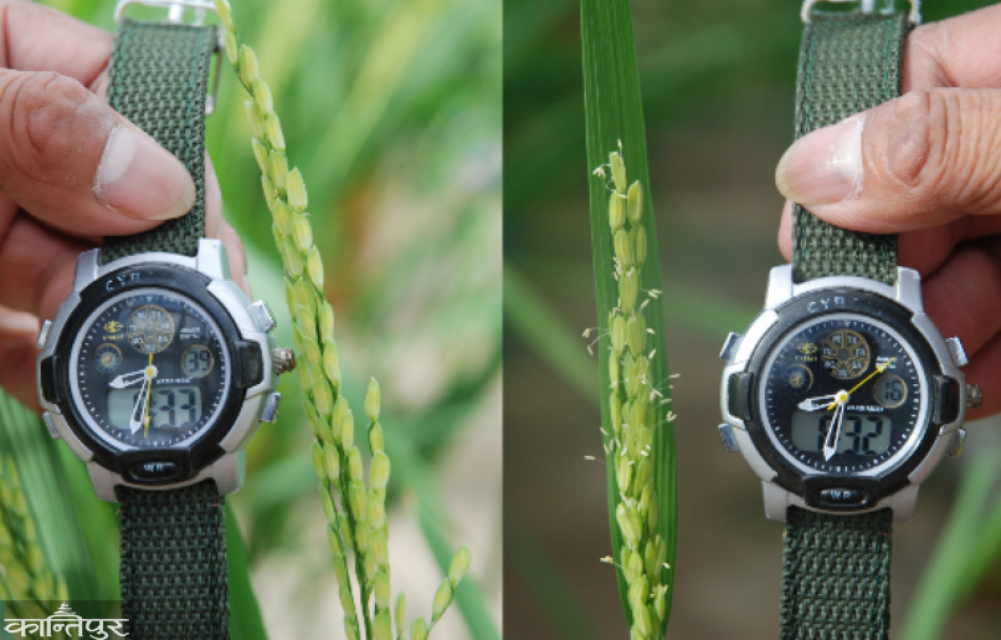
”We can stay in an AC room to escape the heat, but rice has to endure the heat in the field. With the help of EMF-3, rice can also wake up early in the morning and escape the heat. Sometimes, waking up early is beneficial not only for the birds, but also for the crops.”
We use Google Cloud Translation Services. Google requires we provide the following disclaimer relating to use of this service:
This service may contain translations powered by Google. Google disclaims all warranties related to the translations, expressed or implied, including any warranties of accuracy, reliability, and any implied warranties of merchantability, fitness for a particular purpose, and noninfringement.
What do you do when it's hot? You might sit under a tree somewhere. Take the help of fans, coolers, and ACs. But what if it's hot for rice? Can rice be grown during droughts due to lack of rain?
Scientists have discovered a way to grow rice even during extreme heat and droughts to address these problems. Scientists from Japan's National Agriculture and Food Research Organization (NARO), other Japanese research organizations, and the International Rice Research Institute (IRI) have discovered a new gene that can protect rice from extreme heat.
In a research article published in the internationally renowned Plant Biotechnology Journal , scientists have mentioned a gene that helps rice bloom by reducing damage caused by high temperatures.
According to scientists, the flowering process of rice is very short and sensitive. The small flowers inside the spike mature and open for a short time, usually in the morning. As soon as the flower opens, the anther bursts and the pollen is released, and in most rice, the pollen reaches its own anther and is pollinated. After pollination is complete, the flower closes again within a few minutes to one or two hours. If excessive heat, rain, or wind affects pollination during this short period, the grain will not bloom properly.
Scientists say that the timing of rice flowering determines how and how much the grain will grow. A team of scientists including Takuma Ishizaki, Yoichi Hasida, Hiroki Saito, Sung Ryul Kim, Kazuhiko Sugimoto, Michael J. Thompson, Tsutomu Ishimaru and others have discovered a gene called 'Early Morning Flowering-3' (EMF-3). Scientists say that subtle genetic changes in it can move the rice flowering time forward or backward.
Farmers are also facing challenges in crop production due to recent changes in weather systems, including El Nino, during extreme heat and prolonged drought. According to scientists involved in the research, the EMF-3 gene helps rice bloom about an hour and a half earlier than normal. The study has shown that this gene helps in pollination before it gets too hot under the scorching sun, so the seed setting process is safe. Scientists have said that it does not reduce production.
Generally, depending on geography and variety, rice blooms from 10 am to 12 noon. Pollination is also hindered by the temperature reaching 33 to 35 degrees Celsius at that time. Scientists say that this prevents the ears from setting and reduces production. Studies have proven that the newly developed EMF-3 helps rice bloom in the morning by removing these obstacles. Naro scientist Dr. Tsutomu Ishimaru says that it protects rice from heat in its most sensitive state. He says that this discovery was made so that farmers can produce better even in extreme temperatures. According to the researchers, EMF-3 is a rare ‘variant’. They say that it has the potential to be used in popular rice varieties including Indica and Japonica.
Scientists are currently working on incorporating this gene into popular rice varieties such as IR-64, Swarna (India), Pusa Basmati (India), TDK-1 (Laos), Sahel-329 (West Africa), Kaiapo (Brazil) and Toyomeki (Japan).
According to Dr. Hideyuki Hirabayashi, a scientist at NAR, and Kazuhiro Sasaki, a scientist at the Japan International Research Center for Agricultural Sciences (JIRCAS), the gene can be easily used in various rice varieties around the world through DNA marker selection technology.
Similarly, Inez Slamet Loedin, a scientist at IR, says that this trait can be incorporated into high-quality rice varieties through gene editing techniques such as ‘prime editing’. This could help rice in both tropical and temperate regions adapt to climate change, says scientist Loedin. Similarly, research has also found that EMF-3 only changes the flowering time of rice and does not have any negative impact on the normal growth of the plant or its normal production.
Dr. Ishimaru says that crops can also be protected from the heat, just like humans and birds. He says, “We can stay in an AC-equipped room to avoid the heat, but rice has to endure the heat in the field. With the help of EMF-3, rice can also ‘wake up’ early in the morning to avoid the heat. Sometimes, waking up early is beneficial not only for the birds, but also for the crops.”
Dr. Sushilraj Subedi, a scientist at NARC who is also a rice expert, says that ‘gene manipulation’ of crops like EMF-3 will make a big contribution to food security in the coming days. ‘If the flowers bloom early, fertilization will occur early. The temperature at 11/12 o’clock is high. If the flowers can be made to bloom around 8:30 in the morning, production can be increased. If the temperature is a little high on a given day, the pollen can die.
That is why this development is very fruitful,' he said. Subedi says that this technology will be very good in improved varieties. 'Rice is a self-pollinated crop. Its male and female are inside, so it does not matter if the flowering time is a few days. Scientists have tried to shift the flowering time by catching that,' he said.
More than half a dozen seeds suitable for dry weather have been developed in Nepal as well. The developed seeds are suitable for dry weather and do not reduce production much, says Senior Crop Development Officer Prakash Acharya, Information Officer at the Seed Quality Control Center. He said, 'Dry 1, Dry 2, Dry 3, Dry 4, Dry 5, Dry 6 are seeds that are suitable even in dry weather. Similarly, Bahuguni 1 and Bahuguni 2 and Sanwa Mansuli are also varieties that can tolerate both drought and flooding.'
Rice expert Subedi says that the new discovery will help address the challenges in food security due to climate change. 'The discovery and challenge of scientists is to create climate-smart varieties. This will be very useful in such a situation if there is a big difference between morning and afternoon temperatures in the future,' he said.
Climate change is continuously increasing the average temperature of the earth's surface. 2024 was recorded as the hottest year ever. According to the European Copernicus Climate Change Service, in 2024, the average temperature exceeded 1.5 degrees Celsius for the first time compared to the pre-industrial period.
Due to seasonal changes, weather events such as 'heatwaves' and droughts are decreasing. This has also shown that the production of major food crops is decreasing. According to the Food and Agriculture Organization of the United Nations (FAO), rice is the staple food for more than half of the world's population. FAO estimates that the demand for rice will increase by about 12 percent by 2033 compared to 2021-2023, due to the growing population in Asia and Africa.
Agricultural economist Sudha Sapkota, who is also the information officer of the Nepal Agricultural Research Council (NARC), also said that such technologies will provide special support in future food security. "For the last few years, the weather has not been supportive of farmers in Nepal. Moreover, there is a problem of drought during rice planting. In such a situation, it is a good thing that scientists are developing varieties that yield crops that are adapted to the weather," she said.