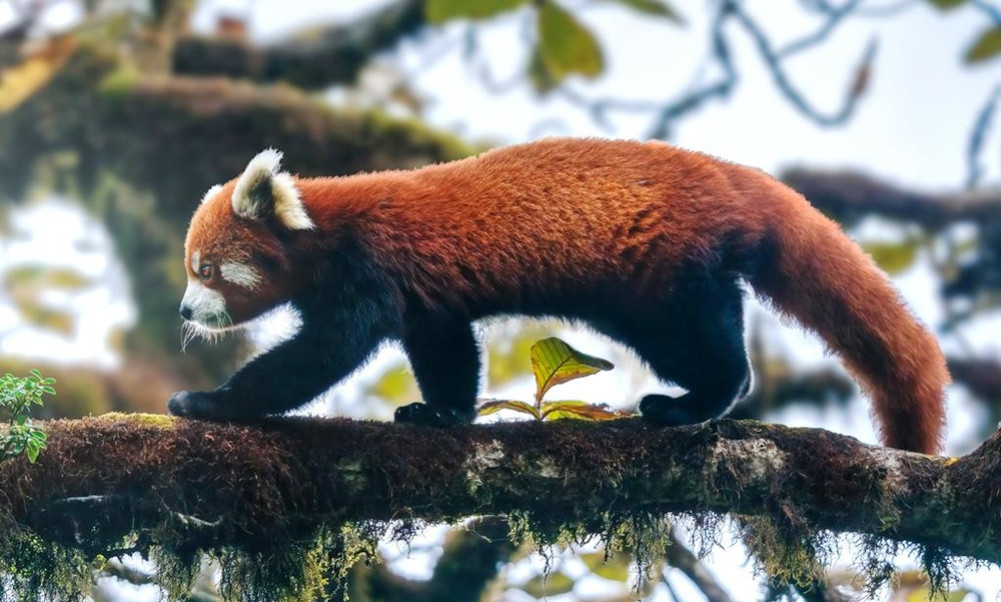
An investment of Rs 65.5 million is being made in organic trails, tree planting, and conservation education in community and national forests of Panchthar, Ilam, and Taplejung.
We use Google Cloud Translation Services. Google requires we provide the following disclaimer relating to use of this service:
This service may contain translations powered by Google. Google disclaims all warranties related to the translations, expressed or implied, including any warranties of accuracy, reliability, and any implied warranties of merchantability, fitness for a particular purpose, and noninfringement.
A campaign to save the endangered red panda is underway in three districts of eastern Nepal. In the three districts of Panchthar, Ilam and Taplejung, efforts are being made to protect the future of the red panda through conservation of its natural habitat, development of biological pathways connecting fragmented forest areas, planting plants for food, improving community livelihoods and conservation education.
Conservationists are running a campaign for these three districts as the PIT Corridor. This year, 65.553 million rupees are being spent for the conservation of the red panda in 42 community and two national forest areas of the three districts included in this corridor. Thousands of trees are currently being planted in the conservation areas in the high hilly areas of these districts. These trees are not only to increase greenery but also to preserve the existence of the red panda.
A campaign to protect the old habitat of the endangered red panda, build new habitats and conserve it is underway in the PIT Corridor. Its food sources include reeds, malingo and bhaluchinde. Programs ranging from planting such plants to restoring biological pathways, mobilizing forest guardians and improving community livelihoods have covered the conservation campaign.

Conservationists say that the conservation campaign was launched after the habitat of the habre, which loves a secluded and peaceful environment, has been fragmented in recent years. 'Somewhere, the forest was destroyed during the construction of new roads, while somewhere else, the encroachment of people and domestic dogs in the forest area has caused difficulties for the habre.' In some places, the existence of this creature has become endangered due to attacks by wild animals, so the conservation campaign was launched in collaboration with donor agencies, the federal, provincial and local levels,' says Sunil Bantawa, executive director of Deepjyoti Youth Club, which is active in the conservation campaign in Ilam and Panchthar.
The main campaign to protect habitat
Nursery management, seedling production, planting and conservation programs for plants such as reed, malingo and bhaluchinde, which are preferred as food by red pandas, are prioritized .
Tree planting has been made the main strategy to reconnect the habitats broken due to forest fragmentation .
According to Bantawa, Executive Director of Deepjyoti, this year, about 40,000 trees are being planted in the Habre Conservation Area alone in the high-hill areas of Phidim, Falelung and Yangwarak in Panchthar.
Last year, 70,000 trees were planted in Ilam. Tree planting is being done on 800 ropanis of land in the Jaubari area of Ilam alone . 'Work is being done to plant and conserve suitable species of trees for the development of biological pathways . Raising awareness at the community level to protect red pandas is the most positive aspect,' says Bantawa. According to him, habitat conservation, study-research and awareness programs are moving forward together in the conservation area. Habre conservation is not seen as just a campaign to protect wildlife but as a long-term effort linked to community participation.
Efforts have been made to make the conservation campaign a community campaign with the community at the forefront of conservation. Locals in the area where Habre is found have been given the responsibility of 'forest guardians' and 'nursery leaders'. Currently, 30 forest guardians have been produced in three districts.
They are working to spread awareness about conservation at the community level, monitor the condition of red pandas and facilitate forest management. Conservationists have defined them as 'local scientists'. Similarly, 12 nursery leaders are handling the responsibility of plant production, nursery management and conservation, according to the Red Panda Network.
To reduce dependence on the forest, programs related to solar energy distribution, nursery management and livelihood are being implemented for households in the Red Panda Pocket area. After this campaign was continued, the community has also become active in the conservation of this creature.
‘Earlier, when we saw the red panda, it seemed strange, we tried to catch it and play with it, but someone would kill it and eat its meat.’ Nowadays, we protect this creature wherever we find it, and if we find it in trouble, we rescue it and take it to the conservation area and release it,’ says Birman Rai of Falelung-4. He also said that in the last four years, three red pandas found in different places have been rescued and handed over to the forest office and conservation workers.
For 18 years, the red panda lives in the cold temperate forest that stretches from about 2200 to 4800 meters above sea level. In Nepal, this creature is found at an altitude of 2400 to 4000 meters.
Habre is called by different names depending on the place. Nepalis call it Pudekundo or Habre, while its English name is Red Panda. It has been 18 years since the community-based Red Panda Conservation Program started in the PIT Corridor. The program has now expanded to 13 districts of Nepal.
Wangchu Bhutia, Project Coordinator of the Red Panda Network, says that forest management, research, school education, habitat management and rehabilitation programs are priorities. According to him, the conservation campaign is becoming more effective when the program is conducted by linking tree planting, conservation education and study and research with each other.
This year, 60 million rupees are being spent
Along with expanding the scope of the conservation program in the PIT Corridor, investment has also been increased. In 2026, a budget limit of Rs 65.553 million has been set for red panda conservation in 42 community forests and two national forests of Ilam, Panchthar and Taplejung, and programs are moving forward within that limit.
Last year (in 2025) in Panchthar district alone, Rs 7.198 million was spent. This year, work is progressing with an allocation of Rs 16.324 million, says Saraswati Neupane, accounting officer of Deepjyoti Yuva Club. The budget is being spent on tree plantation, research, school education, community mobilization, development of biological pathways and habitat conservation.
Studies have shown that 75 percent of Nepal's red pandas are found outside protected areas.
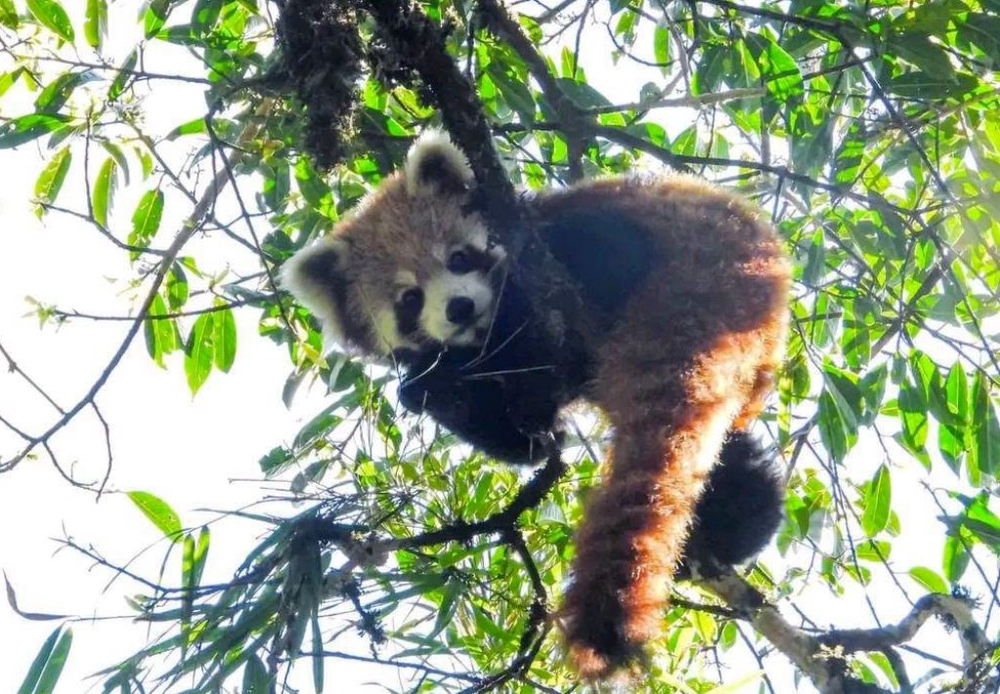
Studies have shown that red pandas are found in 25 districts of Nepal. Studies conducted by the Red Panda Network at various times have shown its presence in Taplejung, Panchthar, Ilam, Sankhuwasabha, Solukhumbu, Khotang, Ramechhap, Sindhupalchowk, Nuwakot, Rasuwa, Dhading, Gorkha, Lamjung, Myagdi, Baglung, Bhojpur, Dolpa, Rolpa, Rukumpurba, Rukum Paschim, Jajarkot, Jumla, Mugu and Kalikot.
About 75 percent of the habres in Nepal's natural habitat live outside national parks, reserves and other protected areas. This is why the role of local communities in the conservation campaign has become even more important.
According to conservationists, the campaign to save the habres is not only an effort to save a rare wildlife species, but also a campaign to secure the future of the Himalayan ecosystem. Statistics show that there are about 10,000 habres in the world.
This animal is found in Nepal, China, India, Bhutan, and Myanmar. Since most of the habre in Nepal's natural habitat live outside protected areas, its future is said to be in the hands of local communities rather than government conservation areas. Forest guardians are walking in villages along the PIT corridor carrying the message of conservation. Thousands of seedlings are growing in nurseries, and new shoots of sedge and malinga have started sprouting again on the tops of the hills.
People's representatives see the ongoing campaign in the PIT corridor as a long-term investment linked to the future of the habre. Bir Bikram Thamsuhang, chairman of Falelung Rural Municipality, said that since the program for habre conservation started in the PIT corridor, its number has increased and it has also helped promote domestic tourism. 'Earlier, there was no discussion, nowadays the number of people visiting the hills just to see the habre has increased,' he said.