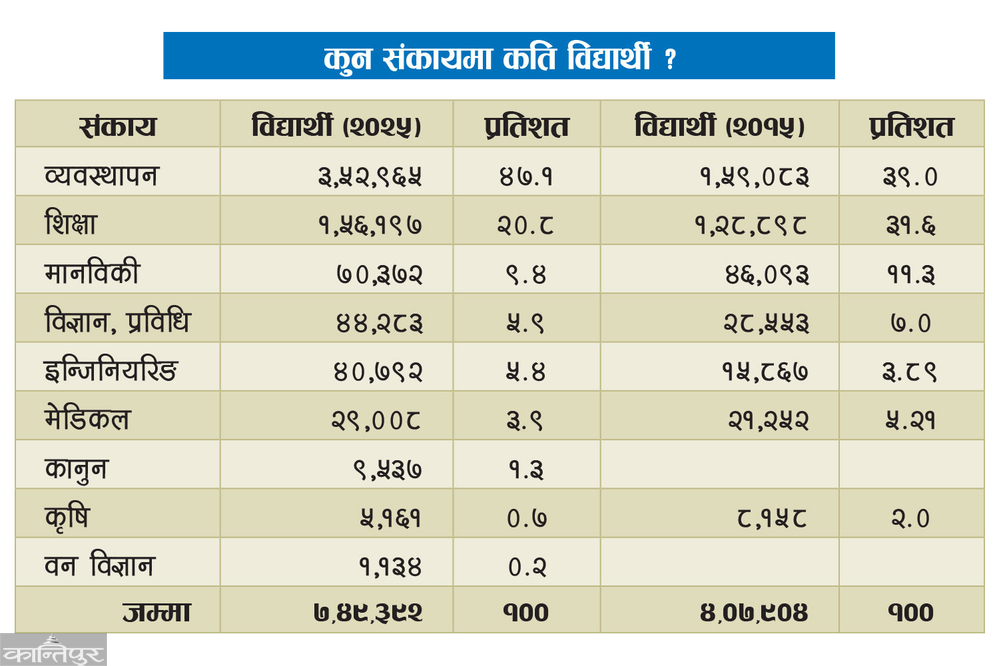
While the number of students studying in the management faculty is 47.1 percent, and engineering students are also increasing, the share of students studying in education, humanities, agriculture, and medicine is decreasing.
We use Google Cloud Translation Services. Google requires we provide the following disclaimer relating to use of this service:
This service may contain translations powered by Google. Google disclaims all warranties related to the translations, expressed or implied, including any warranties of accuracy, reliability, and any implied warranties of merchantability, fitness for a particular purpose, and noninfringement.
The number of students enrolled in universities is increasing every year. According to the latest government data, 749,392 students have enrolled for higher education. The number of universities and institutes providing higher education has also increased to 30. There are 1,608 campuses with affiliations and affiliations across the country.
According to the Economic Survey, the number of students studying in universities and institutes has increased by about 10 percent compared to the previous fiscal year. In the fiscal year 2080/81, 672,489 students were enrolled, which is 76,903 less than the number of students enrolled in the last academic session. According to the data of the Ministry of Education, the number of students enrolled in all universities has increased.
According to the annual report of the University Grants Commission in 2015, 47,000 students were studying in 12 universities and institutes. Even then, 80 percent of the students studying higher education used to enroll in Tribhuvan University. In 10 years, only 5 percent of students have enrolled in other universities. According to the commission's data, 89 percent of those admitted are at the undergraduate level, 10 percent at the postgraduate level, and the remaining 1 percent at the MPhil and PhD (postgraduate) levels.
Former chairman of the University Grants Commission, Devraj Adhikari, said that the number of students in higher education has increased for three reasons. He said that the number has increased because students who were stopped due to the ongoing wars in various countries are enrolling here. He said that the number has also increased because of students who have failed to complete their courses since the Covid pandemic. 'The third reason is that some students have been added after universities started organizing their academic programs by implementing the academic calendar,' he said.
Last year, there was also an improvement in the pass rate of class 12 students compared to previous years. That is also the reason why the number of students admitted to higher education has increased. Dilliram Sharma, a professor at Tribhuvan University and former dean of the Faculty of Management, says that the pressure of students in higher education has automatically increased due to the increase in the pass percentage in class 12.
 Last year, 61.71 percent of students passed the class 12 examination. There was an improvement of 9 percent in the results compared to the previous year. According to the National Examination Board, 242,465 out of 396,347 examinees passed. Around 60 percent of students also passed the grade promotion exam. This year, there has been an improvement in the pass rate of grade 12. According to the results released a week ago, 64.13 percent of students have passed.
Professor Sharma said that despite some countries that attract Nepali students for higher education tightening student visas, the number of students enrolling in the country has increased. 'Compared to before, after countries such as Australia and Canada tightened student visas, more students have enrolled in Nepali universities,' he said.
Even though universities have started to be established at the provincial level, the burden of students remains at Tribhuvan University. According to student enrollment data, 561,235 students (75 percent) have enrolled in Tribhuvan University.
Till the end of Chaitra of the current fiscal year, 91,638 students have obtained NOC (No Objection Certificate) to study higher education abroad. In the previous fiscal year, the number of students obtaining NOC was 123,000. According to the Ministry of Education, 34,500 students have enrolled in colleges run in Nepal affiliated with foreign universities. There are 57 colleges operated under foreign affiliation with the permission of the ministry. Higher education is offered in 21 universities in Nepal, including 15 central and 6 provincial, and 8 health science institutes, including 6 central and 2 provincial.
There are always many students studying management. The admission rate in the faculty of management, which has always attracted students, is increasing. According to the data of 2015, 39 percent of those enrolled in higher education were enrolled in subjects related to the faculty of management. According to the data of 2025, 47.1 percent of students are studying in the faculty of management. In terms of the number of students, the first, second and third faculties are management, education and humanities, respectively. It seems that twice as many students are enrolled in education than in the humanities faculty, and twice as many students are enrolled in management than in education.
There are data that 350,000 students are enrolled in management, 150,000 in education, and 70,000 in humanities. There is a significant increase in students in engineering. The share of education, humanities, agriculture, and medicine is gradually decreasing. The number of students has declined after the phase-out of PCL from the university and the strict implementation of the quota system in medicine since 2075.
The attraction of the management faculty has increased due to the professional and market-oriented education, says Adhikari, former chairman of the commission. 'If you study management, you have a high chance of getting employment in the government and non-government sectors. You study according to a market-oriented and skill-oriented curriculum,' he said.
Former Dean of the Faculty of Management, Sharma, says that the studies in the Faculty of Management have always been preferred by students because they are targeted at entrepreneurship, employment, and self-employment. He said that students have also been attracted due to the expansion of new subjects and programs. 'After studying management, there is a high chance of employment both within Nepal and abroad. Entrepreneurship, employment, and self-employment are created according to the
curriculum,' he said, 'The number of students seems to be high as the access to colleges and new subjects/programs has expanded outside Kathmandu.' In recent years, new subjects including IT, Hotel Management, BBA, BBM have been taught in management.
Tribhuvan, Kathmandu, Pokhara, Purbanchal, Sudurpaschim, Madhyapaschim and Open Universities have been teaching subjects under the faculty of management. The number of students admitted to management in all these universities is higher than others. There is a lot of pressure during admissions in old and affiliated campuses in Kathmandu, including Shankardev and Nepal Commerce Campus. Jitendra Prasad Upadhyay, campus head of Minbhavan Nepal Commerce Campus Minbhavan, said that it is not possible to admit all the students who apply. 'More students are applying than the specified quota. Students seem to prefer new subjects over old ones.'
Last year, Minbhavan Campus had admitted 1,300 students to BBS and 700 to MBS and then postponed the admission program, Upadhyay said. “More than 500 students applied for the BBA quota of 99. There is a lot of pressure on new programs. We cannot admit all the students who want to get admitted,” he said.
Student Sandhya Lamichhane said that she enrolled in the Faculty of Management because there are more opportunities in the government and non-government sectors. “After completing my studies, I prepared for the civil service for a government job. There is also a high possibility of getting a job in the banking and financial sectors,” she said.
Although the number of students in the Faculty of Education and Humanities has increased in a decade, the admission rate is decreasing. In 2015, 31.6 percent of students were enrolled in the Faculty of Education. According to the Ministry of Education, only 20.8 percent of students were enrolled in 2025. Similarly, only 9.4 percent of students have opted for the Faculty of Humanities, down from 11.3 percent.
The number of students in the Faculty of Law has increased. Last year, there are data that 9 and a half thousand students were enrolled in the Faculty of Law. It is said that this number will increase further as Tribhuvan University has started teaching the Faculty of Law in its affiliated campuses in Kathmandu and outside from this year. Nepal Open University, which opened since 2072, has also started teaching law. This has also increased the number of students.
Bedraj Acharya, Dean of the Faculty of Education of Tribhuvan University, argues that the decrease in students studying education is due to state policies. ‘Overall, it seems that the interest in becoming a teacher is decreasing in society. The state also seems to be neglecting the Faculty of Education,’ he said. ‘The state has not made it mandatory to study the Faculty of Education to choose a teaching profession. That is why students have stopped studying.’ Acharya, who is also a professor in the Faculty of Education, said that the overall attraction of students has decreased due to the failure to make the teaching profession prestigious. ‘A person who is named as an associate professor leaves when he gets a job as a civil servant. "A person who is nominated as a secondary level teacher goes to a shopkeeper, a deputy sub-district headman goes there," he said. "The problem has arisen because the state has not treated the teaching profession as a dignified profession." He said that although there are ample employment opportunities for those studying the faculty of education, the interest of students has not increased. "There is a shortage of subject teachers in schools and universities. It cannot be said that they have stopped studying because they did not get employment," he said. The highest number of students enrolled in colleges affiliated to foreign universities is in the field of science and technology. Out of the 34,465 students admitted there, 66 percent, or 22,764 students, have chosen science and technology subjects. About 10,000 students are studying the faculty of management in colleges affiliated to foreign universities.
Professor Bhojraj Aryal, Faculty of Management, Tribhuvan University, says that the attraction of students remains as the 'brand' of Tribhuvan University is good both nationally and internationally. In terms of expansion, Tribhuvan University has also reached everywhere. In all aspects of the academic program and curriculum, the new university has been accused of copying Tribhuvan University rather than the latest. Professor Aryal said, ‘The original tree, Tribhuvan University, and other universities are just like branches of a tree.’
 He gave three reasons why the management faculty has had more students over the years. According to him, first, the campuses where the management faculty is taught are spread across the country. Second, studying subjects such as BBS is relatively easy and the second reason is that the employment field is wide. ‘There is also a greater possibility of opportunities both in the country and abroad if you study management,’ said Aryal.
There is no exact government data on how many students go to which field after university education. The projection of the field of education and overall manpower requirement has also not been reliable. However, university professors say that they are associated with administrative positions in the public service, education, health and other technical sectors, private banks, insurance companies, hotels, tourism, construction and industry. It is found that some students are also involved in social programs and research work, including non-governmental organizations (NGOs). The market in the information technology sector is said to have expanded. There are also students who go abroad for employment and further higher education.
Poor passing percentage
The passing percentage in universities with a large number of students seems to be poor. According to the 2025 data of the University Grants Commission, the passing percentage of students in 9 faculties of Tribhuvan University is only 47.25. There is data that 55.15 percent of students passed in Purbanchal and 56.66 percent of students passed in Pokhara.
The overall passing rate of 12 central universities is only 62 percent. In comparison, the passing percentage of students in the Academy of Health Sciences is better. There is data that 100 percent of students passed in Patan Academy of Health Sciences, 98 percent of students passed in the National Academy of Medical Sciences (NAMS/BIR). The passing percentage of students in Kathmandu University is 67 percent.
There is data that 85 percent of students passed in Lumbini Buddhist University and 66.75 percent of students passed in Agriculture and Forestry University. Only 50.17 percent of students passed in Midwest and 39.87 percent of students passed in Farwest. कर्णाली स्वास्थ्य विज्ञान प्रतिष्ठान जुम्लाको विद्यार्थी उत्तीर्ण प्रतिशत ८६.९० र बीपी कोइराला स्वास्थ्य विज्ञान प्रतिष्ठानको विद्यार्थी उत्तीर्ण दर ९२.४० प्रतिशत छ । विश्वविद्यालयमा भर्ना भए पनि नियमित पठनपाठन नगर्ने र बीचैमा कक्षा छाड्ने कारण पनि विद्यार्थी उत्तीर्ण प्रतिशत कमजोर देखिएको अनुदान आयोगका पूर्वअध्यक्ष अधिकारीले जनाए ।
उच्च शिक्षामा राज्य र अभिभावकको समेत लगानी वृद्धि हुँदै गएको छ । चालु आर्थिक वर्षमा उच्च शिक्षामा सरकारले १९ अर्ब बजेट विनियोजन गरेको थियो । नेपाल संस्कृत विश्वविद्यालयमा प्रतिविद्यार्थी २ लाख ४३ हजार राज्यको लगानी भएको देखिन्छ । तर विद्यार्थी उत्तीर्ण दर ५३ प्रतिशत मात्रै रहेको छ । त्रिविमा प्रतिविद्यार्थी ६६ हजार रुपैयाँ राज्यको लगानी भएको देखिन्छ, जहाँ विद्यार्थी उत्तीर्ण भने ५० प्रतिशतभन्दा कम छ । कृषि तथा वन विज्ञानमा प्रतिविद्यार्थी १ लाख ६४ हजार, राजर्षि जनकमा ४ लाख ५७ हजार, लुम्बिनी बौद्धमा २ लाख ४ हजार, मध्यपश्चिममा ४९ हजार र सुदूरपश्चिममा ५० हजार राज्यले लगानी गरेको देखिन्छ । पोखरामा ५० हजार, पूर्वाञ्चलमा ७६ हजार र काठमाडौं विश्वविद्यालयमा २५ हजार रुपैयाँ प्रतिविद्यार्थी राज्यको लगानी छ ।
राज्यको लगानीअनुसार विद्यार्थी उत्पादन हुन नसकेकामा महालेखा परीक्षकको वार्षिक प्रतिवेदन, २०८३ ले प्रश्न उठाएको छ । ‘राज्यको लगानी, विद्यार्थी भर्नाको तुलनामा नतिजा दर सन्तोषजनक देखिँदैन । आयोगले अनुदान नीतिमा पुनरावलोकन गर्नुपर्छ,’ प्रतिवेदनमा भनिएको छ । सरकारले आयोगलाई एकमुष्ट उपलब्ध गराएको अनुदान रकम त्यहाँबाट बाँडफाँट हुने गरेको छ । आगामी आर्थिक वर्षका लागि सरकारले आयोगका लागि १६ अर्ब ९२ करोड रुपैयाँ विनियोजन गरेको छ । चालु आवको तुलनामा २ अर्ब कम बजेट विनियोजन गरिएको हो ।