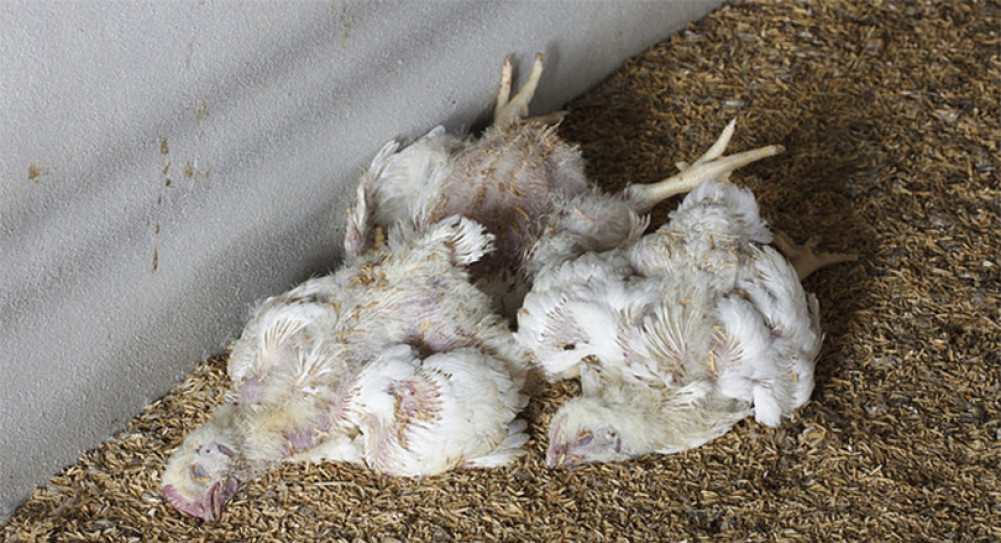
About 600,000 birds, 1 million eggs, and 200,000 kilograms of grain were destroyed. Despite the government's provision to provide 75 percent relief to farmers, they have not yet received it.
We use Google Cloud Translation Services. Google requires we provide the following disclaimer relating to use of this service:
This service may contain translations powered by Google. Google disclaims all warranties related to the translations, expressed or implied, including any warranties of accuracy, reliability, and any implied warranties of merchantability, fitness for a particular purpose, and noninfringement.
5,700 chickens were destroyed last week due to bird flu at Dipendra Asrumali's farm in Damaitar, Godavari Municipality, Lalitpur. Dipendra also destroyed 35 quintals of feed and 1,000 eggs in his farm. However, he has not given up since the government has promised to provide relief. "The damage may have been around Rs 6 million, but I think we will get relief since the government has promised to provide 75 percent compensation," he said.
Bird flu (H5N1) has spread to 11 districts of Nepal. The bird flu that spread from Sundarharaincha-4 and Urlabari-8 in Morang on Chaitra 4 is becoming a 'hotspot', now the Kathmandu Valley. According to Dr. Umesh Dahal, Director General of the Animal Services Department, bird flu was seen in 5 places in the Kathmandu Valley on Wednesday alone. So far, bird flu has been confirmed in 87 places in 11 districts including Jhapa, Morang, Sunsari, Mahottari, Bara, Chitwan, Nawalparasi, Kathmandu, Bhaktapur, Lalitpur and Kavre.
The department has stated that there are 'active cases' only in Kathmandu, Lalitpur, Bhaktapur and Kavre. The department has data that about 600,000 birds affected by bird flu have been destroyed. Similarly, 989,313 eggs and 195,485 kg of feed have also been destroyed.
A few days ago, the zoo in Jawalakhel was also confirmed to have bird flu, after which the zoo was closed indefinitely. So far, 37 animals, both big and small, have died in the zoo, while bird flu infection has been confirmed in 24. The latest infection was confirmed in 3 places in Changunarayan, 1 each in Suryabinayak and Tokha.
38,795 chickens raised in wards 2, 8 and 9 of Changunarayan Municipality have been destroyed, while 9,378 chickens have been destroyed in wards 1, 4 and 8 of Suryabinayak Municipality, informed Dr. Amik Shrestha, a veterinarian at the Animal Services Office, Lalitpur. He said that many chickens have already died due to the disease in Suryabinayak Municipality. Dr. Shrestha said that the disease has now been seen in local and layer chickens and has spread less in broilers.
Farmers will receive compensation from the government as per the relief criteria for items destroyed during bird flu control, 2079. It is mentioned that the compensation will be determined according to the market price. There is a provision to provide relief to farmers up to 75 percent of the cost price based on the recommendation of the Rate Determination Committee coordinated by the Chief District Officer.
But this time, there is a budget shortage as the infection has spread more than expected, says the Director General of the department, Dr. Dahal. ‘This time, the damage was more than expected, so the budget was not enough,’ he said, ‘We have requested the Ministry of Finance through the Ministry of Agriculture, Forest and Environment to transfer funds for relief.’
The department estimates that the direct damage caused by the infection that started in Morang in Chaitra has been worth Rs 600 million. Director General Dr. Dahal says, ‘This is only an estimate of the direct damage, farmers have been in a lot of trouble. When bird flu appears, farms are closed for at least two months, and their income cycle is disrupted.’
Director General Dahal informed that only Rs 20 million has been allocated for providing relief to farmers in the current fiscal year. He said that an additional Rs 500 million has been requested to provide relief to farmers affected by bird flu. In the budget for the coming fiscal year, Rs 560 million has been allocated to provide relief to farmers. The Bagmati Province government has been allocating budget for the loss of livestock due to disasters. But there is a legal provision that such relief money should be distributed in a way that does not repeat itself. The government does not provide relief in cases of livestock deaths due to diseases such as H-9, Ranikhet and Ecolai. The department has urged farmers to pay attention to sanitation and management to protect livestock from these diseases.
Information Officer and Crop Development Officer of the Ministry of Agriculture and Livestock Development of Bagmati, Abhishek Poudel, said that compensation has been provided till Chaitra. ‘The provincial government had allocated Rs 50 million for relief to farmers for the loss of livestock due to the disaster, we have already provided relief for various losses till Chaitra,’ he said, ‘Relief for Chaitra will be provided from the budget of the next fiscal year.’
Poultry farmers, who have suffered huge losses due to bird flu (H5N1) that has spread to various districts of Koshi Province since Chaitra, have not yet received compensation. On Chaitra 4, after chickens suddenly started dying at the Athiyabari Agricultural Farm in Urlabari Municipality-7 of Morang, bird flu infection was confirmed in tests conducted.
On the same day, the infection was also seen in chickens raised at Halesi Mahadev Agricultural Farm in Sundarharaincha Municipality-4. Two days later, on Chaitra 26, bird flu was confirmed at Oko Agricultural Farm in Itahari Sub-metropolitan City-14 of Sunsari. On Chaitra 27, the infection was also found at Damak Agricultural Farm in Damak Municipality-10 of Jhapa.
According to the Directorate of Livestock and Fisheries Development, Biratnagar, since Chaitra 2082, infection has been confirmed in 23 agricultural farms in Sunsari, 14 in Morang and 4 in Jhapa. According to the directorate, 412,954 chickens, 602,155 eggs and 157,078 kilograms of feed have been destroyed in three districts.
Veterinarian Dev Kumar Darlami, Information Officer at the Ministry of Industry, Agriculture and Cooperatives of Koshi Province, said that despite noting the details of the damage caused by bird flu and sending them to the Animal Services Department, the amount has not been received.
According to Assistant Fisheries Development Officer Mahesh Katuwal, the maximum number of 286,921 chickens, 377,800 eggs and 121,775 kilograms of feed were destroyed in Sunsari, causing a loss of about 292,393,000 rupees. In Morang, 129,433 chickens, 127,625 eggs and 24,838 kilograms of feed were destroyed.
In Jhapa, 20,900 chickens, 97,450 eggs and 10,465 kilograms of feed were destroyed. This caused a loss of about 296,040,000 rupees, according to the directorate. The directorate stated that a total loss of more than 530 million rupees was incurred in the three districts.
However, although the details of the farmers' losses were sent to the Animal Services Department, the relief amount has not been made available so far. ‘We have collected the details of the damage and sent it to the department with recommendations,’ said Assistant Fisheries Development Officer Katuwal, ‘However, the farmers have not received compensation yet.’
Farmers have said that the delay in the distribution of compensation has made it difficult to resume their businesses. Dhan Prasad Rai, the operator of Oko Agriculture Farm in Itahari, complained that the government has not provided compensation even after three months. ‘They had started their business by taking a loan of about Rs 25 million from the bank,’ he said, ‘Bird flu has sunk everything.’
Infection has been confirmed in the Sukumvasi settlement area of Sanga in Banepa Municipality-13 and Panauti Municipality-7 in Kavre. According to Braj Kishore Thakur, the head of the Animal Services Office in Kavre, about 1,600 to 1,700 chickens have been affected in a layer poultry farm in Sanga and about 750 ducks and local chickens in Panauti. He said that the work of destroying (disposal) infected birds in those places is underway. Parbat Portel (Biratnagar), Jyoti Shrestha (Kavre), and Sundar Shilpkar (Bhaktapur)
Let's recognize bird flu in time, let's diagnose the problem
Dr. Manoj Kumar Shahi
Senior Veterinary Officer, Ministry of Agriculture, Forest and Environment
As soon as the news of bird flu spreads, a fear arises among many consumers - is it safe to eat chicken meat and eggs? But according to health and animal health experts, there is no need to be afraid of it as the bird flu virus is destroyed when meat and eggs are cooked or boiled properly. Therefore, the safest way is to make it a habit to eat meat and eggs available in the market after cooking them properly.
If people working on poultry farms, cutting or selling meat use masks, gloves and boots and wash their hands and feet thoroughly with soap and water after work, the risk of infection can be reduced to a great extent. Farmers and businessmen also need to take special precautions to avoid bird flu. Putting up nets to prevent wild birds from entering poultry farms, disinfecting people and vehicles entering the farm, and paying attention to cleanliness can prevent the spread of the disease.
Vehicles transporting chickens, chicks, feed, or eggs should be cleaned and disinfected regularly. If bird flu is detected on a farm, new chickens should not be added in a hurry. It is considered safe to resume rearing only after no new infections have been detected for at least 42 days after the disease has been controlled. Bird flu is not just a problem for farmers or poultry business owners. It is also an issue related to public health, animal health, and the country's economy. Therefore, it is necessary to act based on accurate information and precautions, not on rumors and fear. Providing timely information, informing the relevant agencies if there is any doubt, and taking necessary safety measures can control the risk of bird flu.
According to global statistics, chicken meat and egg production has increased by about 90 percent over the past 20 years (2004 to 2023), and the share of chicken meat in total meat production has increased from 30 to 40 percent during the same period. During the same period, egg production in Nepal has increased from 580 million eggs per year to 1.64 billion eggs per year, and meat production has increased from about 15,000 tons to about 200,000 tons. The poultry industry plays an important role not only in nutritional security but also in employment and livelihoods of low-income farmers.
According to the World Organization for Animal Health, bird flu, which was first seen in birds in 1978, was first seen in humans in 1997. Now, in addition to humans and birds, this disease has also been seen in animals including cows, cats, dogs, tigers, lions, foxes, eagles, pigs, and others, which has increased interest and concern. The main way to avoid an epidemic is to keep the virus confined to birds through rapid control methods and minimize mutations or changes in appearance without allowing it to spread to other animals and humans.
Bird flu has a mortality rate of almost 100 percent in birds. So far, the disease has only been transmitted from animals to humans, and the rate of transmission has been found to be very low. There is no evidence of human-to-human transmission of bird flu. According to the World Health Organization, about 900 people worldwide have been infected with bird flu, and about 50 percent of them have died.
One person has died in Nepal due to bird flu so far. According to the Bird Flu Disease Control Regulations, 2078, control work is carried out after the disease spreads in Nepal. For this, not only infected birds are killed, but all birds, eggs, feed, poultry and other objects that have or may have come into contact with infected birds in the vicinity are destroyed and disinfected. Public awareness programs are conducted, disease detection programs are conducted in humans, wildlife and birds in coordination with the Ministry of Health and wildlife-related agencies, and the movement of birds and bird products is also prohibited.