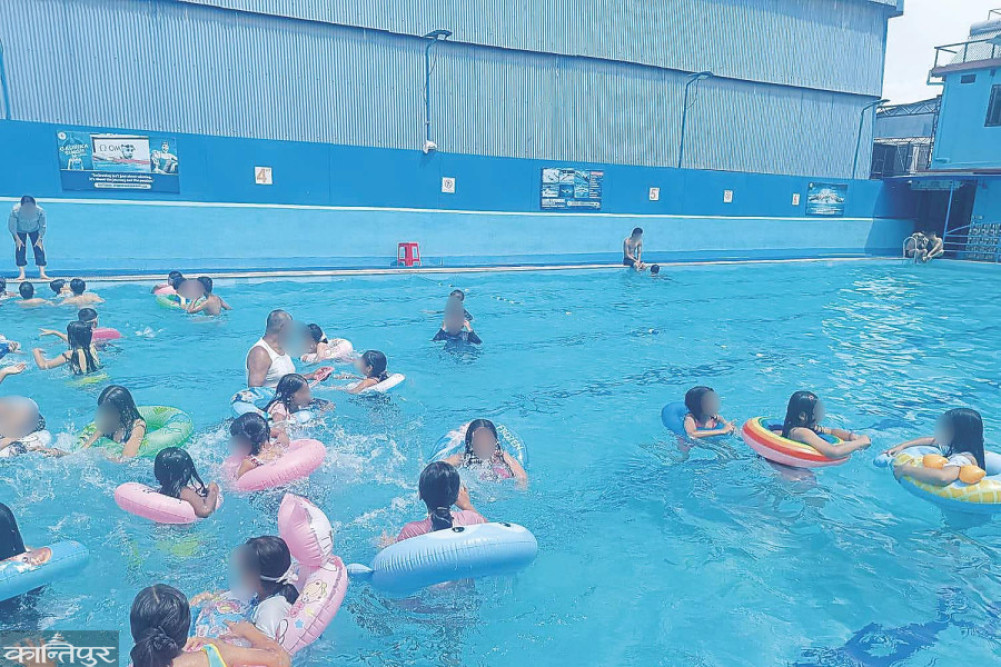
Placing children's photos on school Facebook pages without parental permission poses a serious risk to their safety, self-esteem, and digital identity.
We use Google Cloud Translation Services. Google requires we provide the following disclaimer relating to use of this service:
This service may contain translations powered by Google. Google disclaims all warranties related to the translations, expressed or implied, including any warranties of accuracy, reliability, and any implied warranties of merchantability, fitness for a particular purpose, and noninfringement.
One evening, Uma Prasai was playing TikTok. While scrolling, she saw a video of her son swimming. In the video, which was taken in a pool, it seemed like her son did not want to be filmed. The video was made public with music in the background.
Uma did not receive the video from the school, she had seen it on the internet. Later, it turned out that it was posted in a school group and another parent downloaded and made it public.
Prasai's son is an autistic child. The video contained comments and remarks about his son's behavior. No one had asked Prasai for permission to shoot or make the video public for the video. Expressing disagreement with the video being posted on social media without permission, she said, "Whether my child is autistic or not, the photo should not be made public without his or her parent's consent. The school can send information about fees home and can also send a consent form for using the photo."
Shilpa Dhakal, a mother of a seven-year-old son and 13-year-old daughter, also has similar concerns. Her complaint is more about the behavior of parents than the school's posts. She said some parents share test results without permission and make their children's personal information public. She has also found that students compare themselves to others based on photos.
She said, "Children compare. When one child's photo appears repeatedly, another child may wonder why they were left out."
According to Dhakal, posting photos of children, especially those in swimwear, on the school's public Facebook page is a more sensitive issue. She said there is a risk that such photos could be misused.
According to psychologist Pallavi Ghimire, children are very sensitive to signs of inclusion and exclusion. If a child is repeatedly excluded from photos, they may receive the message that they are less important. She said, "Such repeated experiences can affect self-esteem and social identity." Young children can express their interests, but they don't understand the long-term impact of making their images public.' Ghimire said the risk may be even greater for children with autism and other neurodivergent conditions. She said that when videos of children in emotional distress are made public, they can be embarrassed or become victims of online abuse. 'Although the images shared by schools may seem normal, they pose a risk of identification because they show children's faces, school uniforms, logos, locations and sometimes even names. Once a video is posted on social media, it can be shared repeatedly.'
Although Nepal has some legal provisions regarding online child safety, experts say that implementation is weak. The 'Online Child Protection Procedure, 2078' issued by the Ministry of Women, Children and Senior Citizens prohibits the collection or uploading of children's images and personal details without the prior consent of their parents.
According to Anil Raghuvanshi, founder of ChildSafeNet, which works to prevent online sexual exploitation and abuse against children, schools should keep children safe on the internet, just like they are at school or at home.
He said, “Publicly posted images are accessible worldwide, searchable and downloadable. A school notice board and a public Facebook page are not the same thing. Children’s achievements should be respected and promoted, but it should not come at the cost of their privacy, dignity, safety and future well-being.”
Nepal’s constitution recognizes privacy as a fundamental right. The Privacy Act and the Children’s Act also contain provisions for the protection of personal information. But rights activists say there is a lack of clear and enforceable standards on how schools can take, store and make public images of children.
According to Raju Ghimire, general secretary of ‘Children as Zones of Peace’, the current legal system is not sufficient. He said that although there are laws to protect children from online abuse, there are still many weaknesses.
He said, “Child-centric cybersecurity laws, effective implementation and digital literacy are essential.”
However, not all schools have ignored the issue of consent. Kathmandu World School said it has adopted a system of obtaining parental consent at the time of admission and renewing it every year. According to Siresh Ratna Tuladhar, the school’s chief branding, partnerships and strategy officer, parents are given clear information about the purposes for which photos, videos and student creations can be used.
He said, “Expectations regarding privacy and child protection are changing. It is better to adopt a clear and transparent process from the beginning than to react after a problem arises.”
Experts say that risks are increasing with the development of artificial intelligence (AI). According to experts, linking public photos with school names, programs and locations can create a detailed digital identity of children, which increases the risk of online seduction, fraud and exploitation.
Therefore, they have suggested that schools adopt the principle of ‘data minimization’. They suggest that people should practice publishing photos only when necessary, blurring faces, taking photos from behind or using group photos, not adding full names, not revealing location details, controlling comments, deleting old posts, and removing photos upon request.