Delegates begin returning home as leadership selection process drags on, discontent over documents determining party's future direction being passed without discussion
We use Google Cloud Translation Services. Google requires we provide the following disclaimer relating to use of this service:
This service may contain translations powered by Google. Google disclaims all warranties related to the translations, expressed or implied, including any warranties of accuracy, reliability, and any implied warranties of merchantability, fitness for a particular purpose, and noninfringement.
Representatives have expressed dissatisfaction with the chaotic management seen in the first general convention of the Rashtriya Swayamsevak Sangh (RSS) that has been saying that it will establish a different political culture. After the general convention was prolonged due to repeated closed sessions and election processes, some people's representatives have started returning home. Representatives have also started complaining that there was not enough discussion even on the political document that will determine the future direction of the party.
Representatives have said that the general convention of the RSSS has seen a reflection of the old political culture. Bishnu Bahadur Khadka of Doti is one of the representatives dissatisfied with the management of the general convention. ‘I had expected to witness the party’s new policy and leadership selection in Chitwan, but the closed session and election process have been repeatedly affected, and it has become impossible to stay,’ he said. ‘I have to pay two thousand rupees a day just to stay in a hotel, how many days will I be able to afford it?’
Questions ranging from convention management to internal democracy have thwarted the claim of establishing a 'different political culture' in the first convention of the Rashtriya Swayamsevak Sangh (RSS) Khadka, who became active in politics after the Gen-G movement and became the Doti district secretary of the Rashtriya Swayamsevak Sangh (RSS) said that hundreds of delegates like him suffered due to the lack of good management at the general convention. ‘This is a party that came to create a system to digitize the country, and we have to queue for an hour or two hours to fill out the form in its elections,’ he told Kantipur. ‘We should have done our homework well in advance. It doesn’t seem like any preparations have been made. The management is very bad.’
He said that he was fed up after hearing that there were around 400 candidates for the central membership and that it would take 7/8 hours to register his name in the voting machine. 'I jumped into politics after the Gen-G movement thinking that I wanted to do something good for the country, but the party's management was not good at all,' he said. Some delegates have even started returning home due to the confusion in the voting process. Prime Minister Balendra Shah himself has returned to Kathmandu with his family on Wednesday without voting.
The RSS had said that the convention would give a different message. But the RSS could not present itself in a different style right from the inaugural session on Sunday. On the first day itself, there was a delay in time management like the old party. The inaugural ceremony was supposed to start at 1 pm, but it was later postponed to 2 pm. On top of that, it was 3:30 pm when President Ravi Lamichhane and Prime Minister Balendra Shah, who is also a senior leader, arrived. Then the program finally started.
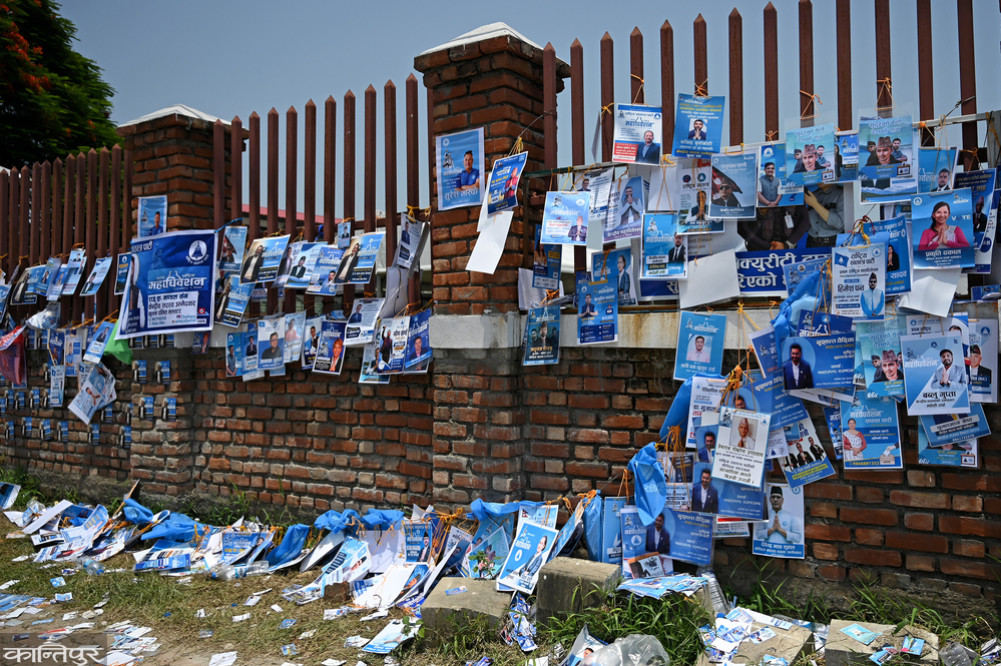
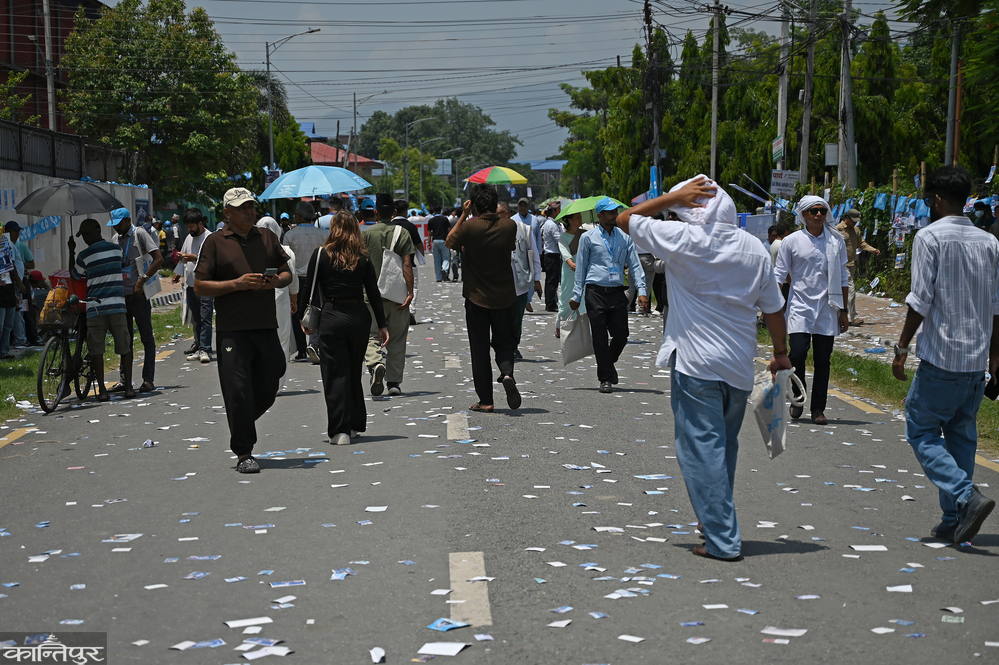
Some people expressed dissatisfaction with the lack of adequate fans and coolers for the delegates at the program venue in the 36-degree heat. Not only the internal management of the program, but also the campaigning style of the central member candidates seemed like that of the old party. Without finalizing the list of delegates, central member aspirants started asking for votes with leaflets, while such solicitation was prohibited before the election. Like in the general conventions of the old party, propaganda materials were scattered everywhere around the convention venue, and even water bottles were pasted with propaganda materials.
The Rashtriya Swayamsevak Sangh (RSS) had to face a dispute over delegates at the close of the session without holding a convention in any district except Parsa in Madhesh. While the leaders who were taken action against by the party at the last moment appeared in the list of delegates, the names of some MPs did not appear in the list of delegates to the general convention. The closed session was extended by a day while the list was being sorted out. The delegates were not even able to discuss the political report presented by Chairman Lamichhane in the closed session. The delegates had to applaud as soon as the report was presented.
Some delegates have raised questions saying that there is no internal democracy in the Rashtriya Swayamsevak Sangh (RSS). Outgoing central member of the RSSS, Ramesh Poudel, says that it is sad that the report was approved without discussion. ‘There was only about seven seconds between you finishing the report and calling on the hall to pass it,’ Poudel wrote on social media, addressing Lamichhane after his re-election as the president. ‘From this perspective, the ‘in-depth discussion’ conducted by 4,200 representatives in seven seconds automatically deserves to be registered in the Guinness Book of World Records.’
Other representatives also wanted to discuss the report presented in the closed session. They are regretting not getting the opportunity. Janakraj Joshi, the general convention representative from Darchula, said that although he had come with great hopes and expectations to participate in the party’s thoughts and discussions, that did not happen. ‘We have come here after a long journey, we had high expectations that we would be present in the hall that would decide the party’s course of action,’ he told Kantipur, ‘However, no political document could be discussed during the closed session.’
The then Deputy Speaker Swarnim Wagle, who was also the Finance Minister, had said that the issue of restructuring federalism, including the abolition of the provincial assembly, had been brought up for debate. Joshi said that although they had different opinions on that idea, they could not say. ‘There was no discussion or debate in any group on the economic and political document during the closed session,’ he said, ‘We can immediately agree that it is right due to time constraints.’ But the economic and political document has come in a way that attacks federalism itself. Which the people of Sudurpaschim, Madhesh and Karnali cannot accept.’ He demands that the responsible officials review it as exercising the rights clearly written in the constitution will cause dissatisfaction.
Political analyst Uddhav Pyakurel also says that it will be difficult to implement issues such as the abolition of the provincial assembly and the reduction in the number of local levels included in Wagle's report in the constitution. 'Questions naturally arise in the provinces on these issues,' he told Kantipur. 'Such issues should be adequately discussed, otherwise it can lead to a more complicated situation.'
Another representative, dissatisfied with Wagle's report, said that if ideas, discussions and discussions are prohibited in the party, there will be no difference between the old party and the Rashtriya Swayamsevak Sangh (RSS). 'Debates on ideas were similarly prohibited in the old party,' he said. 'If the same thing happens here too, what difference will it make politically?' Representatives say that they have not even been assigned a secretariat to find out what is happening.
Representative Pramod Mandal, who is also a member of the RSP Koshi Province, alleges that an attempt is being made to push back the voting with the aim of bringing certain people forward and sending representatives from all over the country home. ‘There are representatives who have come from far away, they cannot stay for a long time, many are going home,’ he told Kantipur, ‘It has given room for suspicion that the situation has been created to make people close to them win.’
Stating that he is opposing the management, not the Chairman Lamichhane and the party, he asks, ‘Should the Election Commission and him inform him about why this is happening or not?’
Mandal met outgoing Chairman Wagle himself at the general convention venue on Wednesday afternoon and lodged a complaint. ‘I told him myself – we have no money, the financial situation is critical,’ he added, ‘I told him that considering him as the leader and guardian when many people have started going home.’ Wagle himself says that since he is also a candidate, he is in the process of understanding the delay. ‘I also have to understand, but someone should be responsible for that matter,’ he told Kantipur.
RSP leader Ganesh Parajuli says it took time to sort out the issue of the convention delegates and the voting was delayed due to purely technical issues. ‘Voting has been arranged through electronic voting machines, but since the forms were collected manually, it took time to manage the voting,’ he told Kantipur, ‘First, we had to verify, check all the details from the candidate’s photo. Then, we had to move on to the process of converting them to digital forms.’ This has complicated the Election Commission.’
New generation political analyst Naveen Tiwari says that the RSP has failed despite having the opportunity to send a message of new culture, style and position to other parties through the convention. ‘Neither the political documents were discussed, nor the agenda was moved forward on time,’ he said, ‘That is why the new party did not show a different style.’
Unlike other parties, there has not been a collective candidacy announcement in the Rashtriya Swayamsevak Sangh (RSS), but there is latent dissatisfaction among the groups that left after the integration and have been active in the RSSW since its establishment. Leaders are saying that collective candidacy has been banned. But Tiwari says, ‘Especially in democratic parties, there are factions and sub-factions, which are not interest groups, but ideological groups. In the current situation, it seems like different ideological groups have been banned in the RSSW.’
Even though the responsible officials of the party have worked day and night, RSSW leader Sobita Gautam, who is also the Law Minister, feels that some improvements need to be made in terms of management. She says, ‘Because it is our first experience, the time has been delayed, but we will come to the next general convention with more preparations.’