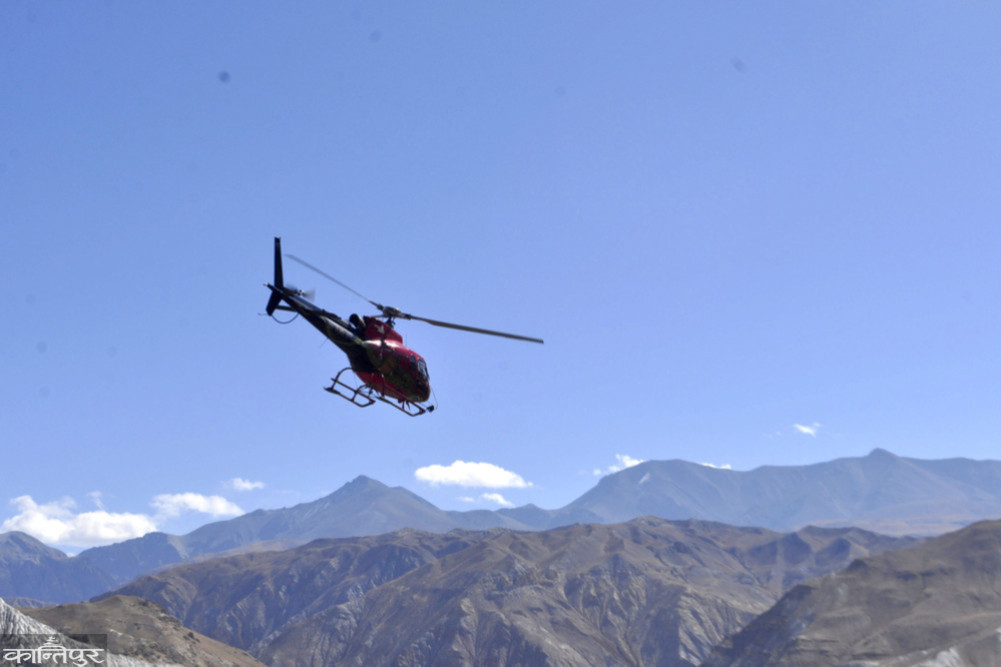
The private sector has become dissatisfied after the authority implemented the 'Monsoon Circular-2026', which made it mandatory to have two pilots (dual pilots) even for helicopter sling flights (flights carried out with luggage hanging outside).
We use Google Cloud Translation Services. Google requires we provide the following disclaimer relating to use of this service:
This service may contain translations powered by Google. Google disclaims all warranties related to the translations, expressed or implied, including any warranties of accuracy, reliability, and any implied warranties of merchantability, fitness for a particular purpose, and noninfringement.
There have been technical differences between the regulator and helicopter operators regarding the new safety policy introduced by the Civil Aviation Authority of Nepal to reduce aviation risks during the monsoon.
The private sector has become dissatisfied after the ‘Monsoon Circular-2026’ implemented by the authority made it mandatory to have two pilots (dual pilots) even for helicopter sling flights (flights carried out with luggage hanging outside).
The Airline Operators Association of Nepal has formally requested the authority to reconsider it and maintain the old single-pilot system, claiming that this provision is impractical.
During the pre-monsoon and monsoon periods in Nepal, challenges such as heavy rain, lightning, windshear (sudden changes in wind speed and direction), low visibility, and icing (ice formation problem) in the mountainous regions increase. Due to these risks, the Flight Safety Standards Department of the Civil Aviation Authority of Nepal approved special aviation safety instructions on Jestha 20 and implemented new arrangements for the monsoon period from Asad 1.
However, private helicopter operators have argued that the rule of having two pilots for short-distance and fixed-time flights like sling operations is against international practice. ‘Having an additional pilot in a helicopter with limited capacity increases the weight, reduces the cargo carrying capacity, and makes coordination within the cockpit more complicated, adding to the pilot’s workload,’ the operator of a helicopter company that has been operating sling flights told Kantipur.
According to the letter written by the association to the authority, the H125 (AS 350 B3E) series helicopters, which are widely used in Nepal, have been certified worldwide to be able to carry external loads by a single pilot, and the association has claimed that such flights can be safely operated by a single pilot due to the helicopter's high operating capacity, stability and controllability. The association has claimed that since most of the sling operations are of 10 to 15 minutes duration, the presence of a second pilot is not effective.
The letter states, 'Adding a second pilot to short-duration sling shuttle flights increases cockpit coordination and workload.' Which can distract the pilot-in-command (captain) during a sensitive phase of the flight. According to helicopter companies, the main responsibility during sling operations is related to monitoring, controlling and placing materials in the right place. For which the necessary equipment and visual system in the helicopter are available only to the main pilot.
In a letter sent to the Civil Aviation Authority of Nepal by the president of the association, Pratap Jung Pandey, it has been mentioned that if the current arrangement continues, the transportation of construction materials, development and construction work and rescue flights in the high mountainous areas will be affected.
However, the authority has stated that while issuing the monsoon circular, strict criteria have been introduced this time to reduce human error in hazardous weather and strengthen air safety. He said that this circular will remain in force until the Department of Hydrology and Meteorology announces the end of the monsoon.
This new rule binds pilots, flight dispatchers, air traffic controllers (ATC) and operations staff. Its main provisions include that helicopters must first check the technical condition and minimum equipment list of the aircraft before taking off. Similarly, windshield wipers, anti-skid, weather radar, slats-flaps, engine reverse thrust and ground proximity warning systems must be fully operational.
The monsoon circular states that if any of these systems are not airworthy, no flight will be allowed. Similarly, during this period, complete information about the flight route and destination weather must be obtained. Airlines, pilots and other stakeholders have been asked to follow the standards, including identifying alternative options for safe landing in mountain gorges for helicopters in advance.
The association has stated that the new system may also affect mountain rescue and material transport flights carried out above 17,000 feet during the monsoon. During the monsoon period, materials are transported by helicopter for hotel construction, infrastructure expansion and other development in the mountainous areas including Khumbu, Gorkha, Dolpa in Nepal.
Since patient rescue flights are also carried out in the high mountainous areas during this time, businessmen say that the service will be affected if the operating capacity decreases. Since special equipment, trained pilots and technical capacity are required to operate sling operations in Nepal, only four helicopter companies are active in this area. Among them, Simrik Air, Kailash Helicopter Services and Altitude Air are currently operating sling operations mainly in the high mountainous areas.
The Airline Operators Association has claimed that the single-pilot system, strict training, experience and adherence to visible weather conditions that have been adopted so far are sufficient safety measures. The association has said in a letter sent to the authority on Monday, "Reconsider the currently implemented mandatory dual control system and re-implement the prevailing single pilot system for sling operations." According to helicopter businessmen, if the demand is not heard, sling operations may be affected and its direct impact will be on construction, transportation and rescue services in the Himalayan region.